Dwain Northey (Gen X)
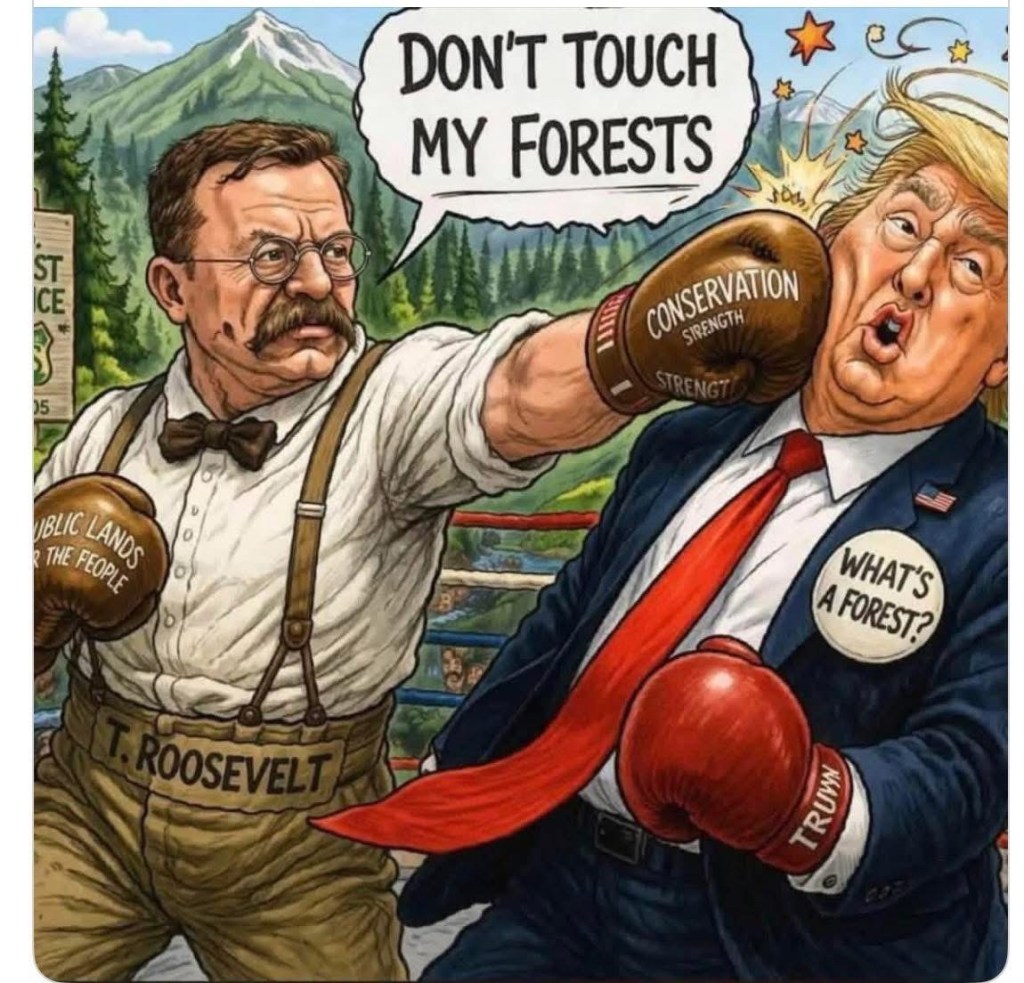
There was a time when American leadership could be summed up in one elegant line from Theodore Roosevelt: “Speak softly and carry a big stick.” It implied restraint, competence, and the quiet confidence of someone who didn’t need to scream into a microphone to feel important. Roosevelt wasn’t perfect—no president is—but he managed the remarkable trick of both projecting strength and understanding that some things are worth protecting simply because they exist. Forests, rivers, canyons—those inconvenient stretches of land that can’t be turned into quarterly profits.
In fact, Roosevelt helped establish what became the National Park Service, preserving millions of acres of wilderness so future generations could experience something other than strip malls and billboards. He looked at places like Yellowstone National Park and thought, “Maybe we shouldn’t bulldoze this.” A radical concept, apparently.
Fast forward to today, and the contrast feels less like history and more like satire that wrote itself and then gave up out of exhaustion. Enter Donald Trump—a man who has taken Roosevelt’s philosophy and flipped it into something like: “Speak loudly, carry nothing, and sell the stick for parts.” The volume is turned up to eleven, the substance is somewhere under the couch cushions, and the “big stick” has been replaced with a clearance sale sign slapped across public land.
Where Roosevelt saw irreplaceable natural heritage, the modern approach seems to see “unused real estate.” Why preserve a canyon when it could be a mining pit? Why protect wildlife when you could lease the land to the highest bidder and let them figure out how many endangered species fit in a quarterly earnings report? It’s as if the entire concept of conservation has been rebranded as “missed opportunity.”
And let’s be clear: this isn’t just a policy disagreement—it’s an identity crisis. The same country that once decided to safeguard vast landscapes for no immediate profit is now flirting with the idea that everything must justify itself in dollars per acre. Roosevelt’s America asked, “What should we protect?” Today’s version too often asks, “What can we sell?”
The irony would be funny if it weren’t so bleak. The party that loves to wrap itself in patriotic imagery now treats some of the most uniquely American treasures—the national parks—as disposable assets. Because nothing says “love of country” like auctioning off its most iconic landscapes to whoever promises the quickest return.
Roosevelt didn’t need to shout. The parks speak for him. The forests, the mountains, the open skies—they are the “big stick,” a lasting demonstration of foresight and restraint. Meanwhile, all the noise in the world can’t drown out the uncomfortable truth: once those places are gone, they’re not coming back. You don’t get to un-mine a canyon or un-drill a wilderness. There’s no “undo” button on ecological damage, no matter how loudly someone insists otherwise.
So here we are, comparing a president who quietly protected the country’s natural inheritance with one whose legacy, at least in this arena, risks being measured in how efficiently it can be dismantled. It’s not just a difference in style—it’s a difference in whether leadership means stewardship or liquidation.
And if that isn’t embarrassing, it’s only because we’ve apparently decided embarrassment, like national parks, is just another thing we can afford to lose.

