Dwain Northey (Gen X)
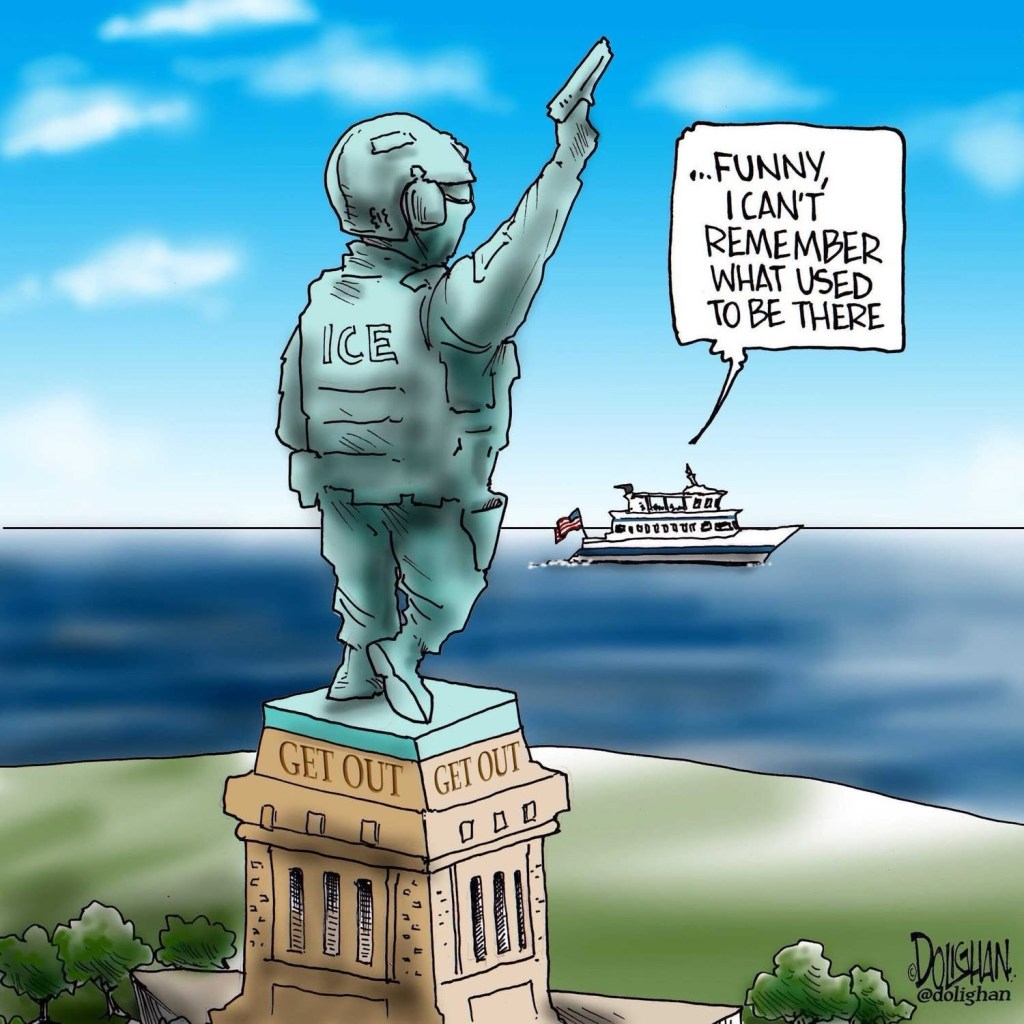
Oh yes, because nothing says “serious governance” quite like solving complex, decades-old policy debates with… a vowel.
Apparently, Donald Trump has decided that the issue with U.S. Immigration and Customs Enforcement isn’t policy, oversight, accountability, or those inconvenient headlines—it’s branding. Just branding. A rebrand. A little linguistic makeover.
ICE? Too cold. Too harsh. Too… on the nose.
But NICE? Now that’s the ticket. Warm. Friendly. Reassuring. Like a customer service rep who just denied your claim but thanked you for your patience and invited you to have a wonderful day.
And the brilliance of it all? If you rename it “National Immigration and Customs Enforcement,” suddenly the acronym becomes NICE, and the media is “forced” to say “NICE agents” all day long. Problem solved. Public perception: fixed. Decades of controversy: gone. All it took was the strategic deployment of a single consonant swap.
That’s it. That’s the plan. Madison and Hamilton are somewhere asking if this was really the endgame.
Because clearly, if something sounds pleasant, it is pleasant. That’s just common sense. Next up, we’ll be renaming root canals to “Happy Tooth Journeys” and hurricanes to “Aggressive Breezes.” Maybe we can call traffic jams “spontaneous parking opportunities” while we’re at it.
And honestly, it’s not even surprising. This is entirely consistent with a worldview where reality is negotiable as long as the branding is strong enough. After all, this is the same orbit of thinking that has flirted with calling the United States Department of Defense the “Department of War”—because why settle for measured, diplomatic language when you can sound like the title card of an action movie?
Think about that contrast for a second. One agency gets softened into something that sounds like it hands out cookies. Another gets hardened into something that sounds like it hands out ultimatums. It’s like federal agencies are just emotional support labels now—adjust the tone depending on what reaction you want that day.
And threading through all of this is the small, almost charming detail that there’s still an apparent desire for a Nobel Peace Prize. Yes, the same mindset that thinks “Department of War” really pops is also eyeing one of the world’s highest honors for peace.
It’s a kind of conceptual multitasking that’s hard not to admire. Why choose between sounding tough and sounding benevolent when you can just rename things until you’re somehow both?
Of course, there’s the minor inconvenience that renaming federal agencies isn’t like updating your Wi-Fi password. It involves laws, bureaucracy, Congress—all those pesky details that don’t fit neatly into a branding exercise. But why let reality interrupt a perfectly good naming brainstorm?
Because that’s what this really is: government by rebrand. Policy by vibes. If something feels controversial, soften the name. If something feels weak, toughen it up. If people are concerned, just give the concern a nicer label and hope it goes away.
And the underlying assumption is almost endearing in its simplicity—that Americans are just one clever acronym away from completely rethinking complicated institutions. As if decades of debate can be undone by the linguistic equivalent of putting a smiley face sticker on it.
At this rate, we’re not far from a full rollout:
Deficit? “Surprise Savings Gap.”
Recession? “Economic Nap.”
War? “Extended Peacekeeping Opportunity.”
Problem solved. Everything is NICE now.

