Dwain Northey (Gen X)
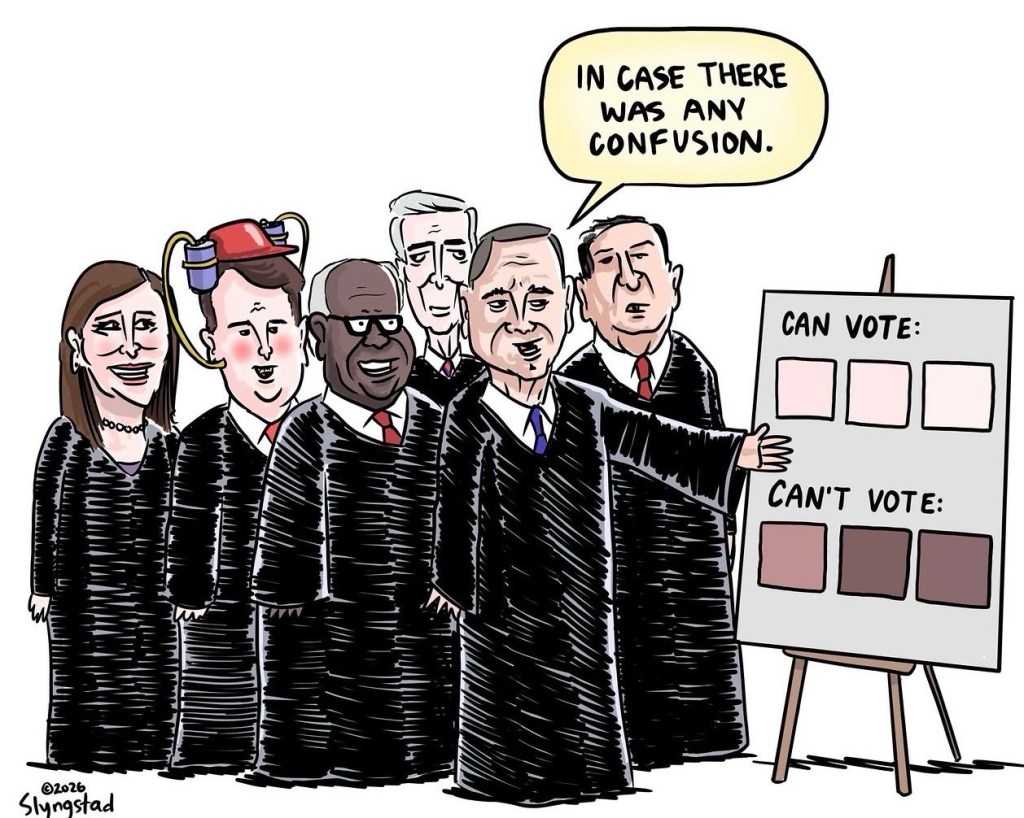
Here’s a sharper essay in the vein you’re aiming for, focused on the implications of the Court’s recent ruling in Louisiana v. Callais, which significantly narrowed how Section 2 of the Voting Rights Act can be used to challenge racially discriminatory district maps. Multiple legal analyses describe it as one of the most consequential voting-rights decisions in years because it raises the bar for proving racial vote dilution claims.
For decades, the basic idea was simple enough for even politicians to understand, which is saying something: if you carve up voting maps in a way that dilutes the political power of racial minorities, that’s racial gerrymandering, and the courts can stop you. It wasn’t a perfect system, but it was at least built on the radical notion that democracy works better when voters choose politicians instead of politicians choosing their voters.
Apparently that concept has now become too complicated.
The Supreme Court has essentially unveiled a new legal magic trick: if a predominantly Black or Latino community happens to vote heavily Democratic, then slicing that community into pieces and scattering it across districts isn’t racial discrimination — it’s just “partisan line drawing.” Because, according to this logic, race and voting patterns exist in completely separate universes, floating around independently like they’ve never met.
That’s a pretty remarkable conclusion when the very same maps often divide communities along lines that just happen to correlate almost perfectly with race. What an astonishing coincidence. A statistical marvel, really. Future mathematicians may study how neighborhoods can be split with surgical precision to weaken minority voting strength while somehow remaining totally innocent of racial intent.
It’s the legal equivalent of someone stealing your car, repainting it, and then arguing in court that technically they didn’t steal your car because this one is blue.
The ruling shifts the standard toward requiring proof of intentional racial discrimination rather than discriminatory effect — which sounds neat and tidy until you remember that modern discrimination rarely comes with a signed confession and a PowerPoint titled “Our Plan to Suppress Minority Votes.” Courts historically looked at outcomes because lawmakers learned a long time ago not to put the ugly part in writing.
And that’s the real sleight of hand here. The Court is basically saying: unless legislators explicitly announce, “Hello, yes, we are doing racism now,” then we’ll generously assume they’re just making innocent partisan adjustments.
Convenient.
This creates a loophole wide enough to drive an entire state legislature through. If racial communities vote in ways that happen to threaten the party in power, lawmakers can now fracture those communities and simply shrug: “Nothing racial about it. They just vote wrong.”
Which is a fascinating constitutional theory. By that standard, almost any racial discrimination can be repackaged as political strategy so long as you remember to workshop the press release.
The Voting Rights Act wasn’t created because America had a few accidental paperwork issues in the 1960s. It was created because discrimination evolves. It adapts. It swaps out literacy tests for legal technicalities, fire hoses for judicial opinions, and blunt exclusion for carefully calibrated district lines.
The tactics change. The result doesn’t.
And once again, the burden falls on disenfranchised communities to prove what everyone can plainly see, while those drawing the maps get to stand there with straight faces insisting the whole thing is just a coincidence of geometry.

