Dwain Northey (Gen X)
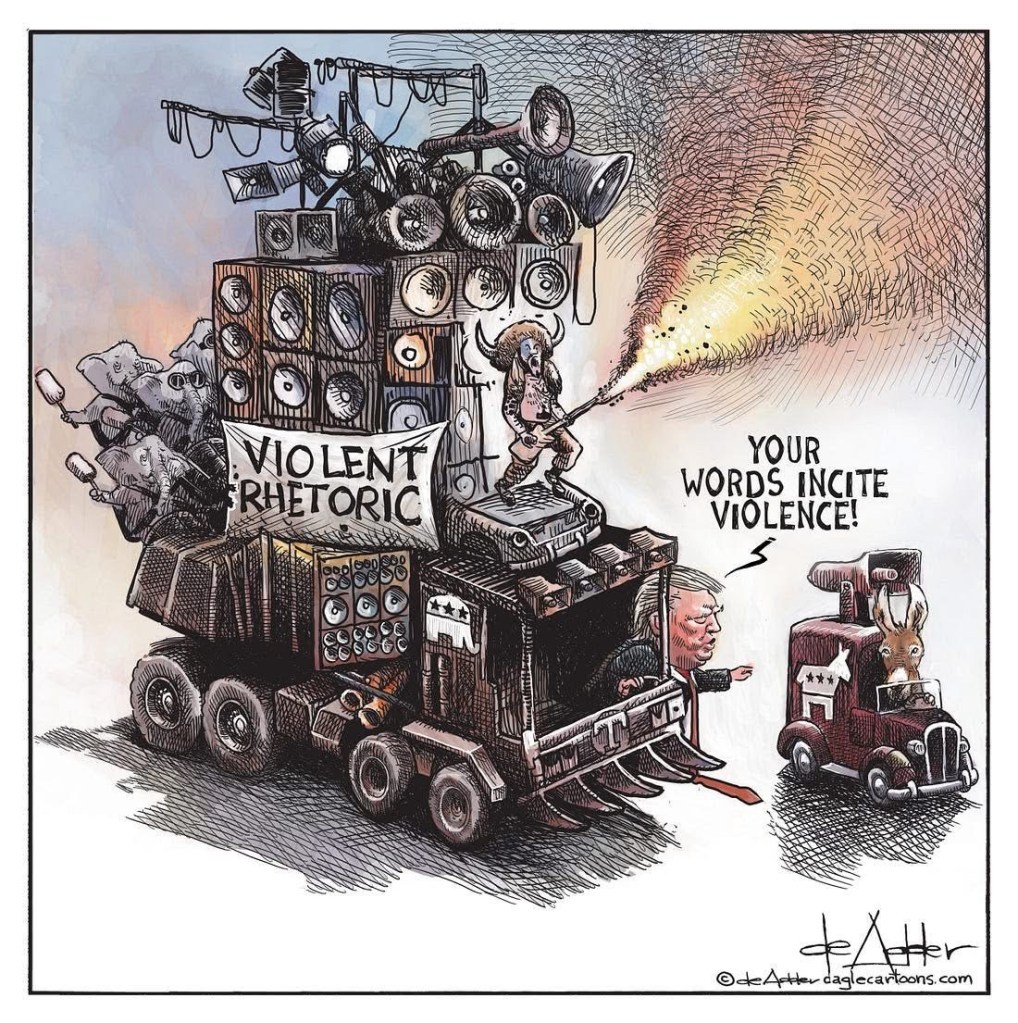
There’s something almost admirable about the sheer athleticism it takes to clutch pearls this hard while simultaneously setting fire to the entire jewelry store.
On one hand, you have Donald Trump—a man who has never met a rhetorical overreach he didn’t want to strap to a rocket and launch into orbit. We’re talking about speeches where “we’ll defeat them” quietly morphs into “we’ll obliterate them,” where entire nations or cultures get discussed like they’re optional menu items. Casual talk of “annihilation” isn’t a slip; it’s practically a brand identity.
And yet—somewhere, somehow—the true crisis emerges not from that, but from a late-night monologue.
Enter Jimmy Kimmel, who does what late-night hosts have done since the invention of television: make jokes about politicians. In this case, a jab about Trump’s age, with a side comment about Melania Trump looking like a “glowing, expectant widow.” It’s the kind of joke that lands somewhere between mildly spicy and aggressively dad-humor-adjacent.
But if you listened to certain corners of the political world, you’d think Kimmel had just issued a formal declaration of war.
Suddenly, the same voices that shrug off literal threats of destruction are sounding the alarm: This is dangerous rhetoric. This is incitement. This is crossing a line.
A line, apparently, that sits somewhere between “annihilating civilizations = fine” and “late-night joke about aging = attempted assassination.”
And then, as if the irony hadn’t already reached critical mass, we get the resurrection of the “8647” controversy—because someone posted seashells arranged in numbers. Seashells. On a beach. A setting previously known for sunsets, not sedition.
Here’s the part that makes the whole thing wobble under its own weight: the number “86” isn’t some shadowy code invented in a basement message board. It’s a piece of everyday slang with roots in the restaurant world. To “86” something simply means it’s out—off the menu, unavailable, done for the night. The kitchen ran out of salmon? It’s 86’d. No more fries? 86 fries. It’s not a hit list; it’s a supply issue.
Yes, language evolves, and in some contexts “86” can be used more broadly to mean “get rid of” or “remove.” But treating it as an inherent call for violence requires a leap that would make an Olympic long jumper nervous. By that logic, every short-order cook in America has been issuing threats for decades.
Which is fascinating, because during Joe Biden’s presidency, variations like “8646” floated around with all the urgency of a bumper sticker at a gas station. No emergency panels. No breathless headlines. No calls for legal consequences. Apparently, numerical symbolism only becomes dangerous when it’s politically inconvenient.
So now seashells are suspect, jokes are dangerous, and late-night hosts are apparently one monologue away from toppling civilization—while actual escalations in rhetoric get waved through like they’re holding a VIP pass.
If there’s a unifying theory here, it’s this: rhetoric isn’t judged by its intensity, its implications, or even its content. It’s judged by its direction. A joke aimed the wrong way becomes a national emergency. A number with a mundane origin becomes a sinister code. Meanwhile, language that openly flirts with destruction barely earns a shrug.
And that’s the real punchline—one that no late-night host could improve upon.
 Esoteric Meandering Shouting Into the Void