Dwain Northey (Gen X)
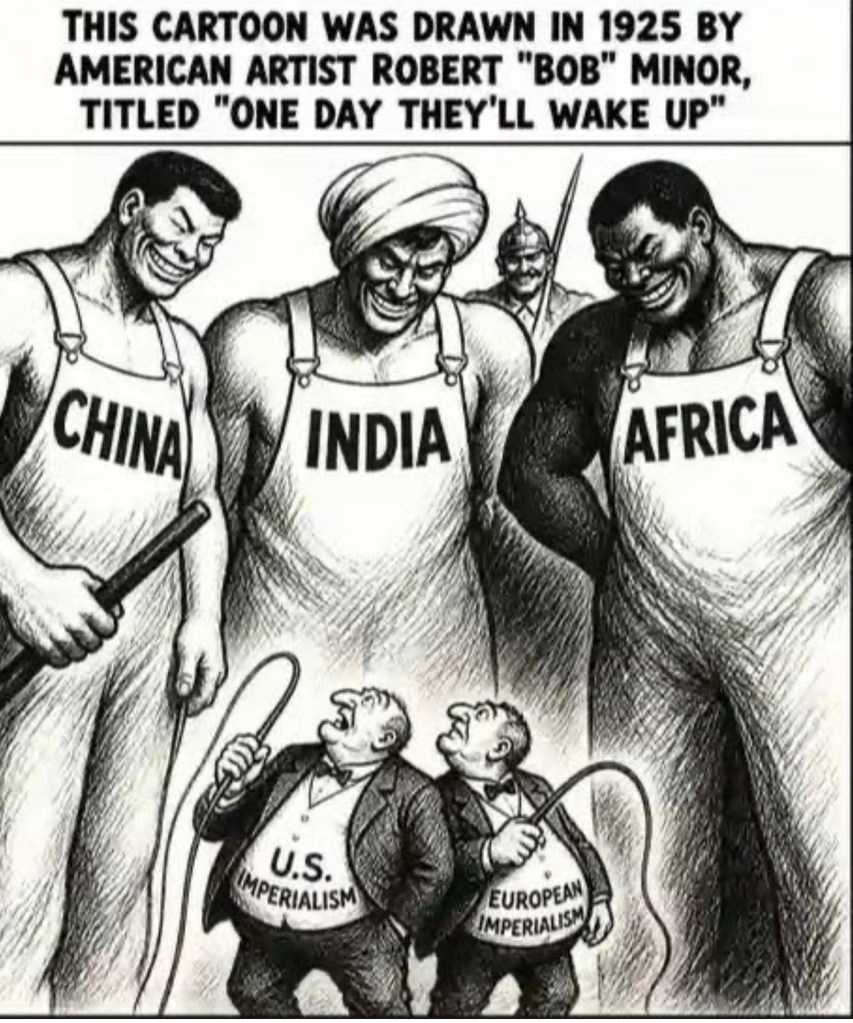
We’ve been watching this story play out for over a century now, and at some point you’d think the lesson would stick. But it doesn’t. It just changes costumes.
At the dawn of the 20th century, the great empires strutted across the globe with absolute certainty. The logic was simple: industrial power needed resources, markets, and cheap labor, and the rest of the world was conveniently full of all three. The scramble for Africa, the carving up of Asia—these weren’t accidents. They were business models with flags attached. And then came the shock: World War I. Empires collided, alliances snapped, and millions died in trenches over the spoils of influence and control. You’d think that would’ve been enough of a warning.
It wasn’t.
Instead, the interwar years doubled down on humiliation and extraction, setting the stage for World War II. Again, domination was the goal—territory, labor, ideology forced at gunpoint. And again, the result was devastation on a scale that made the previous war look like a rehearsal. Cities flattened, entire populations targeted, and in the end, the same realization: you can conquer land, but you can’t sustainably crush people into submission without consequences.
So the old empires faded—but not the mindset.
It just got rebranded. “Colonies” became “markets.” “Occupation” became “stabilization.” The flags changed, but the underlying assumption stayed intact: that powerful nations and corporations could shape entire regions to suit their economic interests. Enter the Cold War, where influence replaced outright ownership. Proxy wars became the new frontier—Vietnam War being one of the clearest examples. A superpower tried to impose its will on a population that had already spent decades resisting foreign control. The result? Years of bloodshed, a fractured nation, and ultimately, failure.
Still, the lesson didn’t land.
By the early 21st century, the pattern was practically muscle memory. The language shifted again—this time to “liberation” and “nation-building.” But when you look at Iraq War, the echoes are unmistakable. A foreign power topples a government, assumes it can reshape the political and economic landscape, and then acts surprised when the population doesn’t neatly cooperate. Insurgency follows. Instability lingers. The cost—human, financial, moral—spirals far beyond the original justification.
And here we are, in the present, still pretending this is a new conversation.
Because modern imperialism doesn’t always arrive with tanks. Sometimes it shows up as debt traps, trade imbalances, or corporate monopolies that quietly dictate the fate of entire regions. It’s cleaner on paper, easier to justify in boardrooms—but the resistance it generates is just as real. People notice when their resources are extracted, when their labor is undervalued, when decisions about their future are made somewhere else entirely.
That’s the part that never seems to sink in: populations are not passive assets. They don’t stay subdued indefinitely. They organize, resist, adapt, and eventually push back—sometimes politically, sometimes economically, sometimes violently when every other avenue is closed.
So we keep asking the same question history has been asking for over a hundred years: how many times does this cycle need to repeat before the conclusion becomes unavoidable?
You cannot sustainably build prosperity on subjugation.
You can try. Plenty have. Empires, governments, corporations—they’ve all taken their turn, convinced they’ve found the version that will finally work. But the pattern is stubborn. Control breeds resistance. Exploitation breeds instability. And eventually, the cost of maintaining dominance outweighs whatever was gained in the first place.
The frustrating part isn’t that we don’t have the evidence. It’s that we do—and keep ignoring it anyway.

