Dwain Northey (Gen X)
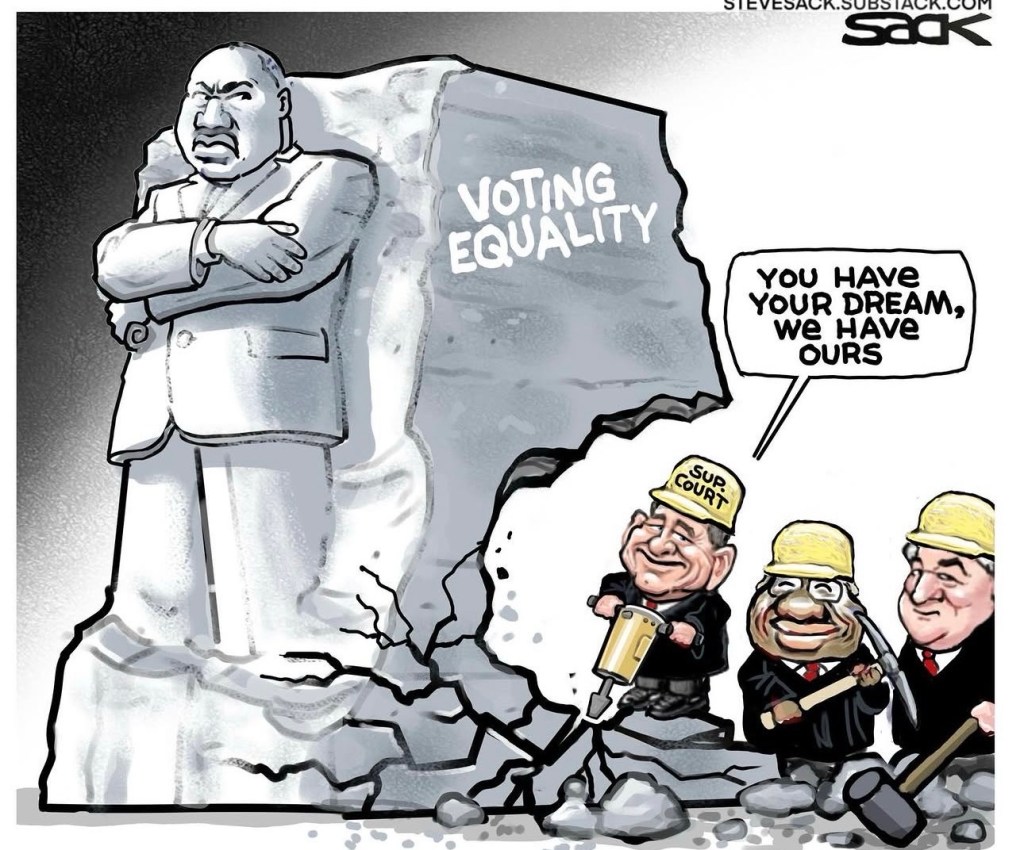
There’s something almost admirable about the modern political imagination in America. We used to at least put effort into hiding discrimination. There was theater. There were coded speeches, dog whistles, strategic pauses before saying “urban voters.” Now? We’ve apparently streamlined the process down to: “No, no, it’s not about race. It just so happens the people we’re targeting are overwhelmingly minorities. Totally different.”
And thankfully, the recent Supreme Court logic has handed politicians a shiny new permission slip. According to this legal masterpiece, if you carve up districts and disenfranchise people because of how they vote instead of explicitly because of their race, then congratulations — apparently racism has been solved. It’s not discrimination if you’re targeting voting patterns. Even if those voting patterns are directly tied to race because of, you know, centuries of American history.
That’s some Olympic-level semantic gymnastics.
It’s basically the political version of a guy standing in the rain insisting he’s dry because technically the water is “atmospheric moisture.”
Southern states heard this ruling and reacted the way toddlers react when they discover the baby gate isn’t locked anymore. Suddenly there’s a stampede toward maps, redistricting software, and dimly lit back rooms where democracy goes to die beside an overflowing ashtray and a half-empty bottle of bourbon.
Take Tennessee. Memphis — a heavily Black city — had a congressional district that actually allowed its residents to speak with some unified political voice. Clearly unacceptable. So in what felt like a late-night poker game among men named Bubba and Earl muttering “hold my whiskey,” they split Memphis apart like a pizza nobody wanted Black voters to finish eating.
Problem solved.
Now those communities get diluted into larger, whiter, more rural districts where their votes disappear into the political equivalent of screaming into a tornado. But remember: not racist. Absolutely not. They’re not targeting Black voters because they’re Black. They’re targeting them because they tend to vote a certain way. Which, coincidentally, is exactly why race and voting rights became linked in the first place.
That distinction apparently makes perfect sense if you attended the “Legal Technicalities for Cowards” school of constitutional interpretation.
And honestly, the most insulting part is the fake innocence afterward.
Politicians stand there with perfectly straight faces saying things like, “This is about fairness,” while holding district maps that look like someone dropped cooked spaghetti across the state. You don’t accidentally create districts shaped like a drunk salamander unless your goal is to make sure certain people’s votes count less than others.
At this point, America doesn’t even gerrymander districts anymore. We perform abstract expressionism with democracy.
And for those of us old enough to remember civics class, this all feels vaguely familiar. “Taxation without representation” used to be a slogan Americans got very dramatic about. There may have been a tea-related incident over it. But apparently the modern version is perfectly acceptable as long as you bury it under enough legal jargon and say “partisan advantage” instead of “racial suppression.”
Because that’s the magic trick now. Replace the word “race” with “political behavior,” and suddenly everyone in power pretends not to notice who’s actually being silenced.
It’s like banning a church choir from singing and then insisting you have nothing against religion — you just happen to oppose group harmonization occurring on Sundays.
Completely different.
The truly terrifying part is how open it’s becoming. There was a time when getting caught suppressing minority votes caused public shame. Now it gets you invited onto cable news to explain how dismantling representation is actually preserving democracy. Somewhere George Orwell is staring at Earth like, “I mean… even I thought that was a little too on the nose.”
And the Supreme Court’s position essentially boils down to this: if racism and politics become statistically inseparable because of the country’s history, then targeting the politics is somehow magically constitutional even when the outcome is identical.
That’s not justice. That’s laundering discrimination through Excel spreadsheets.
But hey, at least we’ve simplified things. America no longer has to ask whether voter suppression disproportionately harms minorities. We can just shrug and say, “Well technically we’re suppressing Democrats,” as entire communities lose their voice.
Progress.
 Esoteric Meandering Shouting Into the Void