Dwain Northey (Gen X)
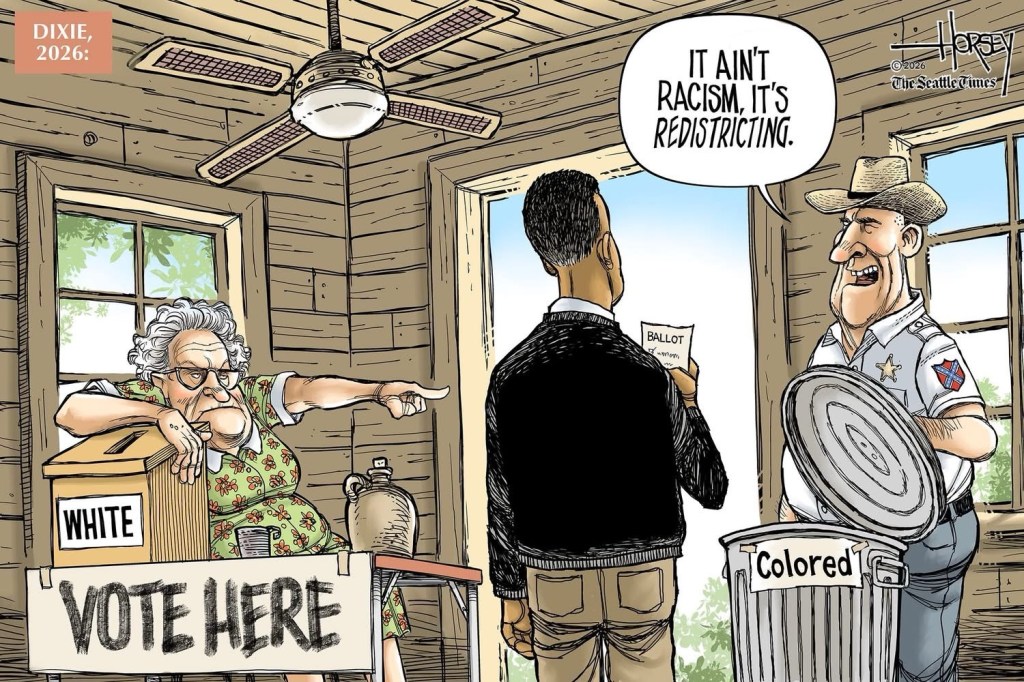
For years, I’ve listened to politicians explain to me that gerrymandering is not voter suppression. And technically, in the most lawyerly, hair-splitting, “depends on what your definition of is is” kind of way, they’re right. They’re not stopping me from physically casting a ballot. Nobody is standing outside the polling station snatching pens out of my hand like some democracy-themed mugging. I still get to vote.
What they are doing is making sure my vote matters less.
And apparently that distinction is supposed to comfort me.
Gerrymandering is basically political engineering disguised as cartography. It’s taking communities, especially minority communities or urban populations that tend to vote differently than rural conservative areas, and cracking them apart like a windshield hit by a brick. One district gets sliced into three. Another gets stretched across half a state like melted mozzarella cheese on a bad pizza commercial. Suddenly neighborhoods that actually share interests, schools, infrastructure, and culture are split apart because somebody in the state legislature decided the map looked better if democracy resembled a hostage situation.
Republicans will tell you this is just politics. Completely normal. Perfectly legal. Nothing to see here.
And again, technically, they’re right. Gerrymandering isn’t usually about preventing votes from being cast. It’s about diluting those votes after they’re cast. It’s the electoral version of turning down the volume on voices they don’t want heard.
You can pack voters into one overwhelmingly blue district where Democrats win with 85% of the vote, then spread the remaining Democratic voters thinly across five other districts where Republicans win 52 to 48. Congratulations. Same number of people voted, but magically one side now controls nearly everything. It’s democracy by optical illusion.
The House of Representatives is where this game matters most because House seats are geographic. Draw the lines right and you can practically preselect who wins before a single ballot is cast. Politicians love talking about “the will of the people” while simultaneously using software sophisticated enough to make Vegas odds makers blush.
But when it comes to Senate races or presidential elections, the game changes because you can’t gerrymander an entire statewide vote the same way. You can’t redraw Arizona into twelve tiny Floridas just because you don’t like Maricopa County. So when certain politicians realize the numbers aren’t going their way statewide, suddenly the strategy shifts from dilution to outright negation.
That’s where we saw the real mask slip off.
Because after the 2020 election, Donald Trump and his allies weren’t trying to redraw congressional districts. They were trying to throw out entire batches of votes. Entire counties. Entire cities. Entire populations that happened to vote against him.
And somehow we were all supposed to pretend that was about “election integrity.”
Funny how election integrity always seems to mean invalidating somebody else’s election.
That’s the important distinction people dance around. Gerrymandering says, “You may vote, but we’ll reduce the impact afterward.” Election denialism says, “You voted, but we may simply pretend it never happened.”
One weakens representation. The other attacks the existence of representation altogether.
And the truly amazing part is how calmly this all gets discussed now. As if carving up districts to engineer outcomes or attempting to discard lawful votes are just normal policy disagreements, like debating highway funding or whether schools need better cafeteria food.
Two hundred and fifty years after declaring independence from a king, we somehow arrived at a political era where some Americans are perfectly comfortable with the idea that voters shouldn’t really choose leaders anymore. Leaders should choose voters. And if voters still make the “wrong” choice, apparently the solution is to either dilute their voice or erase it entirely.
But sure, they’ll remind me with a straight face that technically it isn’t voter suppression.
Technically.

