Dwain Northey (Gen X)
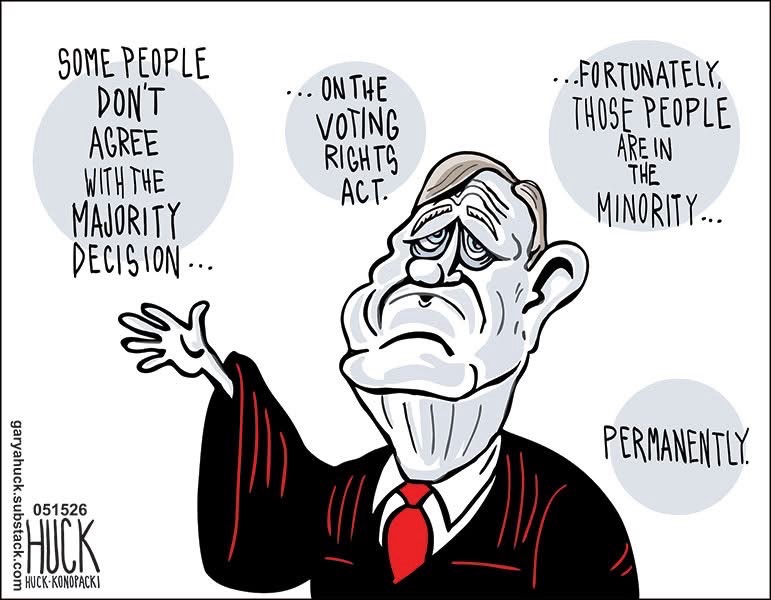
The recent push by the Supreme Court to hollow out Section 2 of the Voting Rights Act feels less like constitutional interpretation and more like watching a demolition crew insist they’re merely “renovating.” At this point, every time the Court takes a swing at voting rights, civil rights, labor protections, environmental regulations, or basic governmental authority, Americans are told not to worry because the Court is simply applying “originalism.” Funny how originalism always seems to land directly in the lap of corporate power and partisan advantage.
Section 2 of the Voting Rights Act was one of the last meaningful tools available to challenge racial discrimination in voting after the Court gutted Section 5 in the infamous decision involving preclearance. The logic back then was essentially, “America solved racism, therefore oversight is no longer needed.” Which is a fascinating conclusion to reach while states were simultaneously sprinting to pass restrictive voting laws the second federal oversight disappeared. It was the judicial equivalent of removing the fire department because one house on the block hadn’t burned down recently.
Now we are watching the continuation of that project: weaken protections, narrow standing, raise impossible legal standards, and slowly transform civil rights law into a decorative museum piece. The law technically exists, but good luck using it.
And this is precisely why Supreme Court reform has moved from a fringe academic discussion into a mainstream political necessity.
There is absolutely nothing sacred about the number nine. The Constitution does not say there must be nine justices. It never did. The number has changed repeatedly throughout American history. Sometimes there were six. Sometimes seven. Sometimes ten. Congress sets the number. Period. The idea that nine justices descended from Mount Sinai carrying stone tablets is pure mythology.
In fact, the argument for expansion becomes even stronger when you look at the structure of the federal judiciary today. The United States has thirteen federal circuit courts, yet only nine Supreme Court justices. The math alone makes the current arrangement feel outdated. We expanded the nation, expanded the judiciary, expanded the population, expanded federal law, and expanded the power of the Court itself, but apparently the number of justices is somehow untouchable because political commentators on television clutch pearls whenever reform is mentioned.
Meanwhile, the Court itself has shown zero hesitation about reshaping decades of precedent whenever it feels like it. Voting rights? Gone. Reproductive rights? Gone. Agency authority? Under attack. Campaign finance restrictions? Obliterated long ago. The Court acts with the confidence of a body that knows there are virtually no structural consequences for its actions.
That is the real issue. Lifetime appointments plus unchecked power plus strategic retirements plus partisan confirmation warfare has turned the Court into the most powerful unelected institution in modern American life. Americans can vote out presidents. They can vote out senators. They can vote out governors. But if a 45-year-old justice gets confirmed, the public can spend forty years living under that person’s ideological worldview whether they like it or not.
That is not stability. That is judicial monarchy with extra paperwork.
Which is why reform proposals are no longer radical. They are rational responses to a system that has drifted badly out of balance.
Term limits, for example, are overwhelmingly popular among ordinary Americans. The “Rule of 18” proposal — where justices serve staggered 18-year terms — would at least normalize appointments so every president gets a predictable number of nominations instead of the current political Hunger Games where parties pray for strategic retirements and occasionally treat octogenarian judges like constitutional horcruxes.
Then there are broader restructuring ideas, including rotating panels or balanced ideological representation. The concept of six liberal, six conservative, and six neutral justices with randomized panels for cases is one attempt to reduce the perception that outcomes are predetermined by partisan math. Whether that exact structure is workable or not, the fact that people are openly brainstorming alternatives tells you how little public confidence remains in the institution’s neutrality.
And honestly, can anyone blame them?
When confirmation hearings have become theatrical performances where nominees insist precedent is “settled law” moments before vaporizing it a few years later, trust erodes fast. When billionaires and partisan legal organizations effectively cultivate judicial pipelines for decades, people notice. When decisions consistently align with ideological goals that somehow always benefit entrenched power structures, people connect dots.
The defenders of the current system always warn that reform would “politicize” the Court, which is adorable considering we apparently already live in the portion of the movie where the politicization happened years ago. Expansion is not what broke public trust. Public trust broke because the Court increasingly resembles a super-legislature accountable to nobody.
Democrats, if they are serious about protecting voting rights or any progressive legislation long term, cannot keep pretending that winning elections alone solves the problem. You can pass laws, but if the Court is willing to reinterpret, narrow, or outright dismantle them, then electoral victories become temporary speed bumps rather than lasting policy achievements.
That is why Supreme Court reform should absolutely be near the top of the political conversation. Not because one side wants revenge, but because no democracy functions well when one unelected body accumulates this much authority with this little accountability.
And if Americans are expected to simply accept that reality forever because “that’s how it’s always been,” history offers a simple response: no, it hasn’t. The structure of the Court has changed before. It can change again.

