Dwain Northey (Gen X)
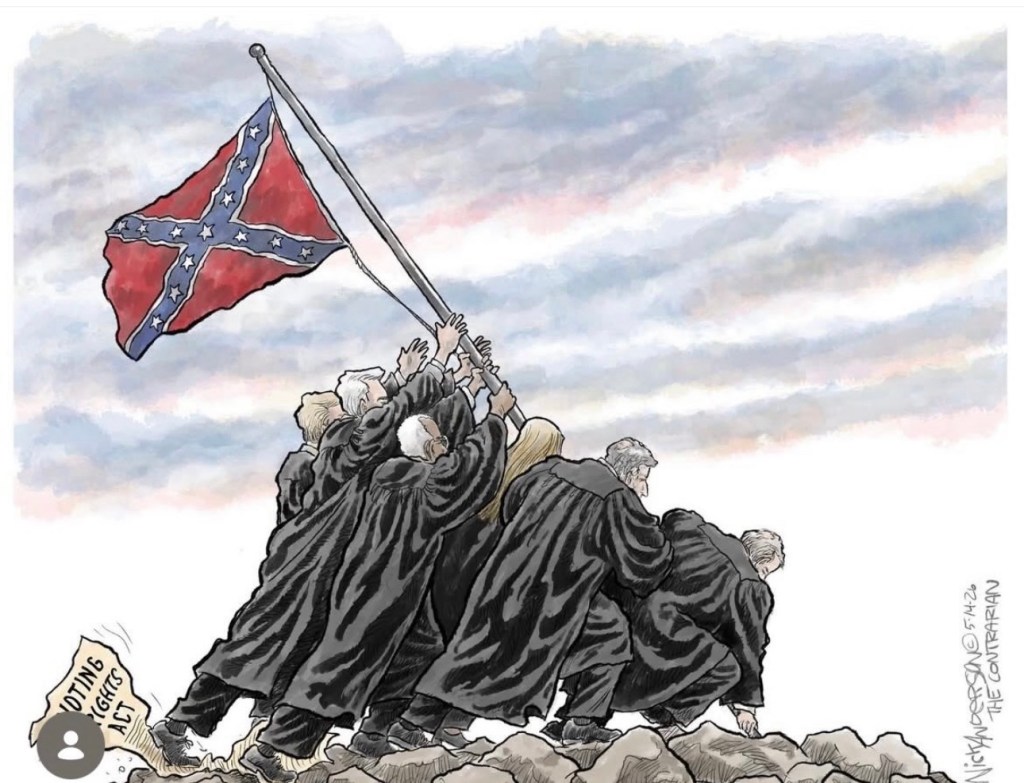
There was a time when conservatives insisted the judiciary was supposed to practice “judicial restraint.” Remember that? Judges were allegedly humble constitutional librarians who simply interpreted the law, not philosopher-kings in black robes rewriting society from the bench. Adorable little fairy tale, that. Because the current incarnation of the Supreme Court of the United States appears to have discovered a far more exciting hobby: speedrunning the post-Reconstruction South while pretending it’s all just “originalism.”
Every few weeks now feels like another episode of Confederacy: The Reunion Tour. Voting rights? Suspicious. Affirmative action? Gone. Diversity initiatives? Apparently the greatest threat to civilization since disco. You half expect the next ruling to begin with, “After careful constitutional analysis, we have determined that the Civil War was a bit of an overreaction.”
The intellectual premise behind many of these decisions seems to boil down to this: America elected Barack Obama twice, therefore racism has been defeated forever. Mission accomplished, everybody. Pack it up. Apparently centuries of institutional discrimination evaporated the moment a black family moved into the White House. By that logic, because someone once ate a salad, obesity has been cured.
Anyone who actually lives in America knows this argument is a complete bag of bullshit.
You can see racism in housing disparities, sentencing disparities, hiring discrimination, school funding, voter suppression efforts, and the fact that every time someone says the words “systemic racism,” half the country reacts like Dracula seeing sunlight. But according to this Court, if racism still exists, it must only survive in magical isolated pockets, certainly not in the systems built over centuries and reinforced by policy decisions. No, no. The systems are perfect now. Meritocracy reigns supreme. Please ignore the billionaire legacy admissions student rowing crew member behind the curtain.
And the most maddening part is the historical amnesia. Civil rights legislation didn’t appear because America was functioning beautifully and everyone was just feeling generous one afternoon. The Civil Rights Movement happened because states — particularly in the former Confederacy — spent generations perfecting the art of denying black Americans equal rights while technically avoiding saying the quiet part out loud. Poll taxes. Literacy tests. Gerrymandering. Segregation academies. “States’ rights.” Funny how “states’ rights” historically always seems to mean the right to treat minorities like second-class citizens.
The Court now acts offended whenever anyone notices patterns. If a state closes polling places in heavily minority districts, aggressively purges voter rolls, redraws maps with surgical precision, and just coincidentally makes it harder for black citizens to vote, the Court’s response is essentially: “Well unless Governor Cletus McSegregation personally rode into town on horseback yelling slurs through a megaphone, we cannot possibly infer discriminatory intent.”
It’s a legal standard so absurd it would fail a kindergarten class. A five-year-old can recognize when one kid keeps “accidentally” excluding the same classmate over and over again. But some of the sharpest legal minds in the country stare at decades of patterns and conclude, “The evidence is inconclusive.”
What makes this especially dangerous is the smug insistence that dismantling protections is somehow proof of equality. That’s the con. They argue that because discrimination is illegal, discrimination therefore no longer meaningfully exists. It’s like removing the fire department because arson is technically against the law.
And underneath all the polished legal jargon sits the same old reactionary fantasy: America was better before all these civil rights laws complicated things. Before minorities, women, labor groups, and marginalized communities got uppity and started demanding equal treatment. The nostalgia embedded in many of these rulings is impossible to miss. It’s less “constitutional fidelity” and more “Make Jim Crow Subtle Again.”
Of course, defenders of the Court insist critics are overreacting. They always say that right before another precedent gets tossed into the woodchipper. Roe v. Wade? Settled law — until it wasn’t. Voting Rights Act protections? Essential safeguards — until they weren’t. Affirmative action? Longstanding precedent — until it wasn’t. At this point, the phrase “settled law” has all the durability of a gas station napkin in a hurricane.
The tragedy is that these decisions don’t happen in a vacuum. They ripple outward into schools, workplaces, elections, policing, and public discourse. They send a message about whose grievances are taken seriously and whose are dismissed as whining. And increasingly, this Court seems deeply concerned with protecting the feelings of people offended by discussions of racism while showing far less concern for the people actually dealing with it.
History has a nasty habit of repeating itself when powerful people convince themselves the work of equality is already done. Reconstruction ended early because America got tired of protecting black citizens from racist state governments. We all know what followed: nearly a century of legalized discrimination and terror. So when people look at this Court and say it seems weirdly eager to hollow out civil rights protections piece by piece, they’re not imagining things. They’re recognizing a pattern America has seen before.
The Confederacy lost the war. But sometimes it feels like its legal theories are making one hell of a comeback tour.

