Dwain Northey (Gen X)
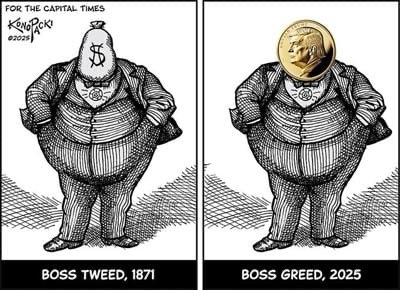
History has a habit of changing the names on the buildings while keeping the story eerily familiar.
A hundred years from now, it is entirely possible that figures like Bill Gates, Elon Musk, Jeff Bezos, and Mark Zuckerberg will be discussed the same way historians now discuss Andrew Carnegie, John D. Rockefeller, and J. P. Morgan. Not because the industries are identical, but because the patterns are.
The Gilded Age robber barons consolidated steel, oil, railroads, and banking. Today’s tech titans consolidated data, media, cloud infrastructure, retail logistics, communication, and increasingly, the public square itself. Carnegie controlled the steel that built the nation. Rockefeller controlled the oil that powered it. Morgan controlled the financing that stabilized or strangled entire sectors of the economy. The modern equivalents control something arguably even more powerful: information, attention, and digital dependency.
Future historians may look back on the early 21st century and see the rise of the “Digital Gilded Age.” They may describe a world where a handful of unelected billionaires quietly accumulated levels of influence once reserved for governments. Not through armies or political office, but through platforms people voluntarily carried in their pockets every waking moment.
Amazon became more than a store; it became infrastructure. Meta became more than a social network; it became an emotional and political ecosystem. Microsoft embedded itself into global business and government operations so deeply that modern civilization effectively runs on its software backbone. Musk’s companies extended influence into transportation, satellites, communications, artificial intelligence, and even the mythology of technological salvation itself.
And like the industrial barons before them, these men cultivated dual identities. Carnegie built libraries while crushing unions. Rockefeller funded universities while monopolizing oil markets. Morgan stabilized markets while tightening financial control. Likewise, Gates became associated with global philanthropy and public health while Microsoft spent decades accused of monopolistic practices. Bezos funds journalism and space exploration while Amazon workers became symbols of modern labor exhaustion. Zuckerberg speaks of “community” while critics argue his platforms accelerated polarization, surveillance capitalism, and the commodification of human attention. Musk is simultaneously viewed as an innovator, provocateur, industrialist, and chaos engine depending on who is telling the story.
That contradiction may become the defining feature of their legacy.
Because history rarely treats immense wealth kindly at first. During their own era, Rockefeller and Carnegie were either worshipped as geniuses or condemned as parasites. A century later, they are remembered as both. The same may happen here. Schoolchildren in 2126 may learn that Musk accelerated electric vehicles and private spaceflight while also normalizing billionaire influence over geopolitical discourse. They may study Bezos as the architect of frictionless commerce and the man who helped hollow out local retail economies worldwide. Zuckerberg may be remembered less as the inventor of social networking and more as one of the architects of algorithmic social engineering. Gates may emerge as the most rehabilitated figure historically because of philanthropy, much the same way Carnegie’s libraries softened public memory of his brutal labor conflicts.
But perhaps the most important comparison to the Gilded Age is not wealth itself. America has always had wealthy people. The real comparison is consolidation.
The late 19th century concentrated physical industry into trusts. The early 21st century concentrated digital existence into platforms.
The old monopolists controlled what people bought. The new monopolists increasingly control what people see, believe, discuss, fear, desire, and vote for. Rockefeller could influence the price of kerosene. Zuckerberg’s algorithms can influence elections, social movements, public health narratives, and the emotional temperature of entire nations in real time. Carnegie could suppress a strike in one factory town. Modern platform owners can alter the visibility of information globally with a software adjustment measured in milliseconds.
That is a scale of influence the old industrialists could scarcely imagine.
Future historians may also note how governments struggled to react. Just as late-stage industrial capitalism outpaced regulation in the 1890s, the digital economy outpaced democratic institutions in the 2000s and 2010s. Legislators often appeared technologically illiterate while corporations accumulated unprecedented quantities of behavioral data and market leverage. Antitrust discussions that once focused on railroads and oil pipelines evolved into debates over app stores, cloud servers, AI models, online advertising, and control of information ecosystems.
And just like the original Gilded Age, the public reaction may eventually produce a political reckoning.
The Progressive Era emerged because Americans eventually decided concentrations of wealth and power had become dangerous to democracy itself. Trust-busting, labor protections, financial regulations, and antitrust enforcement followed. A century from now, historians may frame our era as the volatile transition period before societies finally decided how much authority private technology empires should possess.
Or they may conclude we never truly solved it.
Because unlike Carnegie or Rockefeller, today’s oligarchs do not merely own industries. They own the mechanisms through which billions of people interpret reality. And history may judge that as either the greatest innovation of the modern age — or the moment democracy quietly outsourced itself to algorithms and billionaires.

