Dwain Northey (Gen X)
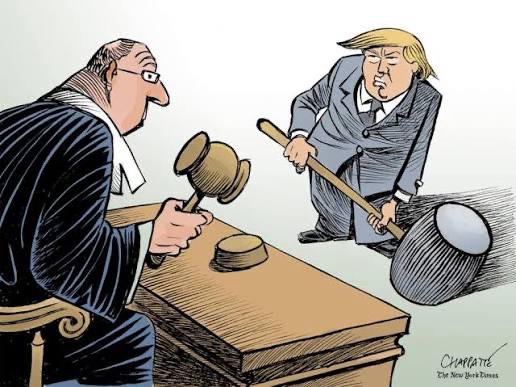
You’re Not Their Employee Anymore
One thing I have never quite understood about American politics is the expectation that judges should remain loyal to the president who appointed them. Once a federal judge is confirmed, whether it’s a district court judge in some federal courthouse or a justice sitting on the Supreme Court, they are not interns. They are not campaign staff. They are not contestants on a reality television show waiting for the boss to point a finger and declare, “You’re fired.”
They have lifetime appointments.
That’s not a bug in the system. That’s the feature.
The Founders, for all their faults and powdered-wig eccentricities, understood that judges needed to be insulated from political pressure. The whole point was to create a branch of government that could tell presidents, Congress, governors, and everyone else, “No, you can’t do that,” without worrying about whether their next performance review was coming up.
Yet every time a judge rules against the administration that appointed them, political commentators react as though they’ve witnessed an act of betrayal. “But he appointed you!” they cry.
Yes. And?
A federal judge’s job isn’t to protect the president’s feelings. It isn’t to rubber-stamp every policy proposal that comes down the pike. Their job is to interpret the law and the Constitution as they understand it. You may disagree with their interpretation, but they don’t owe the president a thank-you card every time a lawsuit appears in their courtroom.
Which brings us to Donald Trump.
One has to imagine that Trump’s understanding of federal judges occasionally collides with reality in a rather painful way. Throughout his business career and television career, if someone displeased him, he could usually remove them. Fire the executive. Replace the manager. Write a nasty social media post. Problem solved.
Federal judges don’t work that way.
If a Trump-appointed judge rules against him in a gerrymandering case, an election case, or an executive power dispute, there is no giant red button on the Resolute Desk labeled “Terminate Employee.” The judge doesn’t suddenly disappear in a puff of constitutional smoke.
They stay right where they are.
For life.
The Constitution essentially says, “Thank you for your concern, Mr. President, but this judge isn’t yours anymore.”
And that’s probably a healthy thing.
Imagine a judicial system where every judge had to constantly worry about pleasing the politician who appointed them. The courts would become little more than political customer service departments. Instead of asking, “What does the law say?” judges would be asking, “What would help my boss’s approval ratings this week?”
That would be disastrous.
Now, all of that said, I do think there’s a legitimate discussion to be had about the Supreme Court itself. We currently have thirteen federal judicial circuits and only nine Supreme Court justices. Contrary to popular belief, the Constitution never specified that there must be nine justices. Congress has changed the number several times throughout American history.
So the idea that nine is some sacred number handed down on stone tablets between the Ten Commandments and a recipe for manna is simply not true.
The Court had six justices at the beginning. At various points it had seven, nine, and even ten. Nine just happens to be the number we’ve settled on for the last century and a half.
Given the growth of the country, the population, and the federal court system, it’s not unreasonable for people to ask whether thirteen justices might better reflect thirteen circuits. Reasonable people can disagree about that, but at least it’s a discussion grounded in practical governance rather than mythology.
What strikes me as ironic is that many of the same people who insist judges should be independent suddenly become outraged when that independence actually shows up. We cheer judicial independence right up until a judge issues a ruling we don’t like. Then, somehow, independence becomes treason.
But that’s the whole point of lifetime appointments. The judge isn’t supposed to be loyal to the president. The judge is supposed to be loyal to the law as they understand it.
Whether they’re appointed by Trump, Obama, Bush, Clinton, Reagan, or whoever comes next, their constitutional duty remains the same.
And if that occasionally leaves a president staring at the television wondering why one of “his” judges just ruled against him, perhaps that’s evidence that the system is working exactly as intended.

