Dwain Northey (Gen X)
History is full of strange “what if” questions. What if Napoleon had won at Waterloo? What if the South had won the Civil War? What if someone had told the passengers of the Titanic that maybe an iceberg at full speed wasn’t a great idea?
One of my favorites is this: What if Russia had never played the role it did in World War I and World War II? Would it be the global power everyone treats it as today, or would it simply be another large country most people couldn’t find on a map?
Before the twentieth century, Russia was certainly big. It had a lot of land. It had a lot of people. It had a lot of winters. What it didn’t have was the kind of global influence we associate with great powers today. It was ruled by Czars who often seemed more interested in maintaining absolute power than modernizing the country. Industrialization lagged behind Western Europe. Political institutions were archaic. The economy was largely agricultural. In many ways, Russia was less a modern power than a giant empire held together by geography and force.
Then came World War I.
Russia entered the conflict as one of Europe’s major empires, but the war exposed just how fragile the country really was. Millions of soldiers were thrown into battle with inadequate equipment, poor leadership, and staggering casualties. The war ultimately helped bring down the Romanov dynasty and paved the way for the Bolshevik Revolution. Russia didn’t emerge from World War I stronger. It emerged transformed.
Then came World War II, where the Soviet Union paid a price that is almost impossible to comprehend today. Entire cities were destroyed. Tens of millions died. The Eastern Front became history’s largest and bloodiest meat grinder. Soviet leaders demonstrated a willingness to absorb losses that would have broken virtually any other nation on Earth. Whether one sees that as resilience, brutality, or some combination of both, it undeniably altered the course of the war.
At the same time, Franklin Roosevelt made the strategic decision that defeating Nazi Germany required cooperation with the Soviet Union. The alliance between the United States, Britain, and the USSR was never based on friendship. It was based on necessity. Yet that alliance had enormous consequences. By war’s end, the Soviet Union occupied much of Eastern Europe and emerged as one of two global superpowers.
The Cold War cemented that status. For nearly half a century, the world was organized around the rivalry between Washington and Moscow. Nuclear arsenals, proxy wars, espionage, and ideological competition gave the Soviet Union influence far beyond what its economy alone might have justified.
Which brings us to today.
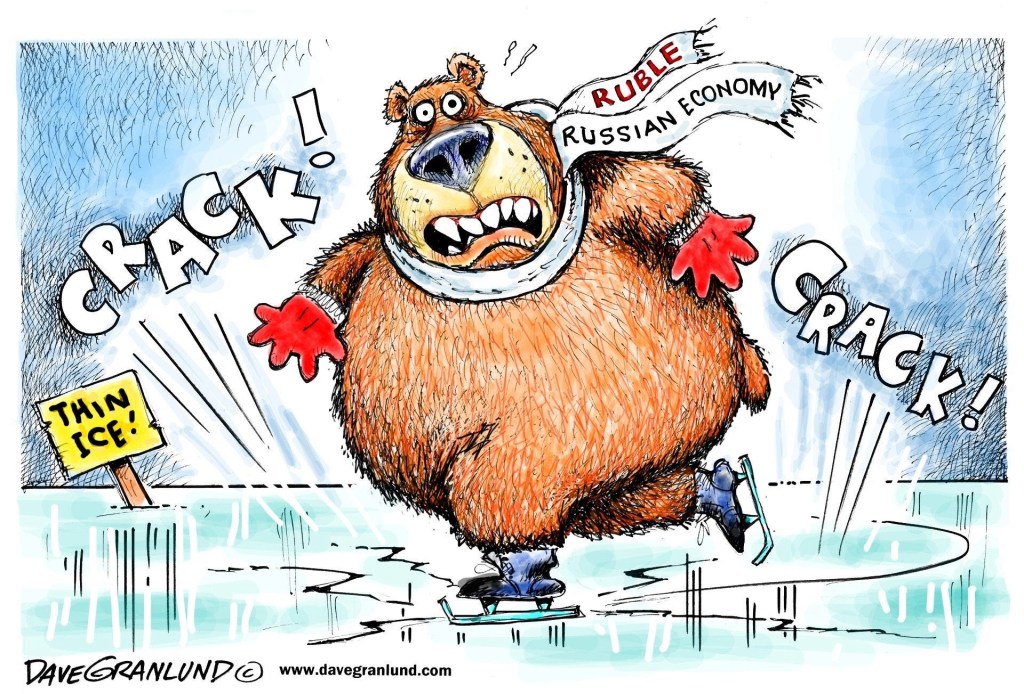
Modern Russia still occupies an enormous amount of territory. It possesses vast natural resources and one of the world’s largest nuclear arsenals. Yet economically, it struggles to match countries that occupy a fraction of its landmass. Its economy is frequently compared to those of medium-sized European nations despite spanning eleven time zones.
This raises an uncomfortable question. If Russia had never emerged from World War II as one of the victorious powers and if the Cold War had never elevated it into superpower status, would the world view it much differently than it views other large but economically middling countries?
The answer may be yes.
Much of Russia’s modern influence rests on foundations built during the twentieth century. Its permanent seat on the United Nations Security Council, its nuclear arsenal, its military prestige, and much of its geopolitical relevance stem directly from the outcome of World War II and the Cold War that followed.
Without those events, Russia might still be large. It might still be resource-rich. It might still be important regionally. But it is difficult to imagine it commanding the same level of global attention.
In a sense, Russia’s story demonstrates that geography alone does not create power. Land helps. Resources help. Population helps. But historical circumstances matter just as much. The Soviet Union’s sacrifices during World War II and the geopolitical realities that followed transformed Russia from a struggling empire into one of the defining powers of the modern age.
Whether that status can be maintained in the twenty-first century is another question entirely.
Because eventually every nation discovers that memories of past victories can only carry you so far. At some point, significance has to come from what you are now, not simply what your grandparents accomplished eighty years ago.

