Dwain Northey (Gen X)
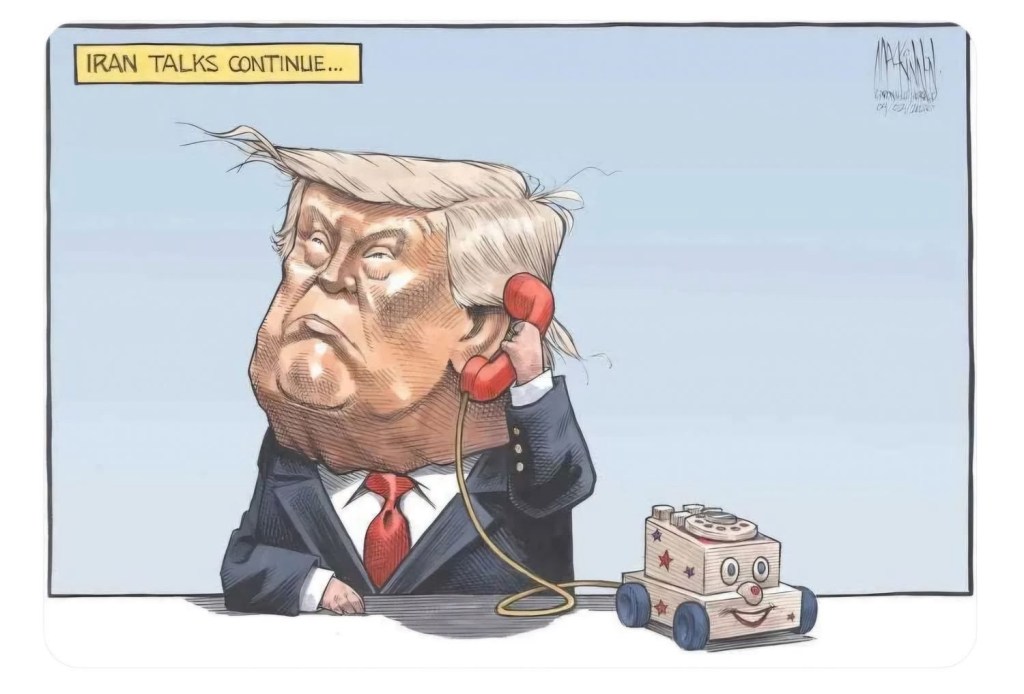
There is an old saying that when you find yourself in a hole, the first thing you should do is stop digging. Donald Trump apparently heard that advice and responded by ordering a larger shovel.
We now find ourselves watching another chapter in an unnecessary and constitutionally questionable military adventure with Iran, a conflict that seems to have been launched without a clear endgame and with goals that appear remarkably similar to what was available before the first shot was fired.
That is the part that should make everyone pause. The demands being made today are, in many cases, the same demands that could have been pursued through diplomacy a hundred days ago. After all the threats, chest-thumping, airstrikes, press conferences, and declarations of strength, we seem to have arrived right back where we started.
At some point you have to wonder if Iran is sitting across the table trying not to laugh.
The situation increasingly resembles a businessman setting fire to his own office and then demanding praise because he found a bucket of water.
The problem is that Donald Trump has always viewed himself as the hero of every movie playing inside his head. Somewhere in that imagination, dramatic music is swelling. Fighter jets are roaring overhead. Advisors are looking nervous. The world is hanging by a thread, and only one man can save it.
Unfortunately, reality is not a Hollywood screenplay.
Trump appears to see himself as the president from Independence Day, standing before humanity, delivering the inspirational speech that unites the world against an existential threat. In his mind, he is both the president and the action hero. He’s the commander-in-chief, the ace pilot, the strategist, and probably the guy who gets the girl before the credits roll.
The problem is that Independence Day involved giant alien spaceships attacking Earth. Reality involves complicated geopolitics, alliances, economic consequences, military casualties, and the inconvenient fact that other countries are not obligated to participate in your fantasy.
History is filled with leaders who convinced themselves that they alone could bend events to their will. History is also filled with examples of how badly that tends to end.
What makes this episode particularly bizarre is that the administration continues to present every development as evidence of success, even when success increasingly resembles returning to the exact position that existed before the conflict began. It’s like crashing your car into a tree and demanding applause because you’ve successfully located the road again.
Meanwhile, Americans are left paying the bill, military families are left carrying the burden, and the rest of the world is left trying to determine whether this is a coherent strategy or simply another season of reality television masquerading as foreign policy.
The fantasy remains unchanged. Trump still imagines himself soaring through the skies, saving civilization while grateful crowds cheer below. But the real world has a nasty habit of refusing to follow the script.
The aliens aren’t coming. Will Smith isn’t flying cover. The soundtrack isn’t swelling. And no amount of wishful thinking can transform a self-created crisis into a heroic rescue mission.
In the end, the greatest obstacle to Donald Trump’s Independence Day fantasy may be the simple fact that reality keeps showing up and ruining the movie.

