Dwain Northey (Gen X)
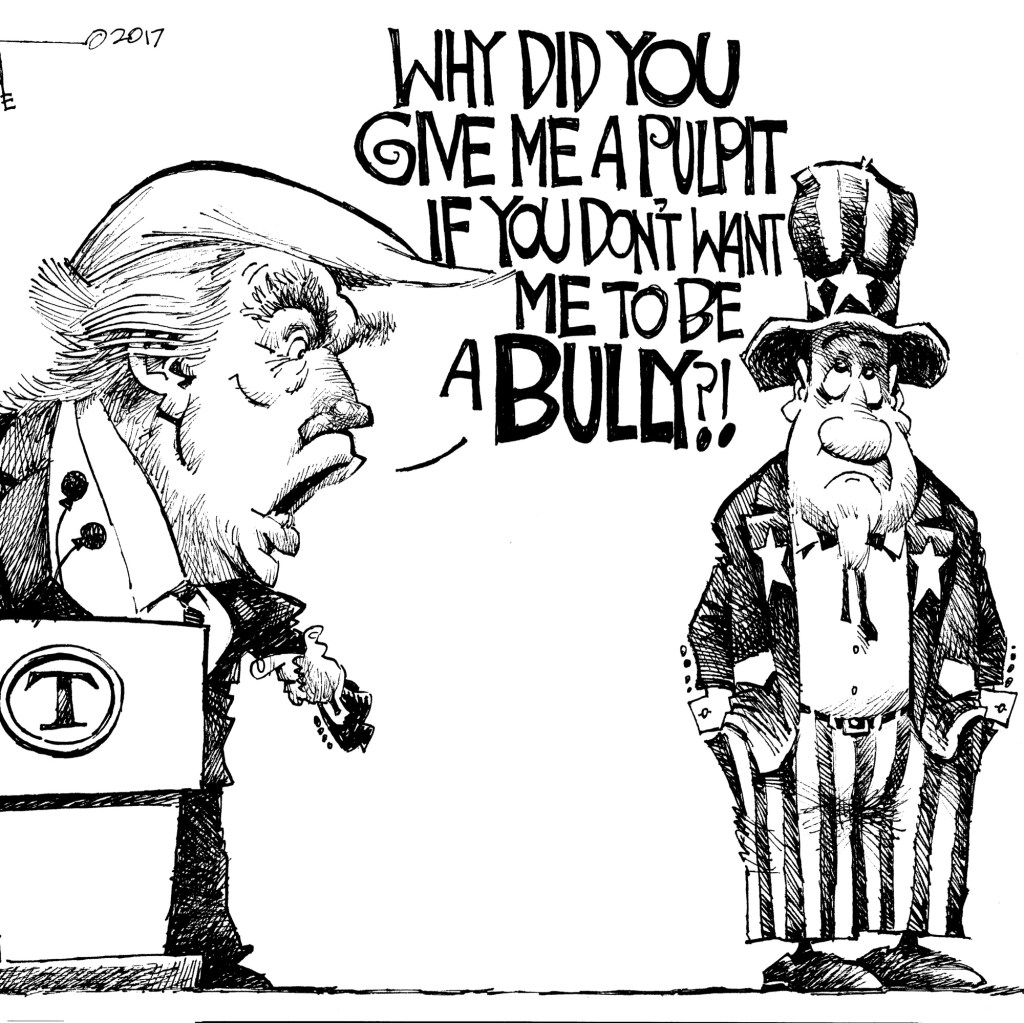
One of the strangest features of Donald Trump’s political career is that he often becomes the most defensive when confronted with his own words. You can accuse him of almost anything and he’ll swat it away, but quote something he actually said six months ago and suddenly you’re watching an Olympic-level exercise in verbal gymnastics.
A recent interview provided a perfect example. The interviewer asked him about the fact that he campaigned on a promise of “no new wars,” yet America now finds itself involved in multiple military conflicts. Instead of addressing the substance of the question, Trump immediately shifted into lawyer mode.
“I never promised there would be no new wars.”
Technically, that’s a clever answer. It is also an answer to a question that wasn’t actually asked.
Of course no president can promise there will never be a new war. A president cannot guarantee that another nation won’t attack an ally, launch a missile, invade a neighbor, or create a crisis that demands a response. Nobody expects a president to predict every possible future event.
But that wasn’t the spirit of the campaign message.
When voters heard “no new wars,” they weren’t interpreting it as a magical guarantee that world history would stop happening. They understood it as a commitment that Trump himself would not be the one choosing to expand conflicts, initiate military adventures, or escalate situations that otherwise might have remained contained.
That’s the distinction that should have been pressed.
A better follow-up question might have been:
“Of course you can’t guarantee that some unforeseen event won’t create a military crisis. Nobody expects that. But when you campaigned on avoiding new wars, voters understood that to mean you wouldn’t be the one starting them. Today the United States is involved in more military conflicts than when you took office. Some of those were the direct result of decisions made by your administration. How do you reconcile those actions with the promise you made during the campaign?”
That’s the question that gets to the heart of the issue.
Because what Trump often does is argue against the literal wording of a criticism while ignoring the obvious meaning behind it. It’s a debating technique that works remarkably well in modern politics. If someone says, “You promised X,” he responds by finding a technicality that allows him to claim he never literally said X in precisely those words. His supporters hear a rebuttal. His critics hear an evasion. The actual substance disappears into the fog.
The pattern repeats itself constantly.
When challenged about spending, he talks about revenue.
When challenged about deficits, he talks about growth.
When challenged about statements he made on video, he argues about the interpretation rather than the statement itself.
The discussion shifts from what happened to whether the wording of the criticism was perfect.
It’s like arguing with someone who was caught speeding and responds by saying, “Well, technically the officer said I was driving fast, and speed is a relative term.”
Maybe. But everyone knows what the conversation is really about.
Another telltale sign of Trump’s approach to criticism is what happens when there is no room for interpretation at all.
Sometimes the challenge isn’t based on a newspaper article or an anonymous source. Sometimes the evidence is literally his own words.
An interviewer can say, “This is your tweet.”
Or, “This is your Truth Social post.”
Or, “This is video of you answering a question from the press corps.”
At that point there isn’t much room to argue that the media took him out of context. The source isn’t a hostile journalist. The source is Donald Trump himself.
Yet rather than addressing the substance of what he said, the conversation often takes a familiar turn.
The interviewer becomes the problem.
Suddenly the response isn’t, “Here’s why I changed my position.”
It isn’t, “The facts on the ground changed.”
It isn’t even, “I was wrong.”
Instead, it becomes, “You’re a nasty person.”
“You’re terrible at your job.”
“You don’t know what you’re doing.”
The criticism shifts from the statement to the person asking about the statement.
It’s a remarkable political magic trick. The evidence can be a direct quote, a social media post, or a video recording, but somehow the controversy becomes the character of the person holding up the mirror rather than the reflection staring back from it.
Imagine any other profession operating this way.
A CEO is shown a memo he wrote and responds by attacking the employee who brought it to the meeting.
A quarterback watches game film of a bad throw and responds by insulting the cameraman.
A contractor is shown the blueprint he signed and decides the architect is a terrible person for asking why the wall is crooked.
Most people would recognize that as avoiding accountability. In politics, however, it often becomes part of the show.
Trump’s political gift has always been his ability to recognize these escape hatches faster than his opponents. His weakness is that he often seems genuinely offended that anyone would hold him accountable for the expectations he created in the first place.
The easiest way to provoke Donald Trump isn’t to invent something about him. It’s to remind people of what he actually said.
And the moment you do, the conversation often stops being about the original promise and becomes a debate over definitions, wording, technicalities, semantics, or the motives of the person asking the question.
The evidence can be his tweet. His post. His speech. His interview. His video.
Yet somehow the real offense isn’t what he said.
The real offense is having the audacity to remember it.
The circle gets squared not by answering the question, but by changing what the question means. If that doesn’t work, then the focus shifts to attacking the person who dared ask it.
For supporters, that’s effective political combat.
For critics, it’s exhausting.
For everyone else, it’s another reminder that in modern politics, the hardest thing in the world is getting a straight answer to a simple question.

