Dwain Northey (Gen X)
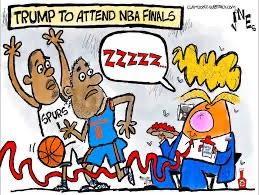
There was a time when presidents understood that not every event was about them.
If your hometown team made it to the championship, you could certainly celebrate. You could congratulate them. You could invite them to the White House afterward. What you generally did not do was insert yourself directly into the middle of the event itself and become part of the story.
Yet here we are.
With New York’s basketball team reaching the Finals, Donald Trump suddenly wants to attend Game Three. Now, to be fair, he’s a New Yorker. Nobody is suggesting he isn’t allowed to enjoy sports or root for a hometown team. The issue isn’t whether he likes basketball. The issue is that the President of the United States cannot simply show up anywhere without fundamentally changing the environment around him.
A sitting president attending a championship game isn’t like an ordinary celebrity buying a ticket. It means road closures, security sweeps, restricted access, Secret Service checkpoints, altered schedules, and thousands of fans dealing with inconveniences they otherwise wouldn’t face. The event immediately becomes partially about the president rather than solely about the athletes and the fans who spent decades waiting for moments like this.
And that’s the difference.
Most presidents understood that there are occasions when the spotlight belongs somewhere else.
If the Chicago Bulls had somehow reached the NBA Finals during Barack Obama’s presidency, nobody seriously believes he would have decided that Game Seven was the perfect venue for a presidential appearance. He understood that the story was the team. The players. The fans. The city.
The same principle has applied throughout modern presidential history. Presidents have attended sporting events, certainly. But they generally recognized that championship moments belong to the athletes competing and the communities celebrating.
Donald Trump has always operated differently.
For him, every event appears to be evaluated through the same question: “How can I become part of the headline?”
A military parade becomes about him.
A disaster response becomes about him.
A diplomatic summit becomes about him.
A sporting event becomes about him.
The pattern is so familiar that it barely surprises anyone anymore.
The irony is that the fans don’t need him there. Knicks fans—or any team’s fans in this situation—have waited years, sometimes decades, for a chance to watch their team compete for a championship. They aren’t buying tickets because they’re hoping to catch a glimpse of the President. They’re there because they love basketball and because this may be a once-in-a-generation moment for their franchise.
Yet the presence of a president inevitably shifts media coverage, security planning, and public attention away from the court and toward the luxury suite.
The players become a secondary story.
The game becomes a secondary story.
The crowd becomes a secondary story.
The president becomes the story.
That may be unavoidable in some circumstances. The problem arises when the president seems to enjoy that outcome.
There is also an uncomfortable possibility that after all the attention, all the security arrangements, all the disruption, the actual game itself may not be particularly important to him. Trump has developed a reputation for treating sporting events less as competitions to be appreciated and more as stages upon which he can be seen.
One suspects that if you asked many lifelong fans to choose between having their team in the Finals and having the President attend the game, they would choose the Finals every single time without hesitation.
Because that’s what matters.
The players matter.
The coaches matter.
The fans matter.
The championship matters.
What should not matter is whether the most powerful person in the country can find yet another opportunity to place himself at the center of someone else’s moment.
Leadership often requires understanding when to speak and when to remain silent. It requires understanding when to lead and when to let others have their day. Perhaps most importantly, it requires understanding that not every spotlight belongs to you.
For many presidents, that lesson came naturally.
For Donald Trump, it seems to be the one lesson he never learned.

