Dwain Northey (Gen X)
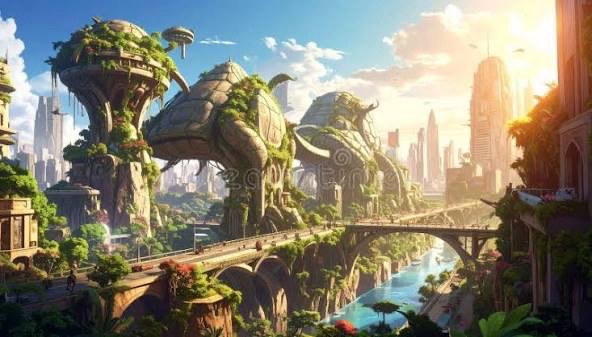
Solarpunk: Imagining a Future Worth Building
For decades, much of our vision of the future has been dominated by dystopia. Popular culture has given us endless versions of cyberpunk cities: towering corporate skyscrapers, polluted skies, neon lights reflected in rain-soaked streets, and populations trapped beneath systems they can neither control nor escape. These stories are compelling because they take many of today’s problems—economic inequality, environmental destruction, and unchecked technology—and project them into a darker tomorrow.
Solarpunk asks a different question.
Instead of asking what happens if everything continues to get worse, solarpunk asks what happens if humanity actually learns from its mistakes.
At its core, solarpunk is a vision of a future where technological advancement and ecological stewardship are not enemies but partners. It imagines cities covered with gardens, buildings designed to generate their own energy, transportation systems that are efficient and clean, and economies that measure success not merely by profit but by sustainability and quality of life.
Unlike the grim aesthetics of cyberpunk, solarpunk is filled with sunlight, greenery, and community. Yet it is not naïve optimism. Solarpunk does not pretend that environmental challenges disappear through wishful thinking. Rather, it proposes that innovation can be directed toward solving problems instead of simply maximizing short-term gains.
One of the defining characteristics of solarpunk is its relationship with industry. Traditional industrialization often relied upon the assumption that nature existed primarily as a resource to be extracted. Forests became lumber, rivers became waste channels, and the atmosphere became a dumping ground for emissions. Solarpunk envisions industries that operate according to a different philosophy: that long-term prosperity depends upon maintaining the ecological systems that support human life.
In a solarpunk future, manufacturing would prioritize renewable materials, recyclable products, and production methods designed to minimize waste. Factories might run on solar, wind, geothermal, or other renewable energy sources. Supply chains would be structured around efficiency rather than excess, reducing unnecessary transportation and resource consumption.
Architecture would undergo a similar transformation. Instead of constructing buildings that merely occupy space, cities would be filled with structures that actively contribute to their environments. Rooftops would generate electricity. Walls could support vertical gardens. Water collection systems would reduce waste while helping communities adapt to changing climates. Urban spaces would blend natural and human-designed environments rather than forcing a rigid separation between them.
Agriculture, too, would reflect this philosophy. Rather than relying exclusively on industrial-scale farming practices that exhaust soil and consume enormous quantities of water, solarpunk envisions regenerative agriculture, urban gardens, and technologies that increase food production while reducing environmental impact. Communities would have stronger connections to the systems that produce their food, making economies more resilient and less dependent on fragile global supply chains.
Perhaps most importantly, solarpunk reimagines economics itself.
Modern economic systems often reward activities that create immediate profit even when they impose long-term costs on society. Pollution, habitat destruction, and resource depletion can generate financial gains in the short run while creating expenses that future generations must bear. Solarpunk proposes that truly successful economies would account for those costs and prioritize investments that create lasting value.
Under such a model, economic growth would not be measured solely by how much is produced or consumed. Success would also be measured by cleaner air, healthier ecosystems, improved public health, stronger communities, and greater resilience against environmental challenges. Innovation would remain important, but innovation would be evaluated by how effectively it improves both human well-being and environmental sustainability.
Critics sometimes dismiss visions like solarpunk as unrealistic. Yet many of the technologies that define the movement already exist. Solar panels continue to become more efficient. Battery storage improves each year. Green building techniques are increasingly common. Advances in recycling, water conservation, and sustainable agriculture are being implemented around the world. The challenge is not whether these technologies are possible; it is whether societies choose to prioritize them.
What makes solarpunk particularly compelling is that it offers something increasingly rare in discussions about the future: hope grounded in practicality. It does not require magical inventions or a complete rejection of modern technology. Instead, it asks humanity to direct its creativity toward building systems that work with nature rather than against it.
The future envisioned by solarpunk is not one without industry, technology, or economic development. It is a future where those forces are aligned with ecological health and human flourishing. It suggests that progress does not have to leave polluted rivers, poisoned air, and exhausted landscapes in its wake. Progress can be measured by how well civilization sustains itself and the world around it.
In that sense, solarpunk is more than an artistic aesthetic or literary genre. It is a philosophy that challenges us to imagine a future where advancement and sustainability are not competing goals but the same goal viewed from different angles. At a time when environmental concerns often inspire anxiety and pessimism, solarpunk offers a simple but powerful proposition: the future can be greener, cleaner, and more prosperous if we choose to build it that way.

