Dwain Northey (Gen X)
From Clone Wars to Drone Wars
As a Gen Xer who grew up on Star Wars, I can’t help but notice that George Lucas may have accidentally predicted part of the future. The prequel trilogy gave us the Clone Wars—vast armies of identical soldiers fighting across the galaxy while politicians debated strategy from safe conference rooms. What we’re witnessing today isn’t the Clone Wars. It’s the Drone Wars.
The battlefields of Ukraine and the conflicts erupting around Iran are showing us what warfare may look like for the rest of the century. Instead of thousands of troops charging across open ground, we have swarms of flying robots hunting tanks, artillery, supply convoys, and sometimes individual soldiers. Instead of a pilot risking their life in a cockpit, someone may be sitting miles away—or even hundreds of miles away—guiding a machine with controls that look disturbingly similar to a video game controller.
The terrifying part isn’t that this technology exists. It’s how quickly it has evolved.
For centuries, military power was measured in soldiers, ships, tanks, and aircraft. A nation needed massive factories and enormous budgets to compete. Now a relatively inexpensive drone carrying a small explosive charge can destroy equipment worth millions of dollars. A machine that costs less than a used pickup truck can cripple a tank that costs more than a mansion.
That changes everything.
Ukraine has become a laboratory for modern warfare. Both sides are throwing drones at each other in staggering numbers. Reconnaissance drones spot targets. Kamikaze drones strike targets. Naval drones attack ships. Long-range drones hit infrastructure hundreds of miles away. It’s beginning to look less like the wars of the twentieth century and more like two giant technological ecosystems trying to out-innovate each other.
Meanwhile, the tensions involving Iran demonstrate that this isn’t a regional phenomenon. Drone technology has spread across the globe. Nations no longer need fleets of expensive bombers to project force. Increasingly, they need engineers, software developers, satellite links, and warehouses full of autonomous or semi-autonomous machines.
The old image of war involved armies meeting on battlefields. The new image may involve operators staring at screens.
That’s where the ethical questions become uncomfortable.
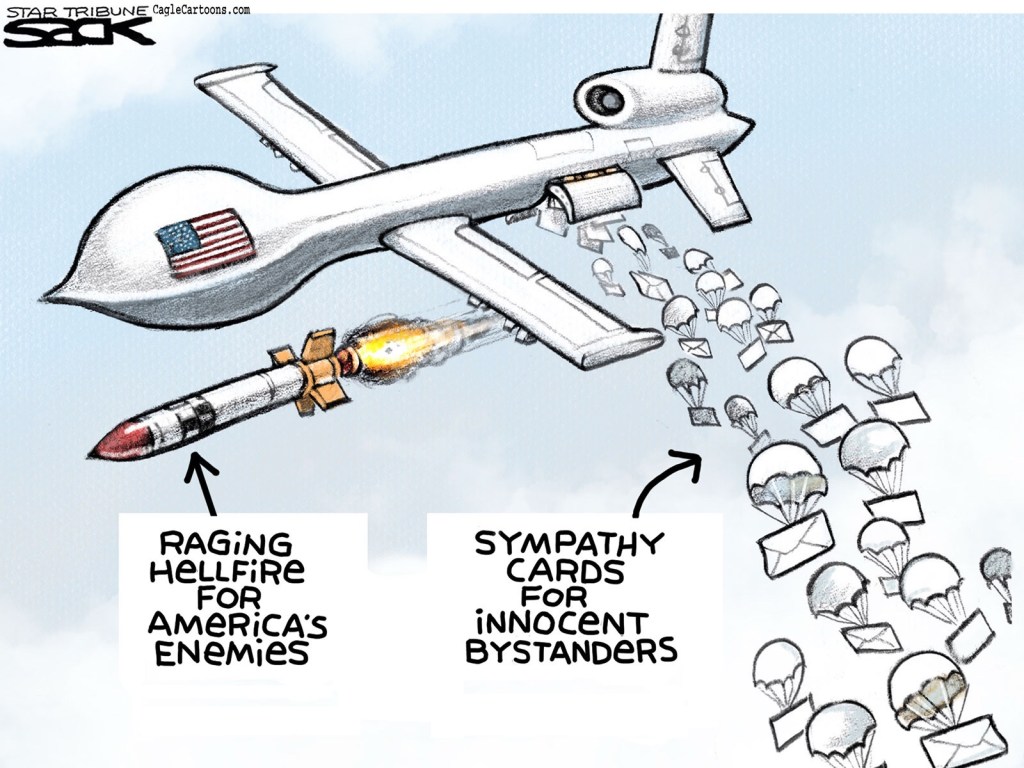
Human beings evolved with a natural psychological barrier against violence. It’s one thing to pull a trigger while looking someone in the eye. It’s another thing entirely to observe a target through a camera feed thousands of feet in the air. Distance can create emotional detachment. The operator still knows there are human beings on the receiving end, but the experience resembles technology more than combat.
The consequences, however, remain painfully human.
Families still lose loved ones. Cities still burn. Infrastructure still collapses. The only thing changing is the distance between the person making the decision and the person suffering the outcome.
And we’re only at the beginning.
Today’s drones often require human operators. Tomorrow’s drones may not.
Artificial intelligence is rapidly advancing target recognition, navigation, and coordination. Military planners around the world are undoubtedly imagining swarms of autonomous systems that can communicate with one another, adapt to changing conditions, and continue operating even when communications are disrupted.
That’s where the conversation starts sounding less like current events and more like science fiction.
Not quite The Terminator. Not yet.
Nobody is building self-aware killer robots plotting humanity’s extinction. Reality is usually far less cinematic and far more bureaucratic. The danger isn’t a robot deciding to destroy humanity. The danger is governments gradually delegating more decisions to machines because machines are faster, cheaper, and more expendable than people.
History suggests that if technology can be weaponized, it eventually will be.
Gunpowder changed warfare. Aircraft changed warfare. Nuclear weapons changed warfare. Cyber warfare changed warfare.
Drone warfare appears poised to become the next revolution.
The irony is that science fiction warned us for decades. We laughed at the droids in Star Wars. We watched Skynet become self-aware in The Terminator. We treated those stories as entertainment.
Now we’re watching the early chapters unfold in real time—not as an apocalyptic robot uprising, but as something much more mundane and therefore much more likely.
Warehouses full of machines.
Algorithms selecting targets.
Operators sitting behind screens.
And somewhere on the other end of that data link, real human beings experiencing very real consequences.
The Clone Wars belonged to a galaxy far, far away.
The Drone Wars are happening right now.

