Dwain Northey (Gen X)
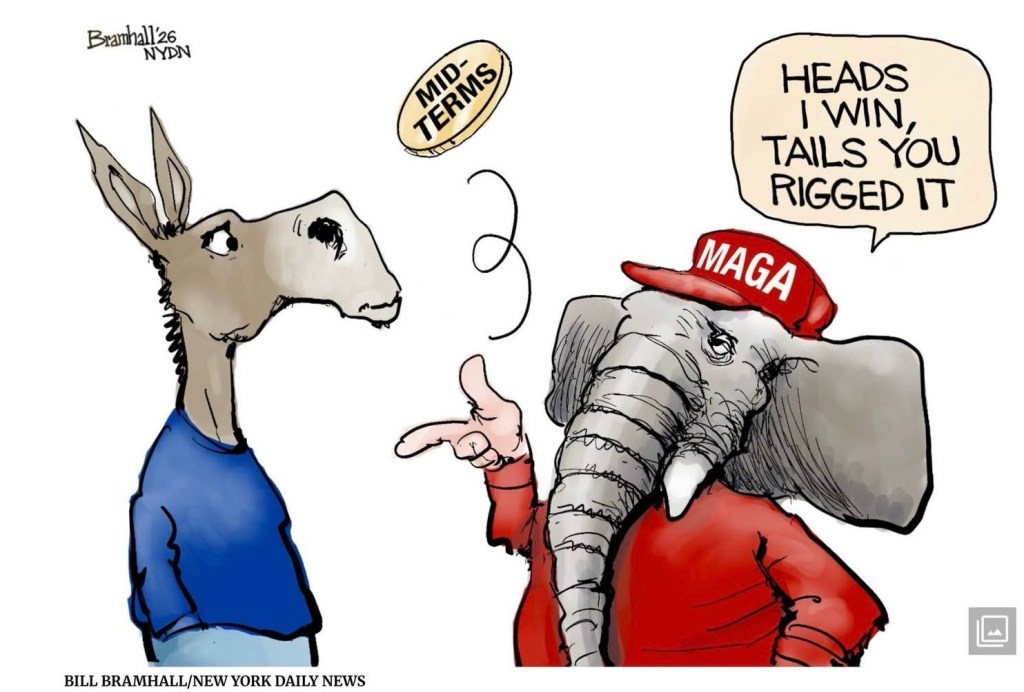
It must be exhausting living in a world where you only recognize the legitimacy of an election when your side wins.
Welcome to another election year, where one of the most predictable traditions in American politics is about to return. Forget campaign ads. Forget attack mailers. Forget candidates kissing babies and pretending to enjoy corn dogs at county fairs. The most reliable tradition of all is the Republican Party’s election theorem:
If Republicans win, democracy worked perfectly.
If Republicans lose, democracy was rigged.
We’re already seeing the opening act in California. The complaints have started about the state’s jungle primary because the Republican reality-show candidate didn’t make it into the top two. Therefore, according to the usual chorus, the system must be corrupt, unfair, manipulated, or some combination of all three.
The funny part is that this argument requires ignoring one very important detail: we’re talking about California.
California isn’t exactly a swing state hanging on the edge of a knife. It’s about as deep blue as the Pacific Ocean sitting next to it. The fact that a Republican candidate was even competitive enough to be discussed is arguably evidence that the system is working exactly as designed. Yet somehow the conclusion isn’t, “Maybe our candidate wasn’t popular enough.” The conclusion is always, “The game was fixed.”
That’s become the default setting.
When Republicans win governorships, elections are secure.
When Republicans win congressional seats, elections are secure.
When Republicans win the presidency, elections are secure.
But when they lose? Suddenly voting machines are suspicious. Mail ballots are suspicious. Early voting is suspicious. Late voting is suspicious. Counting votes is suspicious. Not counting votes fast enough is suspicious. Counting them too fast is suspicious.
The only thing that never seems suspicious is a Republican victory.
As a Gen Xer, I remember when both parties occasionally lost elections and then spent a few years trying to figure out why. Maybe the message was wrong. Maybe the candidate was weak. Maybe voters didn’t like the platform. Maybe demographics were changing.
Crazy concept, I know.
Now the first instinct isn’t self-reflection. It’s conspiracy.
The modern GOP has created a political version of the toddler who flips over the Monopoly board because they’re losing. The rules are fair right up until the moment they aren’t winning anymore. Then suddenly everyone else cheated.
What’s particularly remarkable is that this strategy creates a no-lose narrative. If Republicans win in November, they’ll point to the results as proof that America’s election system is trustworthy. If they lose, they’ll point to the exact same election system as proof of corruption.
It’s a self-sealing argument. Any outcome validates the belief.
And that’s dangerous, because democracies don’t actually survive on elections alone. They survive because the losers accept the results. That’s the whole deal. That’s the social contract. We all agree to play by the rules, and when our side loses, we grumble, complain, write angry Facebook posts, yell at cable news, and come back for the next election.
The moment one side decides that every loss is evidence of fraud, the foundation starts cracking.
Maybe the California primary wasn’t a conspiracy. Maybe voters simply preferred other candidates.
Maybe losing doesn’t automatically mean cheating occurred.
Maybe democracy includes the possibility that people disagree with you.
I know that’s a radical idea in today’s political climate.
But as we head into another election season, get ready. The script has already been written. If Republicans win, we’ll hear endless speeches about the triumph of democracy. If Republicans lose, we’ll hear endless speeches about stolen elections.
The only mystery left is how long we’re supposed to pretend we don’t already know the ending.

