Dwain Northey (Gen X)

The Trillionaire and the Taxpayer
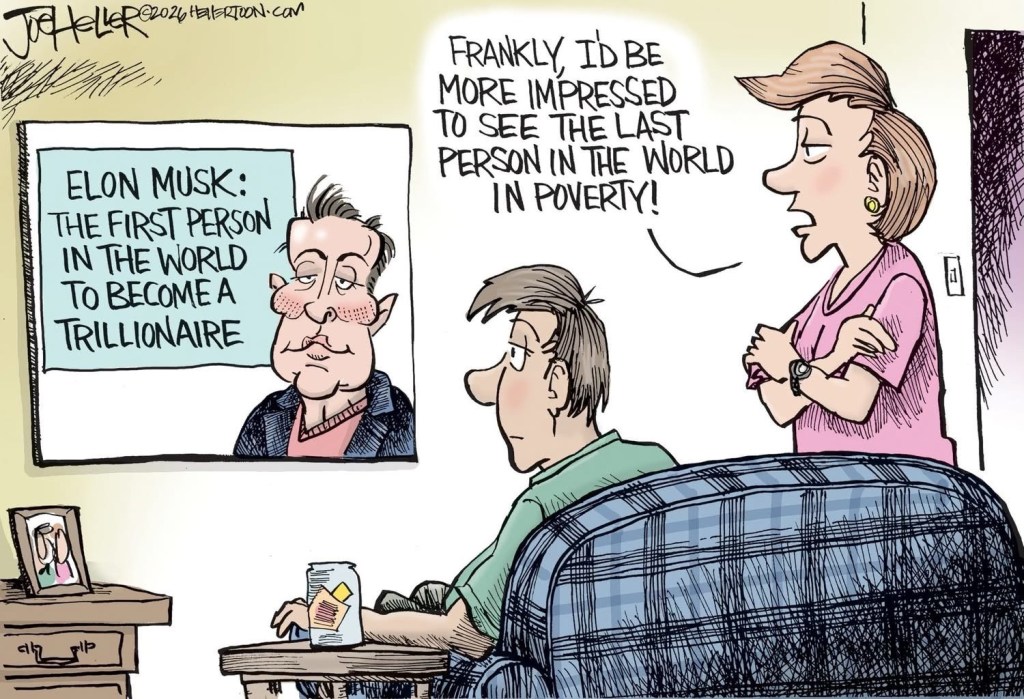
When I was growing up in the 1970s and 1980s, a billion dollars was cartoon-villain money. A billionaire was someone who lived in a mansion on top of a mountain, probably had a secret lair, and appeared in movies as the guy trying to buy a country. Most of us couldn’t even comprehend a billion dollars. It was simply too much money to fit into a normal human brain.
Now we have a trillionaire.
Not a country. Not a government. Not an empire.
One guy.
A trillion dollars.
That’s a number so absurd that our grandparents didn’t even use it in everyday conversation. A million seconds is about eleven days. A billion seconds is over thirty-one years. A trillion seconds is nearly thirty-two thousand years. Human civilization wasn’t even writing things down thirty-two thousand years ago.
Yet somehow we’ve reached a point where one person can accumulate that much wealth and half the country shrugs and says, “Good for him.”
The latest milestone comes as Elon Musk’s fortune explodes thanks to SpaceX’s valuation and public trading. SpaceX is undoubtedly an impressive company. Reusable rockets are remarkable engineering. But let’s stop pretending this was some lone genius building rockets in a garage with spare parts and a dream.
SpaceX has received billions upon billions in government contracts. NASA contracts. Department of Defense contracts. Launch agreements funded by taxpayers. The company was nurtured and sustained by public money from its early years. The same taxpayers who are told there’s no money for affordable housing, no money for healthcare, no money for student debt relief, no money for infrastructure, and certainly no money to make sure kids don’t go hungry.
Funny how money always appears when corporations need it.
Tesla tells a similar story. Federal tax credits. State incentives. Subsidies. Regulatory credits worth billions. Public investment helped create the environment where Tesla could flourish.
Again, none of this means the companies aren’t innovative. They are.
But let’s not rewrite history into some fairy tale about rugged individualism. The American taxpayer was an investor whether they wanted to be or not. The difference is taxpayers don’t get stock options.
They get potholes.
They get higher grocery bills.
They get lectures about fiscal responsibility.
And they get to watch the richest man in history become even richer.
The truly staggering part isn’t that Elon Musk has a trillion dollars. It’s that we’ve somehow normalized it. We live in a society where people struggle to afford rent, where working families juggle two or three jobs, where seniors choose between prescriptions and groceries, and where homelessness exists in virtually every major city.
Meanwhile, one man’s net worth exceeds the economic output of many nations.
Think about that for a second.
A trillion dollars isn’t wealth. It’s power.
It’s the ability to influence markets, media, politics, technology, and public discourse on a scale previously reserved for governments.
Could one person solve world hunger? Not permanently. The problem is more complicated than writing a check.
Could one person dramatically reduce homelessness, fund medical research, transform education, provide clean water, build infrastructure, and improve millions of lives?
Absolutely.
Instead, we’ve built a culture that treats extreme wealth as if it’s an Olympic sport. Every new billionaire is celebrated. Every new hundred billion is applauded. Every new record becomes proof that the system works.
But if one person can accumulate a trillion dollars while millions struggle to survive, maybe that’s not evidence the system is working.
Maybe it’s evidence the system is working exactly as designed.
The billionaire era was already difficult to justify. The trillionaire era is something else entirely. It’s a flashing neon sign announcing that wealth has become detached from any reasonable human scale.
And the irony is impossible to ignore.
The taxpayers helped build the launchpad.
The taxpayers funded the contracts.
The taxpayers absorbed the risk.
Then the profits blasted into orbit.
And now we’re supposed to stand on the ground, looking up, and cheer while a trillionaire waves from space.

