Dwain Northey (Gen X)
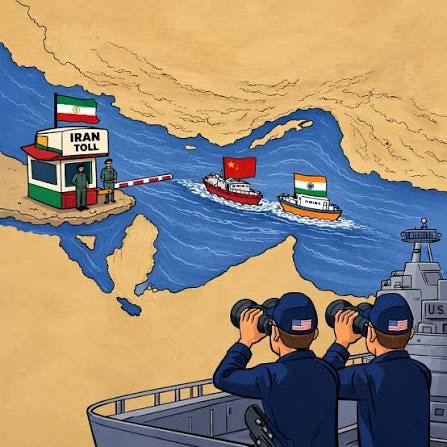
The Strait of Hormuz Is Not a Toilet Drain
Listening to Donald Trump and his supporters talk about the Strait of Hormuz, you’d think global commerce operates like the plumbing under a kitchen sink. In their version of reality, all you have to do is announce that the strait is open, wave a memorandum of understanding around, declare victory, and suddenly oil tankers, cargo ships, insurance companies, ports, and commodity markets all snap back to normal.
That’s not how any of this works.
An aerial view of the Strait of Hormuz looks a little like the pipe coming out of your toilet. But unlike your bathroom plumbing, the global economy doesn’t respond instantly when a blockage is removed. If a plumber clears a clog, water flows immediately. If a major shipping lane has been threatened, restricted, mined, attacked, or subjected to military brinkmanship, the consequences ripple through an entire global system.
Ships don’t magically teleport back into position.
Insurance companies don’t immediately lower risk premiums.
Shipping schedules don’t instantly normalize.
Ports don’t suddenly erase weeks of congestion.
Commodity traders don’t immediately forget the uncertainty that drove prices upward.
Even if the strait were completely secure today—which remains a very big “if”—it could take thirty, sixty, ninety days or more before supply chains begin looking anything like normal. The disruptions create a backlog that has to work its way through the system. Every delayed tanker affects refineries. Every delayed refinery shipment affects distributors. Every distributor delay affects consumers.
That’s the reality of global logistics.
Yet the sales pitch from the White House is always the same. A press release becomes a victory. A memorandum becomes a treaty. A temporary pause becomes permanent peace. A photo opportunity becomes a historic achievement.
We’re told that Iran has agreed to some form of arrangement that allows passage through the strait for ninety days before restrictions could potentially be revisited. Ninety days sounds impressive in a headline. In reality, ninety days may simply be enough time to begin addressing the backlog that already exists. It may not even be enough for markets to regain confidence that the route will remain stable.
Because confidence is the real currency here.
Shipping companies make decisions based on expectations. Insurers make decisions based on risk. Investors make decisions based on stability. None of those groups are known for taking politicians at their word—especially politicians who have spent years announcing victories that later turned out to be temporary, exaggerated, or entirely imaginary.
The global economy doesn’t care about campaign slogans.
It doesn’t care about Truth Social posts.
It doesn’t care how many times someone declares that they alone have solved the problem.
The economy responds to facts on the ground, ships in the water, contracts being honored, and risks being reduced over time.
And that is where the concern lies.
Because we’ve seen how this administration operates. Every challenge becomes an opportunity for self-congratulation. Every crisis becomes a stage. Every temporary development becomes proof of genius. The announcement is often treated as more important than the outcome.
But the outcome is what matters.
If tankers are moving safely six months from now, that’s success.
If energy prices stabilize six months from now, that’s success.
If shipping costs return to normal six months from now, that’s success.
Not the press conference. Not the memorandum. Not the headline.
The actual results.
Unfortunately, Americans have learned to be skeptical. We have watched too many grand declarations dissolve into excuses. Too many promises become moving goalposts. Too many “historic victories” require endless explanations afterward.
So when we’re told that the Strait of Hormuz is open and everything is fine, the proper response isn’t celebration.
It’s patience.
Let’s see the ships move.
Let’s see the markets stabilize.
Let’s see the prices fall.
Let’s see ninety days turn into six months and six months turn into a year.
Then we’ll know whether this was a genuine solution or just another episode in a reality show that happens to be filmed from the Oval Office.

