Dwain Northey (Gen X)
The Constitution Isn’t a Suggestion
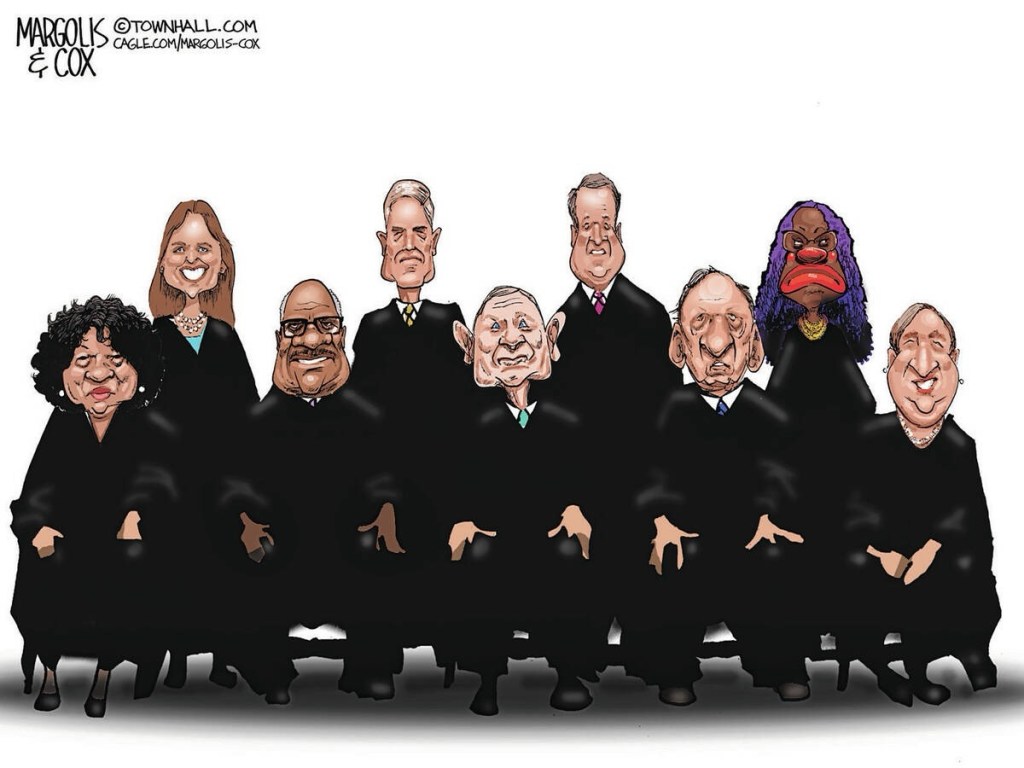
It has been another remarkable week at the Supreme Court, as the justices wrapped up their term by issuing a flood of decisions that will shape American life for years to come. Whether you celebrate or condemn any individual ruling, there is an undeniable pattern emerging: the foundation of the rule of law feels increasingly fractured.
The Supreme Court occupies a unique place in our government. Unlike Congress or the White House, it is supposed to be the non-political branch. The justices aren’t elected. They don’t campaign. They don’t answer to voters every two or four years. Their legitimacy rests on one thing alone: the public’s belief that they are interpreting the law—not advancing a political agenda.
During his confirmation hearings, Chief Justice John Roberts famously compared the job of a judge to an umpire whose responsibility is simply to “call balls and strikes.” It was a reassuring analogy. Umpires don’t decide who they want to win. They don’t change the strike zone depending on who’s at bat. They apply the rules consistently.
Unfortunately, that’s becoming harder and harder to see.
Even before issuing opinions, the Court makes ideological choices simply by deciding which cases deserve its attention. This term provides several examples.
One recent decision involved limiting legal avenues against companies whose Roundup-style herbicides have been linked by some plaintiffs to cancer. Whether those claims ultimately succeed should be determined through evidence, expert testimony, and the judicial process. Yet the perception left behind is troubling: a powerful corporation appears to receive greater protection than ordinary citizens seeking their day in court.
The message many Americans hear is simple: corporations seem to have more rights than people.
Then there was the case involving transgender girls participating in girls’ school sports.
However someone feels about that issue, let’s keep it in perspective. We are talking about an extraordinarily small number of student athletes nationwide—likely dozens or perhaps hundreds, not hundreds of thousands. Yet the Supreme Court devoted its attention to resolving one of the nation’s most politically charged cultural debates.
That naturally raises another question: Why this case?
The Court has limited time. It chooses which disputes to hear. When it repeatedly selects cases that align with the country’s biggest ideological battles while many broader issues affecting millions wait in the background, it’s understandable that people begin questioning whether the docket itself reflects philosophical priorities.
Then came the birthright citizenship decision.
The Court ultimately left birthright citizenship intact—for now. That is significant. But what caught my attention wasn’t simply the outcome. It was the fact that the decision wasn’t unanimous.
That raises a question I genuinely struggle to understand.
The Fourteenth Amendment states:
“All persons born or naturalized in the United States, and subject to the jurisdiction thereof, are citizens of the United States…”
Those words are not hidden in a footnote. They are not implied. They are not vague. They are written plainly into the Constitution itself.
Reasonable people can debate taxes, immigration policy, healthcare, education, or foreign affairs. Those involve policy judgments.
But how does one debate whether words explicitly written into the Constitution are constitutional?
I’m not asking sarcastically. I’d truly like to understand the legal reasoning behind the dissent. If the disagreement centers on the phrase “subject to the jurisdiction thereof,” then explain the historical evidence. Explain why more than 150 years of constitutional understanding should be reinterpreted.
That’s how constitutional law is supposed to work.
Instead, it increasingly feels as though desired outcomes arrive first and constitutional reasoning is constructed afterward.
That perception extends beyond any single case. It invites broader questions about constitutional consistency. If some long-settled precedents can be reconsidered because they were, in the Court’s view, wrongly decided, where does that principle stop? Americans naturally wonder which other landmark decisions could someday be revisited, and whether the same interpretive philosophy would apply equally in every circumstance.
The Supreme Court’s authority does not come from elections, campaign rallies, or political popularity. It comes from public confidence that the justices are applying the Constitution faithfully and consistently, regardless of who benefits politically.
That trust is incredibly difficult to earn and remarkably easy to lose.
Our Constitution has survived civil war, world wars, economic collapse, social upheaval, and enormous political disagreements because Americans generally accepted that the words themselves mattered. Amendments could be added. Laws could be changed. But until they were, the Constitution remained the highest law of the land.
If judges begin treating constitutional text as endlessly malleable depending on the political climate—or if the public comes to believe that ideology determines which cases are heard and how they’re decided—then the Constitution risks becoming less a governing document and more a collection of suggestions.
That should concern conservatives, liberals, independents, and everyone in between.
Because once we decide that clear constitutional language can mean almost anything, it eventually means almost nothing.
The rule of law isn’t about winning today’s case. It’s about preserving tomorrow’s confidence that the same rules will still apply, regardless of who occupies the White House, who controls Congress, or who sits on the Supreme Court.
Without that shared confidence, the strongest democracy in the world develops cracks in its foundation.
History teaches us that foundations rarely collapse all at once.
They fail one crack at a time.

