Dwain Northey (Gen X)
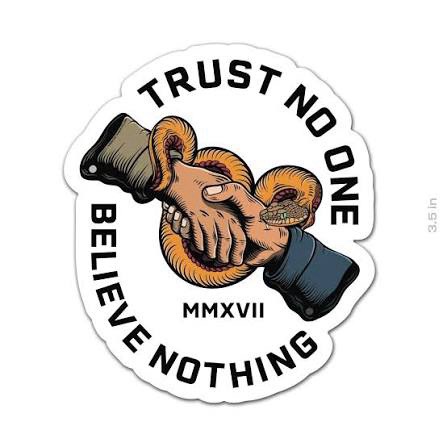
Somewhere Between Blind Faith and Permanent Suspicion
Human beings have always lived on a spectrum. At one end are the people who believe everything they’re told. At the other are those who believe absolutely nothing. Neither position is healthy, yet both seem to be growing more common.
Some people have adopted the philosophy of “Question everything. Trust nothing.” It sounds intelligent. It sounds rebellious. It sounds like the kind of slogan you’d find on a T-shirt next to a wolf howling at the moon, right above a quote that was probably never said by Einstein.
The problem is that, taken literally, it eventually becomes a prison.
Science itself exists because someone questioned accepted wisdom. If nobody had questioned Aristotle, we’d still believe heavier objects fall faster. If nobody questioned the Earth-centered universe, we’d still think the Sun revolves around us. Every scientific breakthrough begins with skepticism.
But science doesn’t stop at asking questions.
It demands evidence.
That’s the part many people conveniently skip.
A scientist asks, “How do we know this is true?” Then spends years gathering data, testing hypotheses, inviting criticism, and trying to prove themselves wrong. Good science welcomes challenges because the goal isn’t winning an argument—it’s getting closer to reality.
Conspiracy thinking works in exactly the opposite direction.
It starts with the conclusion that everyone is lying.
Then every piece of evidence becomes proof of the lie.
If experts agree, they’re colluding.
If they disagree, they’re creating confusion on purpose.
If there’s no evidence, that’s because it was destroyed.
If there is evidence, it’s fake.
It’s a wonderfully efficient system. The answer is always the same, regardless of the facts.
Ironically, people who proudly proclaim they “trust no one” often end up trusting the least trustworthy people on Earth. They’ll reject decades of peer-reviewed research but will absolutely believe a guy livestreaming from his pickup truck wearing mirrored sunglasses, explaining how the moon landing was filmed in his cousin’s garage.
Apparently everyone is lying except the fellow whose profile picture is an eagle wrapped in the American flag.
Meanwhile, on the opposite end of the spectrum are those who never question anything. Every headline is true. Every politician is honest. Every commercial is completely accurate. Every celebrity endorsement is heartfelt. Every chain email from Aunt Martha is apparently breaking news.
Blind trust isn’t wisdom either.
History is filled with governments lying, corporations covering things up, religious institutions making mistakes, and powerful people abusing trust. Healthy skepticism isn’t cynical—it’s necessary.
But healthy skepticism is very different from pathological suspicion.
Questioning everything while trusting nothing eventually leads to believing almost anything.
That sounds backwards, but it isn’t.
Once you’ve decided every established source is corrupt, you’ve removed every filter separating credible information from fantasy. Suddenly, the wildest explanation seems just as reasonable as the ordinary one because you’ve declared all evidence equally suspicious.
That’s how rabbit holes become sinkholes.
One conspiracy leads to another.
Then another.
Before long, every weather forecast is a government plot, every disease was engineered in a secret underground laboratory, every historical event was staged, every famous person was secretly replaced, and somewhere a billionaire, three aliens, and a medieval secret society are apparently holding weekly planning meetings.
Living in that constant state of suspicion has to be exhausting.
Imagine waking up every morning convinced every news story is fake, every scientist is lying, every election is rigged, every medical breakthrough is poison, every weather event is manufactured, and every institution is secretly controlled by unseen puppet masters.
At some point you’ve stopped questioning reality and simply started writing fan fiction about it.
There has to be a healthier middle ground.
Question claims.
Verify sources.
Compare evidence.
Accept that you might be wrong.
Trust—but not blindly.
Question—but not compulsively.
Recognize that some institutions deserve criticism while others have earned credibility through transparency, expertise, and a long history of getting far more right than wrong.
The goal isn’t to trust everyone.
The goal isn’t to trust no one.
The goal is to become a better judge of who and what deserves your trust.
That requires humility because every one of us has been fooled at some point. Every one of us has believed something that later turned out to be false. Intelligence isn’t measured by never making mistakes. It’s measured by being willing to admit them and move on instead of doubling down because your ego won’t let you exit the rabbit hole.
Perhaps that’s the lesson we’ve forgotten.
Questioning should be a path toward understanding, not an identity.
Skepticism should be a tool, not a personality trait.
And trust should be earned—not automatically given, but not permanently withheld either.
Somewhere between believing everything and believing nothing is the place where reason actually lives.
It’s admittedly less exciting than imagining you’ve uncovered the greatest conspiracy in human history while sitting in your recliner watching YouTube.
But it’s a much healthier place to build a life.

