Dwain Northey (Gen X)
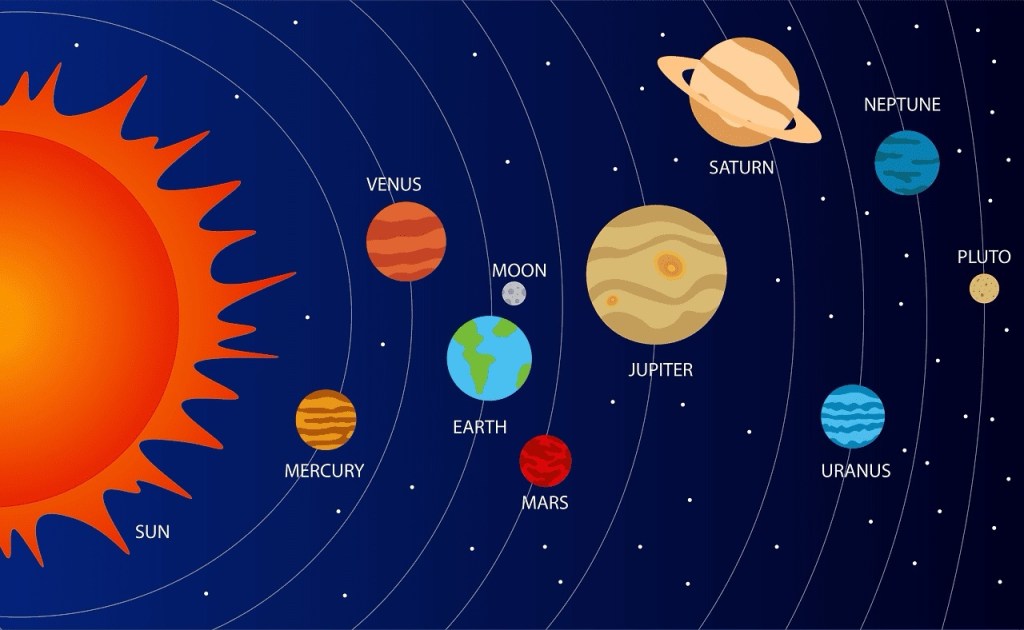
Before telescopes pierced the darkness, before rockets left Earth’s atmosphere, before a single human being set foot beyond our own world, we had already done something remarkable: we named everything.
Mercury. Venus. Earth. Mars. Jupiter. Saturn. Uranus. Neptune.
But here’s the question that keeps nagging at me: Who gave us the authority to do that?
Who granted humanity dominion over an entire solar system?
We often talk about naming things as though it is the most natural act in the world. Parents name children. Scientists name newly discovered species. Explorers have historically named mountains and rivers—often ignoring the names that indigenous people had used for thousands of years. Naming has always been one of humanity’s quiet ways of claiming ownership.
The planets are no different.
Our names come largely from Roman mythology. Mercury, the swift messenger. Venus, the goddess of love. Mars, the god of war. Jupiter, king of the gods. Saturn, the ancient titan. Uranus traces back to Greek mythology, and Pluto continued the tradition when it was discovered. Yet sitting quietly among these mythological figures is one glaring exception.
Earth.
Where did that come from?
It seems almost out of place. We have an entire family of worlds named after ancient gods, and then suddenly there’s… Earth. Not a deity. Not a mythological figure. Just a simple Germanic word that essentially means “the ground” or “the soil.”
I’ve always found that fascinating. We looked to the heavens and filled them with gods, but when it came to our own home, we simply called it dirt.
Perhaps that’s because ancient people weren’t standing on a planet in their minds—they were standing on the ground beneath their feet. They didn’t need a grand celestial name because Earth wasn’t just another object in the sky. It was home. Only later, when we realized it was another planet orbiting the Sun, did “Earth” become the odd one out among its mythological neighbors.
Watching John Carter made me think about this from a different perspective. The people of Mars don’t call their world Mars. They call it Barsoom. Earth is Jasoom. Suddenly you’re forced to realize something profound: names are a matter of perspective. If another civilization existed, why would they use our Roman mythology? Why would they care about Jupiter or Venus? To them, our carefully constructed map of the heavens would probably seem just as arbitrary as theirs would seem to us.
Imagine making first contact with an intelligent civilization.
“We come from Earth.”
“You mean… Jasoom?”
“No, Earth.”
“Never heard of it.”
Neither of you would be wrong. You would simply be using different labels for the same reality.
It raises an even bigger philosophical question. Humans often speak as though the solar system belongs to us. We talk about colonizing Mars, mining asteroids, harvesting the moons of Jupiter, and building bases on Saturn’s moons. We speak with astonishing confidence, as though someone handed us the deed to the neighborhood.
But who did?
Who decided this collection of planets, moons, comets, and asteroids belonged to one species that evolved on a single tiny rock orbiting an average star?
From a cosmic perspective, we’re newcomers. If the history of the universe were compressed into a single calendar year, humanity wouldn’t arrive until the final seconds before midnight on December 31. Yet in those few seconds we’ve already named every planet, drawn imaginary borders in space, and begun discussing which worlds we’ll someday possess.
That seems like extraordinary confidence.
Perhaps even extraordinary arrogance.
Maybe names aren’t ownership. Maybe they’re simply tools that help us communicate. There’s nothing inherently wrong with calling a planet Mars any more than there’s anything wrong with calling our own world Earth. Every language gives the universe its own vocabulary.
But vocabulary has a funny habit of becoming authority.
Once we name something, we often begin to believe we understand it. Once we map it, we begin to think it belongs to us. Once we plant a flag, we act as though the universe acknowledged our claim.
The universe, however, has remained conspicuously silent.
Perhaps that’s the lesson hidden in stories like John Carter. Every civilization sees the cosmos through the lens of its own culture. Every civilization has its own myths, its own languages, and its own maps of the heavens. Ours just happens to be rooted largely in Roman mythology—with one wonderfully ordinary exception.
Our home isn’t named after a god.
It’s named after the ground beneath our feet.
So the next time you hear someone casually refer to Mercury, Venus, Earth, Mars, Jupiter, Saturn, Uranus, or Neptune, it might be worth asking a simple question:
Are those the planets’ names… or are they merely humanity’s names?
Because those are two very different ideas.
And if we ever discover we’re not alone, we may find that our greatest surprise isn’t that someone else exists.
It may be discovering that, in the grand conversation of the cosmos, we’ve been calling the neighbors by the wrong names all along.

