Dwain Northey (Gen X)
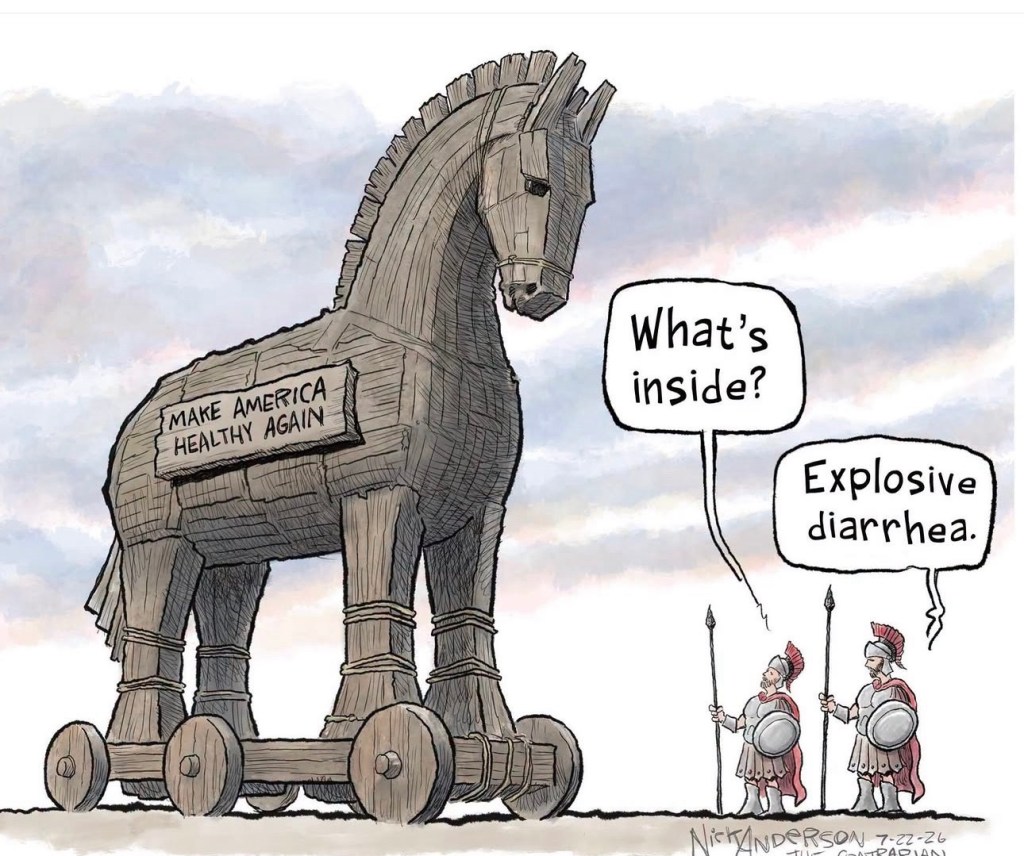
There is an old saying that government is only noticed when it fails. Most of the time, Americans never think about the inspectors examining food processing plants, the scientists tracking disease outbreaks, or the countless public servants whose job is to prevent disasters before they ever reach our dinner tables. Their success is invisible because nothing happens. But when those safeguards are weakened, suddenly everyone notices.
That is why the recent concerns over contaminated vegetables should serve as a reminder that government agencies are not abstract bureaucracies. They perform real-world functions that protect all of us. Food safety isn’t partisan. Neither are bacteria.
Donald Trump and Elon Musk have repeatedly championed shrinking the federal workforce and reducing the size of government. Supporters celebrate these efforts as cutting waste, but there is a fundamental question that deserves to be asked: at what point do efficiency cuts become cuts to the very systems that keep Americans safe?
Food inspectors, epidemiologists, laboratory scientists, and public health investigators are not luxuries. They are the people who identify contaminated products, trace outbreaks, issue recalls, and stop illnesses from spreading further. When agencies lose experienced personnel, every remaining employee is expected to do more with less. Eventually, something gives.
The troubling part is that food safety is only one example.
If agencies responsible for protecting our food can be weakened, what comes next? Will the next consequence involve air safety? Environmental monitoring? Disaster response? Tax enforcement? Medical research? Consumer protection? Government is a vast network of interconnected responsibilities, and weakening one piece often creates ripple effects throughout the entire system.
Healthcare oversight raises another concern. The Department of Health and Human Services oversees issues affecting hundreds of millions of Americans. Its leadership influences responses to disease outbreaks, vaccine policy, public health emergencies, medical research, and healthcare programs. These are positions that require informed, evidence-based decision-making because the consequences affect every family in the country.
Americans should expect competence from those entrusted with public health. This should never be viewed as a partisan expectation. Regardless of political affiliation, the person overseeing the nation’s health infrastructure should inspire confidence through expertise, respect for science, and the ability to manage complex public health challenges.
The irony is that many people who call government ineffective are often the same people applauding when government is stripped of the very resources that allow it to function effectively. It’s a self-fulfilling prophecy: reduce funding, eliminate experienced staff, watch performance decline, and then point to that decline as evidence that government never worked in the first place.
Most Americans never thank the inspector who prevented contaminated produce from reaching grocery shelves. They never know the scientist who identified a dangerous pathogen before it spread nationwide. They never meet the epidemiologist who traced an outbreak back to its source.
But when those people are gone, we notice.
Government isn’t supposed to be invisible because it does nothing. It’s supposed to be invisible because it’s doing its job so well that most of us never have to think about it. Weakening the institutions that quietly protect our health may save dollars on a budget spreadsheet today, but the costs can become painfully obvious when they show up on tomorrow’s dinner plate.

