Dwain Northey (Gen X)
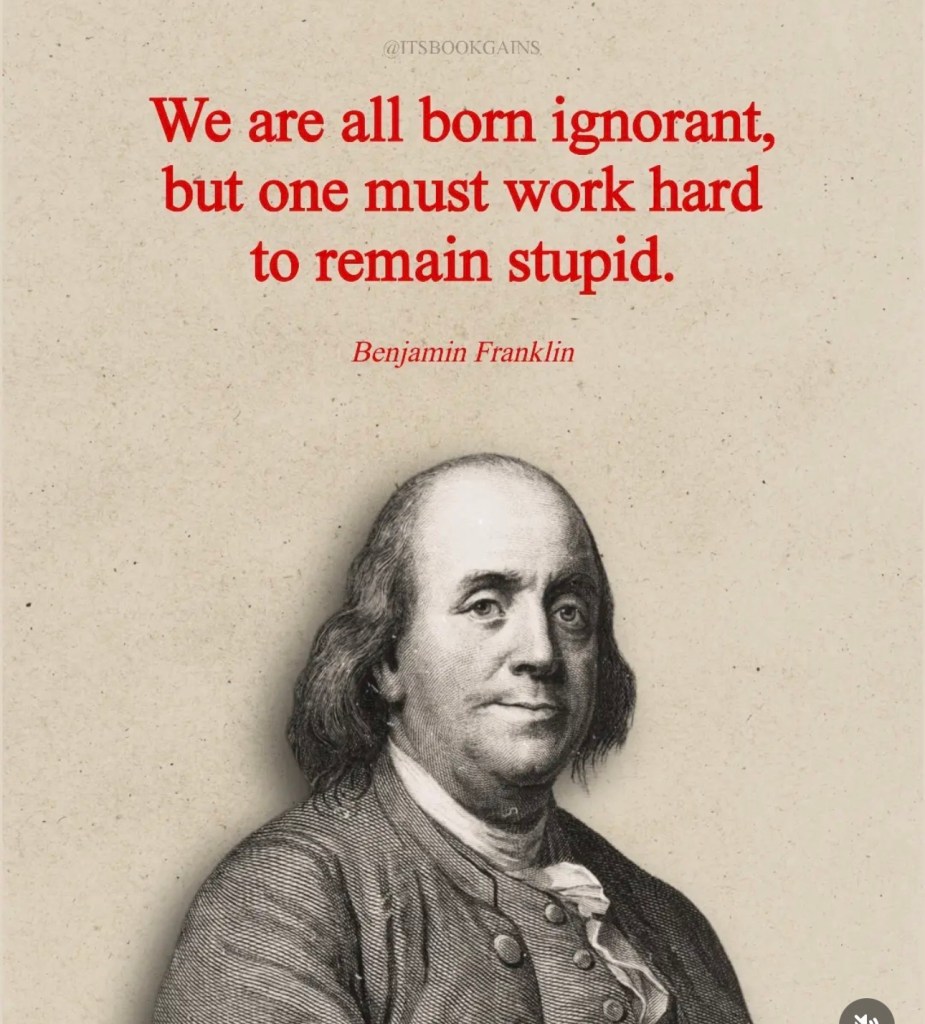
One of the things that has always fascinated me about social media is how easily a quote can be attached to a famous name. Benjamin Franklin, Mark Twain, Winston Churchill, Albert Einstein—you can find them all saying things they almost certainly never said. Every time I see one of these quotes on Facebook or Instagram, I have the same question: Did they actually say that, or did someone simply decide it sounded profound if Benjamin Franklin’s name was attached to it?
One quote in particular has stuck with me, whether Franklin actually said it or not:
“We are all born ignorant, but one must work hard to remain stupid.”
Whether those are Benjamin Franklin’s words or someone else’s, the sentiment is brilliant.
Think about it. Every single one of us enters this world ignorant. That’s not an insult. It’s a fact. A newborn knows absolutely nothing. Ignorance simply means a lack of knowledge. It isn’t a moral failing, and it certainly isn’t permanent. We spend our entire lives replacing ignorance with experience, education, curiosity, and discovery.
Stupidity is something entirely different.
Stupidity isn’t not knowing something. Stupidity is refusing to learn after the evidence is staring you in the face. It’s rejecting information because it challenges your beliefs. It’s deciding that your opinion matters more than facts. Remaining ignorant in the age of libraries, universities, documentaries, and a device in your pocket with access to nearly all of humanity’s knowledge—that takes effort.
I’ve noticed something else over the years.
If you tell someone they’re ignorant about a subject, many immediately respond, “So you’re calling me stupid?”
No.
I’m calling you ignorant.
There’s a huge difference.
If someone doesn’t know how an engine works, they’re ignorant about engines. If someone has never studied astronomy, they’re ignorant about astronomy. If someone doesn’t understand economics, medicine, or history, they’re ignorant in those fields. We all are. Every one of us is ignorant about thousands of subjects because no one can know everything.
Ignorance is fixable.
All it takes is curiosity.
But if I explain that distinction, provide evidence, answer questions, and someone still insists on believing something because it feels better than reality, then we’ve crossed into different territory.
At that point, if you insist that being called ignorant is the same as being called stupid, you’ve made the leap yourself.
As I sometimes tell people, “If I say you’re ignorant and you think I’m calling you stupid, then now I am calling you stupid.”
Not because you lacked knowledge.
Because you rejected the opportunity to gain it.
Perhaps that’s why that quote—whether it belongs to Benjamin Franklin or not—resonates so deeply. It reminds us that ignorance is the default setting for every human being. None of us chooses where we begin.
What we do choose is whether we keep learning.
In an era where answers are available within seconds, remaining uninformed isn’t nearly as understandable as it once was. We have more access to knowledge than any generation in human history. The real challenge today isn’t finding information.
It’s having the humility to admit when we don’t know something and the courage to learn.
That’s the difference between ignorance and stupidity.
One is simply where we all start.
The other is a decision.

