Dwain Northey (Gen X)
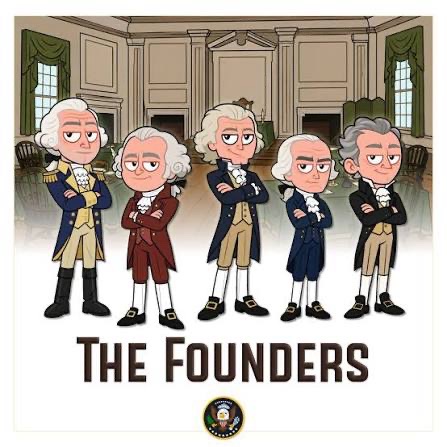
America has a curious habit of turning its Founding Fathers into marble statues. We quote them, invoke them, and claim to know exactly what they intended more than two centuries ago. But when you actually study the men themselves, you discover something far more interesting. They weren’t ideological robots. They were deeply flawed, often contradictory, and constantly arguing among themselves. They disagreed about government, economics, religion, and even what the Constitution should become.
Thomas Jefferson is perhaps the greatest example of that complexity.
Jefferson wrote in the Declaration of Independence that “all men are created equal.” It remains one of the most powerful statements about human liberty ever written. Yet Jefferson himself owned enslaved people throughout much of his life. That contradiction is impossible to ignore. Some dismiss him as a hypocrite, while others excuse it entirely because of the time in which he lived. Reality is more uncomfortable than either extreme. Jefferson articulated ideals that exceeded the society in which he lived, but he never fully lived up to those ideals himself.
History is often like that. Great ideas sometimes come from imperfect people.
Jefferson also held another belief that seems almost forgotten today. He argued that each generation should have the right to govern itself rather than be permanently bound by the decisions of previous generations. He suggested that constitutions should be revisited—and perhaps even rewritten—roughly every generation so that government would reflect the needs, circumstances, and values of the living rather than the dead.
Whether one agrees with that proposal or not, it reveals something important about Jefferson’s philosophy. He did not see the Constitution as a sacred relic frozen in time. He saw it as a living framework designed to serve the people, not the other way around.
Contrast that with much of today’s constitutional debate.
Many modern constitutional originalists or textualists argue that judges should interpret the Constitution according to its original public meaning or the text itself rather than evolving societal values. Their goal is to prevent judges from simply imposing their own policy preferences. That philosophy has a coherent legal rationale, even if many Americans disagree with how it is applied.
But there is an irony worth considering.
One of the principal architects of America’s founding believed that future generations should reshape their governing document as society evolved. If Jefferson himself expected constitutional change to be a recurring feature of American democracy, then treating every word as permanently fixed raises an interesting historical question. Are we honoring the Founders by refusing to reconsider their work, or are we overlooking the fact that at least some of them expected future Americans to do exactly that?
The Founders themselves certainly were not unanimous. Alexander Hamilton envisioned a stronger central government than Jefferson preferred. James Madison changed his views over time. Benjamin Franklin admitted that no constitution could ever be perfect. These men argued fiercely with one another because they understood that governing a free people required constant debate rather than unquestioning certainty.
Perhaps that is the greatest lesson they left us.
The Founding Fathers were not asking to be worshipped. They were asking to be understood.
They knew they were creating an experiment, not writing scripture.
The Constitution itself contains an amendment process because its authors recognized that no generation possesses perfect wisdom. The document was designed to endure, but it was also designed to change when enough of the nation agreed that change was necessary.
Maybe we’ve lost sight of that balance.
Instead of trying to imagine what the Founders would think about every modern issue, perhaps we should emulate what they actually did. They questioned inherited ideas. They challenged existing systems. They debated vigorously. They compromised when necessary. They revised their own assumptions.
In other words, they behaved less like constitutional purists and more like practical problem-solvers.
The greatest tribute we can pay the Founders may not be pretending they all agreed with us. It may be recognizing just how complicated they really were—and accepting that they expected America to keep evolving long after they were gone.

