Dwain Northey (Gen X)
The Great American Brain Drain
For generations, the United States didn’t have to convince the smartest people in the world to come here. They practically begged.
If you were a brilliant engineer from India, a physicist from Germany, a medical researcher from South Korea, or a graduate student from Brazil, America was the destination. This was where the money was. This was where the laboratories were. This was where governments invested in the future instead of pretending the future was some communist conspiracy.
We built the internet. We landed on the Moon. We decoded DNA. We pioneered organ transplants, microprocessors, GPS, advanced aerospace, and enough Nobel Prize-winning research to make the rest of the world collectively sigh and mutter, “Well…of course it happened in America.”
Why?
Because we believed science was an investment.
Today?
Apparently we’ve decided science is just another political party.
We’ve declared war on universities. We’ve declared war on renewable energy. We’ve declared war on climate science. We’ve declared war on vaccines. We’ve declared war on public health. Half the country now hears the word “research” and immediately assumes someone is trying to steal their gas stove.
Nothing screams “world leader” quite like being terrified of windmills.
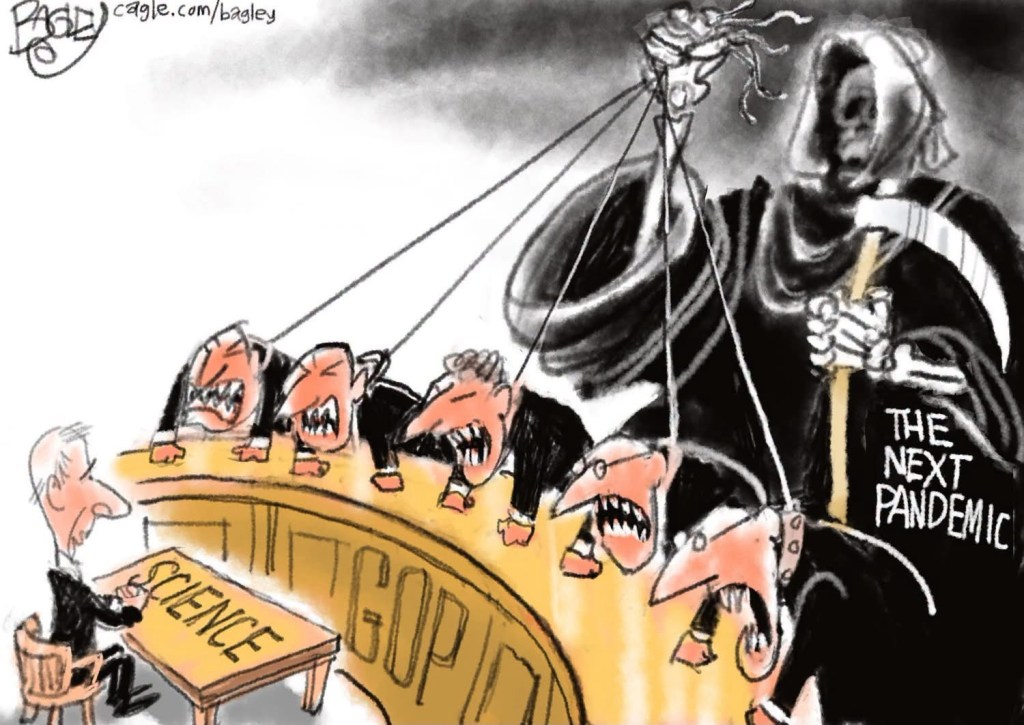
Meanwhile, Congress seems determined to make sure every scientist watching C-SPAN is updating their résumé.
Imagine you’re a brilliant twenty-five-year-old virologist finishing your doctorate. You have job offers from Europe, Canada, Japan, Australia, and the United States.
In one country you’ll be funded.
In another you’ll be celebrated.
In another you’ll have access to cutting-edge facilities.
And in America, there’s a decent chance you’ll spend the next decade getting subpoenaed by politicians who think YouTube comments count as peer review.
What a recruiting slogan.
Then there’s Dr. Anthony Fauci. Whether you agreed with every recommendation he made during COVID or not, the man devoted decades of his life to infectious disease. Long before COVID, he played a central role in advancing research that transformed HIV from what was almost certainly a death sentence into a chronic, manageable disease for millions of people.
That’s a career most scientists would dream of.
Yet here he is, years after the pandemic, still being dragged before congressional committees as though he personally invented viruses in his garage between episodes of Jeopardy!
The irony is almost painful.
COVID was caused by a novel virus.
And since “novel” has apparently become another dirty word, here’s a refresher from high school biology: novel means new.
New virus.
New disease.
New information.
Which means scientists do what scientists have always done.
They observe.
They develop hypotheses.
They test those hypotheses.
They collect more data.
Then—and this is apparently the scandal—they change their conclusions when better evidence becomes available.
That’s not incompetence.
That’s literally the scientific method.
If your doctor treated you today using only the medical knowledge available in 1957, you’d sue them before you even got home.
Yet somehow we’ve convinced millions of Americans that changing recommendations in response to new evidence is proof that scientists were lying all along.
No.
It’s proof they were doing science.
Masks weren’t magic. Vaccines weren’t perfect. Recommendations evolved because the evidence evolved.
Reality isn’t a campaign slogan. It doesn’t care what cable news says.
What worries me isn’t Anthony Fauci.
He’ll be remembered by history far more kindly than many of the people yelling at him.
What worries me is the message we’re sending to every young scientist watching.
Come to America.
Where your funding might disappear because an election changed.
Where decades of research can be canceled because it contains words politicians don’t like.
Where your expertise will lose an argument to a podcast host with a webcam.
Where Congress treats Nobel-level researchers like hostile witnesses but welcomes corporate lobbyists with open arms.
That’s not exactly the sales pitch that built Silicon Valley.
It’s certainly not the sales pitch that built the NIH, the CDC, NASA, or the national laboratories.
There was a time when the brightest minds wanted government service because it meant serving humanity.
The CDC existed to stop outbreaks.
The NIH existed to cure disease.
NASA existed to push humanity forward.
Civil servants weren’t trying to become celebrities. They weren’t trying to maximize shareholder value. They were trying to solve problems that affected millions of people they would never meet.
Imagine that—a career built around helping strangers.
How quaint.
Instead, we’ve entered an era where expertise itself is viewed with suspicion.
Scientists are “elitists.”
Professors are “indoctrinators.”
Researchers are “activists.”
Meanwhile, the loudest voices often belong to people who think spending twenty minutes on social media somehow makes them equivalent to someone who spent twenty years studying immunology.
It’s hard to compete with that level of confidence.
The tragedy isn’t that America will stop producing brilliant scientists.
We always will.
The tragedy is that they may decide to build the next breakthrough somewhere else.
Science doesn’t require an American passport.
Innovation doesn’t owe allegiance to a flag.
Talent goes where it’s welcomed.
Investment goes where it’s valued.
Discovery goes where curiosity isn’t treated like a political liability.
Gen Z and Gen Alpha may inherit an America that still insists it’s the greatest nation on Earth while quietly importing fewer great ideas because we’ve made it abundantly clear that evidence is optional and expertise is negotiable.
We used to compete to attract the smartest people in the world.
Now we’re competing to see who can make them leave first.
That’s not making America great.
That’s making America irrelevant.

