Dwain Northey (Gen X)
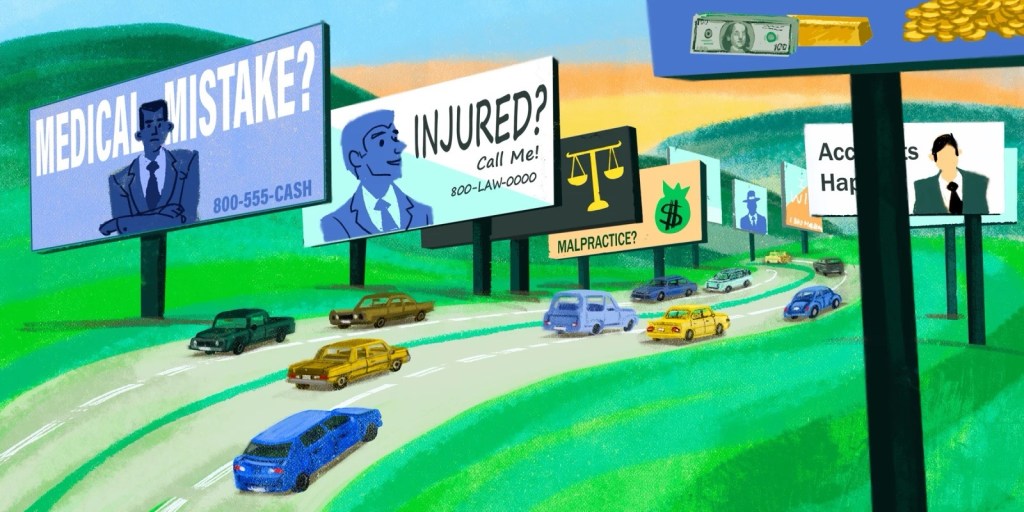
I drive every day. And because apparently the American highway system has decided that my commute should also be a continuing-education course in personal injury law, I see accident attorney billboards everywhere.
Everywhere.
You have the husband-and-wife law firm. You have the guy with the giant head. You have the woman pointing at you like she just caught you stealing a candy bar. You have the attorneys standing dramatically in front of a courthouse. You have slogans that apparently passed through seventeen focus groups and one very caffeinated marketing consultant.
INJURED? CALL US!
WE FIGHT FOR YOU!
DON’T SETTLE!
And, of course, the phone number is approximately 14 feet tall.
Which brings me to the question my sarcastic brain inevitably asks:
Who goes to law school with the dream of eventually having their face on a billboard?
Seriously.
At some point in college, somebody sits down with a career counselor and says, “I’ve given this a lot of thought. I want to become an attorney.”
“Wonderful. What area of law interests you?”
“Well, eventually I’d like my face to be 30 feet tall next to Interstate 17.”
Ah. The dream.
Years of undergraduate education. Law school. Bar exam. Student loans. Internships. Research. Case law. Briefs. Courtrooms.
All so you can eventually stand next to a highway wearing a suit while twelve thousand commuters stare at your giant disembodied head every morning.
That is some serious ambition.
And then there’s another question I’ve always wondered about:
Why do some highways have so many accident attorney billboards?
Is it because there are a lot of accidents?
Or are there a lot of accidents because there are so many accident attorney billboards?
I realize this is probably not how causality works, but hear me out.
You’re driving down the highway and every 500 feet there’s another billboard screaming:
ACCIDENT? YOU MAY BE ENTITLED TO MONEY!
Then another:
INJURED? DON’T TALK TO THE INSURANCE COMPANY!
Then another:
YOU COULD BE OWED MILLIONS!
At some point I’m wondering whether we’ve accidentally turned the highway into a financial incentive program.
“Please maintain a safe following distance.”
Sure.
But also…
What if I get rear-ended?
Maybe that’s my retirement plan.
Forget 401(k)s. Forget Social Security. Forget investing.
I could just get T-boned at 45 miles an hour and hope the other guy has really good insurance.
Apparently, getting into an automobile accident has evolved from being one of the worst things that can happen to you into a potential income opportunity.
And I’m not suggesting anyone should actually want to get hurt. Obviously. An accident can be traumatic, expensive, life-altering and sometimes fatal.
But the cultural messaging surrounding accidents is fascinating.
We have somehow created an entire industry whose advertising message is essentially:
“Congratulations! You got hit by a truck! Let’s see what we can get you.”
There is something profoundly weird about that.
We’ve become so litigious that every unfortunate event now seems to come with a corresponding legal marketing campaign.
Slip on a wet floor?
Call somebody.
Get rear-ended?
Call somebody.
Trip over a sidewalk?
Call somebody.
Look at a ladder wrong?
There is probably an attorney standing behind a billboard waiting for you.
And the billboards themselves have become so ubiquitous that I barely notice them anymore. They’re just part of the American landscape now.
Exit signs.
Gas stations.
Fast food.
Motel.
ATTORNEY.
It’s almost like roadside scenery.
And here’s where my brain starts wandering into the truly ridiculous question:
When did getting into an accident become part of someone’s retirement strategy?
Because somewhere along the line, we seem to have embraced the idea that if something bad happens to you, the first question shouldn’t necessarily be, “How do we fix this?”
It should be:
“How much is this worth?”
That is a pretty extraordinary cultural shift.
We don’t just experience misfortune anymore.
We monetize it.
And lawyers aren’t entirely responsible for this, of course. Insurance companies, corporations, medical billing, questionable business practices and our entire adversarial legal system all play a role.
But the sheer scale of the personal-injury advertising machine is fascinating.
There are apparently enough attorneys competing for accident victims that they have to purchase enormous pieces of real estate along our highways just to remind us that they’re available.
Imagine being the attorney who has to explain the marketing budget.
“Why did we spend $400,000 putting your face on billboards?”
“Because apparently people don’t know I’m a lawyer.”
“Did you try having a website?”
“No.”
“Social media?”
“No.”
“Television?”
“No.”
“So…”
“BILLBOARD.”
And not just one.
No, apparently the ultimate measure of legal success is billboard saturation.
Because if I can drive from one side of town to the other without seeing your face at least six times, are you even really an attorney?
Maybe that’s the next bar association requirement.
Pass the bar exam?
Check.
Character and fitness evaluation?
Check.
Twenty hours of continuing legal education?
Check.
Minimum of six highway billboards?
Congratulations. You’re officially practicing law.
And the funniest part is that these billboards have become so normalized that nobody even questions the underlying absurdity anymore.
We just accept that driving to work means being surrounded by enormous advertisements reminding us that our next fender-bender could potentially be the financial event of our lives.
Which leaves me with one final question:
Are we driving on highways, or are we driving through a gigantic legal vending machine?
Because somewhere between the exit ramp and the next red light, there’s apparently a lawyer waiting to turn my misfortune into a case number.
And somewhere, some law student is currently dreaming about the day when they can finally say:
“I made it.”
Not because they argued a landmark constitutional case.
Not because they changed the legal system.
Not because they defended the innocent or secured justice for somebody who desperately needed it.
No.
Because they drove past their own face on the interstate.
Now that’s the American Dream.

