Dwain Northey (Gen X)
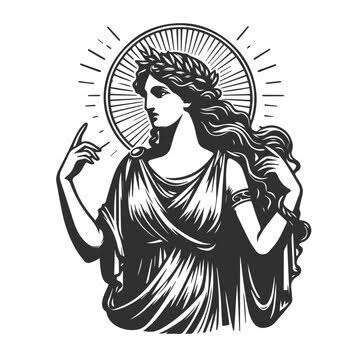
What If the Gods Had Been Goddesses?
Imagine, just for a moment, that history had taken a completely different turn.
Imagine that when the ancient Greeks looked toward Mount Olympus, the most powerful figures weren’t Zeus, Poseidon, and Hades, but goddesses representing love, knowledge, wisdom, intuition, creation, and perhaps even mercy. Imagine that the supreme divine authority wasn’t embodied primarily in the thunderbolt, the trident, and the underworld, but in the ideas of understanding, relationship, learning, and preservation.
Now go one step further.
Imagine that Genesis had placed Eve—not Adam—at the center of humanity’s creation story. Eve was made in the image of God. Eve was the first human being. Eve was the archetype from which humanity understood itself.
Imagine that the great stories of the Bible had followed the same pattern. Noah was Noah, but she was a woman. Moses was Moses, but she was a woman. Abraham was Abraham, but she was a woman. The prophets were women. The apostles were women. And Jesus—the central figure of Christianity—was a woman.
Not because men had been eliminated. Not because women had become the oppressors and men the oppressed.
Simply because, at some foundational point in human history, civilization had decided that the feminine was not secondary.
What kind of world might that have produced?
Of course, this is a thought experiment, not a claim that women are inherently peaceful and men are inherently violent. History doesn’t permit anything nearly that simple. Women have participated in wars, supported authoritarian regimes, and committed terrible acts. Men have been extraordinary teachers, caregivers, philosophers, pacifists, and advocates for peace.
But there is something fascinating about asking what happens when the default archetypes of power change.
Because mythology matters.
Religion matters.
The stories a civilization tells about its gods and heroes become part of the psychological architecture of that civilization. They teach us what greatness looks like.
And look at some of the ancient world’s most powerful male archetypes.
Zeus throws lightning.
Poseidon commands the seas.
Ares represents war.
Kings conquer.
Heroes slay monsters.
Empires expand.
The language of power becomes remarkably physical: territory, domination, conquest, victory.
Now imagine that the civilization’s highest divine archetypes were instead centered around knowledge, love, intuition, fertility, healing, creation, and preservation.
What would children learn when they were taught what greatness meant?
Perhaps greatness wouldn’t necessarily mean defeating someone.
Perhaps it would mean understanding something.
Perhaps wisdom would be considered more impressive than conquest.
Perhaps the greatest person in the room would be the person who could prevent a war rather than the person who could win one.
And that distinction is enormous.
Human civilization has spent thousands of years constructing an almost absurd equation between masculinity and power. The warrior became the hero. The conqueror became the king. The general became the statue in the square.
We built monuments to men on horseback.
We named ships after battles.
We named cities after emperors.
We celebrated borders expanding as though geography itself were keeping score.
And then we wondered why humanity kept going to war.
What if our oldest stories had taught us something different?
What if the ultimate act of heroism wasn’t killing Goliath but convincing Goliath that nobody needed to die?
What if Moses’ greatest accomplishment wasn’t leading people out of Egypt through divine intervention, but creating a society where nobody had to become Pharaoh?
What if the great biblical moral authority wasn’t a male prophet descending from a mountain with commandments, but a woman whose defining characteristic was her ability to understand the human consequences of those commandments?
And what if Jesus had been a woman?
That one change alone would have been an earthquake beneath Western civilization.
Imagine Christianity developing around the image of a female savior whose defining teachings emphasized compassion, forgiveness, humility, love of one’s enemy, care for the poor, and rejection of worldly power.
Imagine generations of children being told that God had chosen a woman to embody divine love.
Suddenly, the sentence “God created humanity in God’s image” would have carried a very different psychological implication.
Women wouldn’t merely have been created by God.
They would have been one of the civilization’s most powerful symbols of God.
And that could have changed everything.
Or perhaps it wouldn’t have.
That’s the uncomfortable part of the thought experiment.
Because changing the gender of the characters doesn’t necessarily change the human beings writing the story.
A patriarchal society could still turn a female deity into an excuse for patriarchal behavior. A woman could still become a tyrant. A female monarch could still wage war. A female religious institution could still accumulate wealth and power.
Humans are remarkably talented at taking beautiful ideas and finding ways to weaponize them.
But perhaps the deeper question isn’t whether women would have magically eliminated war.
It’s whether civilization might have developed a different definition of power.
Consider the difference between domination and influence.
Domination says:
“I have power because you cannot stop me.”
Influence says:
“I have power because you trust me.”
Those are radically different forms of authority.
And perhaps a civilization whose foundational mythology emphasized love, knowledge, intuition, and preservation might have placed greater cultural value on the second.
Maybe the hero wouldn’t be the strongest person.
Maybe it would be the wisest.
Maybe the leader wouldn’t be the person who could make everyone obey.
Maybe it would be the person who could make everyone cooperate.
Maybe intelligence wouldn’t be measured by how effectively someone defeats an opponent, but by how effectively they prevent opponents from becoming enemies in the first place.
And perhaps that would have affected warfare itself.
Wars are rarely started by ordinary people sitting around a table saying, “You know what sounds wonderful? Let’s send our children to die.”
Wars are generally constructed through leadership, ideology, nationalism, fear, resources, territory, revenge, and the glorification of sacrifice.
And someone has to convince millions of people that killing strangers is necessary.
Imagine if the cultural mythology surrounding leadership had made that persuasion more difficult.
Imagine if the most revered leader in history wasn’t remembered for conquering twelve nations but for preventing twelve wars.
Imagine if the greatest monument in every capital wasn’t a general on horseback but a mother embracing the mothers of former enemies.
Imagine if history books devoted entire chapters to treaties that prevented bloodshed rather than merely battles that produced winners.
Maybe we’d still have wars.
Probably.
But perhaps fewer of them.
Or perhaps they would look different.
And there’s another fascinating possibility.
A more matriarchal civilization wouldn’t necessarily have been a world where women ruled men.
The real revolution would be eliminating the assumption that one gender must rule the other at all.
Instead of replacing patriarchy with matriarchy, perhaps humanity could have developed something closer to partnership.
The masculine and feminine would not represent opposing political factions. They would represent complementary dimensions of humanity.
Strength without compassion becomes brutality.
Compassion without strength can become helplessness.
Knowledge without empathy becomes cold calculation.
Intuition without knowledge can become superstition.
Perhaps the ideal civilization would have recognized that humans need all of these things.
And maybe that is the greatest flaw in the way we’ve traditionally constructed our myths.
We’ve often treated power as though it were a scarce resource.
Someone must dominate.
Someone must submit.
Someone must win.
Someone must lose.
But what if power was never supposed to be the ability to stand above everyone else?
What if power was the ability to lift everyone else up?
That’s the civilization I keep imagining when I run this thought experiment to its logical conclusion.
Not a world where women become the new tyrants.
Not a world where men are relegated to some historical apology.
A world where the feminine principles traditionally dismissed as weakness—empathy, intuition, nurturing, cooperation, emotional intelligence, preservation—are recognized as forms of intelligence and power rather than deviations from it.
Because perhaps humanity’s greatest historical mistake wasn’t choosing men over women.
Perhaps it was choosing domination over cooperation.
And maybe that distinction matters more than gender.
We have spent thousands of years worshiping thunderbolts.
Perhaps it was time we tried worshiping wisdom.
We’ve built civilizations around conquest and then congratulated ourselves for becoming civilized.
Maybe civilization begins when winning stops being the highest human achievement.
Maybe the greatest revolution imaginable isn’t putting a woman on a throne.
Maybe it’s finally realizing that the throne itself was never the point.

