Dwain Northey (Gen X)
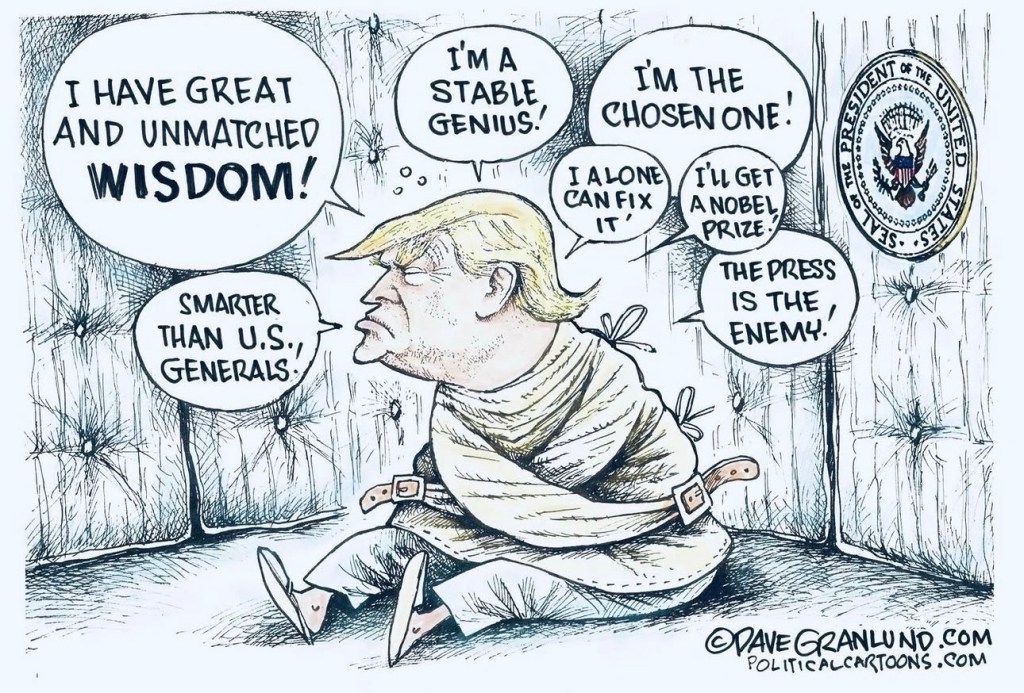
The Man Who Is Never Wrong
There is a peculiar superpower possessed by Donald John Trump that has nothing to do with nuclear weapons, tariffs, executive orders, or the ability to turn a press conference into a three-ring circus.
His superpower is the ability to be wrong without ever actually being wrong.
No matter what happens, somehow Donald Trump is either responsible for the success, the victim of someone else’s failure, or both simultaneously. If something goes well, he did it. If something goes badly, somebody else screwed it up. And if something goes catastrophically badly, well, clearly nobody understands just how brilliant the strategy was supposed to be.
It is a remarkable form of political physics.
The man appears to exist in a universe where accountability is subject to executive privilege.
And that becomes especially dangerous when you surround yourself with people whose careers, salaries, influence, and access to power depend upon telling you that you are doing a fantastic job.
Because eventually, you stop getting advice.
You start getting applause.
And that may be Trump’s greatest problem right now: he has too many toadies at his feet and not enough people willing to tell him that the emperor is, in fact, standing naked in the middle of Fifth Avenue.
The problem with sycophants isn’t merely that they flatter you. The real danger is that they become an information filter between you and reality.
They tell you the polls are wrong.
The generals are wrong.
The economists are wrong.
The journalists are wrong.
The allies are wrong.
The markets are wrong.
The protesters are wrong.
The voters are wrong.
And eventually, apparently, reality itself is wrong.
Meanwhile, Trump continues to take credit for virtually anything that can possibly be spun as a victory while treating failures as if they were delivered to his desk by some disgruntled intern.
That strategy works remarkably well in politics—until reality becomes too large to spin.
And that appears to be where we are now.
Look at Iran.
The administration entered this conflict promising strength, dominance, decisive action and, presumably, some version of the magical Trump formula in which America simply announces that it has won and everyone else politely agrees.
Except wars don’t work that way.
Six months into the conflict, the Strait of Hormuz remains a central problem, oil shipments have been severely disrupted, gasoline prices have risen, and diplomatic efforts are once again consuming enormous amounts of American attention. Reuters reports that tanker traffic through Hormuz has nearly halted and that Trump is now telling Americans to accept higher gasoline prices as a necessary sacrifice. (Reuters)
That is a rather remarkable destination for a president who has spent years promising Americans cheaper energy.
And the irony becomes almost Shakespearean when Trump starts talking about potentially making the Strait of Hormuz American territory.
Because when your original plan is supposed to demonstrate overwhelming American power, and six months later you’re talking about essentially claiming the world’s most important oil chokepoint because you can’t convince the people who control it to cooperate, perhaps the strategy deserves a little less applause and a little more scrutiny.
Even The Washington Post’s editorial assessment this week described the Iran war as a strategic failure, arguing that the initial decapitation strategy did not produce the anticipated collapse of the Iranian regime and that significant threats remain. (The Washington Post)
That’s what happens when the guy in charge is surrounded by people whose primary responsibility appears to be explaining why the guy in charge is never wrong.
And then comes the truly bizarre part.
Trump doesn’t seem to understand the difference between taking responsibility and taking credit.
Those are not the same thing.
A leader takes responsibility when something goes wrong.
A narcissist takes credit when something goes right.
A real leader says, “I made the decision. It didn’t work. Here’s what I learned, and here’s what we’re going to do differently.”
Trump’s political operating system seems to say:
“It worked because I’m a genius. It didn’t work because somebody betrayed me.”
That is not leadership.
That’s an adult version of a toddler insisting he didn’t break the lamp while standing beside the broken lamp holding the baseball.
And the world is watching.
That’s the other problem for Trump now.
You can fool a domestic political audience for a surprisingly long time because American politics has become an industrial-strength propaganda machine. You can find a television network, podcast, social-media account, congressional surrogate or loyal commentator willing to explain almost anything.
But you cannot spin reality to every other country on Earth.
Foreign governments don’t have to watch the campaign rally.
They watch the ships.
They watch the markets.
They watch military deployments.
They watch alliances.
They watch negotiations.
They watch whether threats produce results.
And right now, the world is getting a rather uncomfortable demonstration of the difference between projecting strength and actually possessing strategic competence.
That’s why the situation is becoming so dangerous politically.
The people around Trump can tell him he’s winning.
They can tell him the economy is fantastic.
They can tell him the war is going according to plan.
They can tell him everyone loves him.
They can tell him every problem is somebody else’s fault.
But eventually the president has to confront something Fox News can’t fix, Truth Social can’t fix, and a room full of yes-men can’t fix:
Reality doesn’t care about your approval rating.
Reality doesn’t care how many people clap.
Reality doesn’t care how many times you say “nobody has ever seen anything like this.”
Reality simply sends the bill.
And America is beginning to receive it.
The tragedy isn’t that Donald Trump can’t admit he was wrong.
The tragedy is that the presidency isn’t supposed to be a personality cult in which admitting error is considered a sign of weakness.
Presidents are supposed to have people around them who say, “Sir, I think you’re wrong.”
They are supposed to have generals who can disagree.
Diplomats who can disagree.
Economists who can disagree.
Cabinet officials who can disagree.
Advisers who can say, “This isn’t working.”
Because the most dangerous sentence in government isn’t “Mr. President, I disagree.”
It’s:
“Mr. President, you’re doing a great job.”
Especially when you’re not.
And perhaps the most brutally ironic assessment of the current situation comes from the very people who would ordinarily be considered America’s enemies.
Iran doesn’t need Donald Trump dead to oppose him.
They don’t need to assassinate him.
They don’t need to overthrow him.
They don’t even necessarily need to defeat him militarily.
They can simply let him continue making mistakes.
Why interfere with an opponent who appears perfectly capable of creating his own problems?
That’s the dark punchline.
“We don’t want him dead. He’s doing a remarkably effective job of damaging America all by himself.”
And therein lies the greatest danger of a leader who cannot admit error.
You don’t need someone who hates America to weaken it.
Sometimes all you need is someone who believes so absolutely in his own infallibility that he cannot hear anyone telling him he’s driving in the wrong direction.
And a presidential motorcade traveling 80 miles an hour in the wrong direction is still traveling in the wrong direction.
No amount of flags, applause, television coverage, slogans, sycophants or presidential adjectives can change that.
Eventually, you reach the cliff.
And the only question left is whether somebody in the car has the courage to say:
“Donald, maybe—just maybe—you should stop driving.”

