Dwain Northey (Gen X)
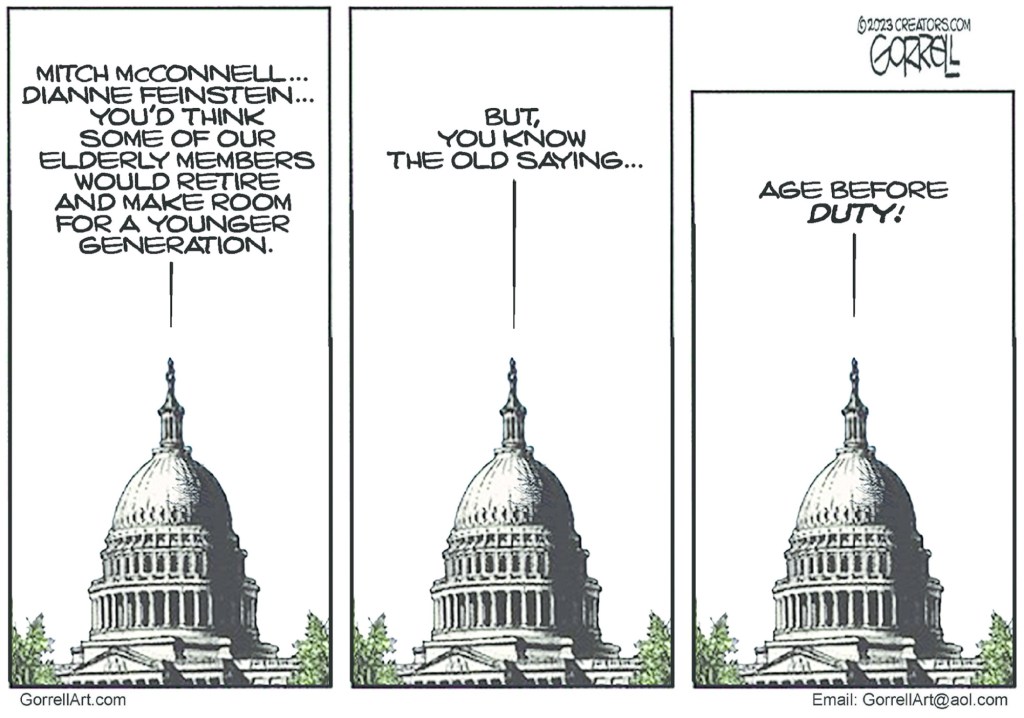
Apparently, America has discovered the secret to immortality.
You don’t need cryogenics. You don’t need experimental medicine. You don’t even need to drink from the Fountain of Youth.
You simply need to get elected to the United States Senate.
Because once you’re there, apparently, the expiration date is optional.
Look at the generational makeup of the Senate and you begin to understand why Washington can sometimes feel less like a representative democracy and more like a very exclusive retirement community with a nuclear launch code.
Approximately six out of every ten senators are Baby Boomers. Another handful belong to the Silent Generation. Gen X—which, depending on whom you ask, has been “next” for roughly 30 years—makes up only about three in ten senators. Millennials barely have a foothold.
And Gen Z?
Please.
They haven’t even been allowed into the building yet.
The Senate has become the political equivalent of a restaurant where the same people have been sitting at the best table since 1987, the waiter keeps bringing them bread, and every time somebody from the next generation asks, “Are you guys almost finished?” they respond:
“We’re just getting started.”
Welcome to the Eternal Internship
Gen X is particularly fascinating.
We are approaching 60.
We’ve spent our entire adult lives watching Baby Boomers occupy positions of political, corporate and cultural authority. We watched them become presidents, senators, governors, CEOs and media moguls. We watched them establish the rules.
And then we waited.
And waited.
And waited.
At some point you start wondering whether Gen X accidentally missed an email.
Because here we are, pushing 60, and we’re still standing outside the political revolving door holding a number that apparently says:
Now serving: 1946.
The irony is that Gen X was always supposed to be the generation that inherited the machinery.
Instead, we’re apparently inheriting the machinery after the previous owners have decided they’re never moving out.
It’s like buying a house where the previous owner says, “Sure, it’s yours now.”
Then you discover they’re still living in the master bedroom.
And they’re charging you rent.
The Senate: Where “Term Limits” Means Nothing You Can Measure
The Senate is especially absurd because there is no institutional requirement that politicians eventually say, “You know what? I’ve been doing this for several decades. Perhaps someone else should have a turn.”
Nope.
If the voters keep electing you, you can stay.
And politicians have become extraordinarily talented at getting reelected.
Some senators have served for decades. They accumulate seniority, relationships, donors, committee assignments and institutional power. By the time somebody from the next generation is finally old enough to realistically challenge them, the incumbent has been in Washington longer than the challenger has been alive.
And then Washington wonders why younger generations are frustrated with the government.
Imagine telling a 40-year-old:
“Don’t worry. Your generation will eventually have political influence.”
When?
After Social Security becomes a historical artifact?
After the last Boomer retires?
After someone finally removes the congressional office furniture from the Smithsonian?
The Great Generational Waiting Game
The strangest part isn’t that older Americans participate in politics.
They should.
Experience matters. Wisdom matters. Institutional knowledge matters.
But there is a difference between experience and permanent occupancy.
A democracy isn’t supposed to be a lifetime subscription.
The purpose of generational succession isn’t to throw older people into the political wilderness. It’s to make room for people who grew up under different circumstances, with different technologies, different economic realities and different social conditions.
The people governing America today came of age in a world before the internet, before smartphones, before social media, before artificial intelligence and before many of the economic realities younger Americans now face.
Meanwhile, Gen X grew up watching the world transform from rotary phones to smartphones.
We went from vinyl records to cassette tapes to CDs to MP3s to streaming.
We watched computers go from something that occupied an entire room to something sitting in our pockets.
We witnessed the birth of the internet.
And somehow Washington’s response was:
“That’s adorable. Now go sit over there.”
The Generation That Was Supposed to Be Next
Gen X has always had a peculiar relationship with history.
We were the generation sandwiched between two enormous demographic waves. We were smaller than the Boomers and smaller than the Millennials.
We learned early not to expect anyone to notice us.
So perhaps it’s fitting that we’re approaching 60 and still waiting for our turn.
But here’s the problem:
Eventually there isn’t supposed to be a turn.
There is supposed to be a transition.
That’s what succession is.
You don’t wait until the previous generation disappears before allowing the next generation to participate. You gradually hand over responsibility.
That’s how institutions survive.
That’s how families survive.
That’s how businesses survive.
That’s how civilizations survive.
But apparently the United States Senate has decided the best succession plan is:
“We’ll cross that bridge when we’re no longer physically capable of crossing bridges.”
And Then They Wonder Why We’re Cynical
Maybe this helps explain why so many Americans have become cynical about government.
People aren’t necessarily demanding that older politicians disappear.
They’re asking why the political system seems incapable of producing meaningful generational turnover.
Why does political experience increasingly mean how long you’ve managed to keep your job rather than what you’ve accomplished?
Why does seniority automatically translate into authority?
Why does somebody who entered politics when MTV was still playing music get to decide what the future of artificial intelligence, social media, cryptocurrency, climate technology and the modern workforce should look like?
Again, experience matters.
But experience isn’t the same thing as relevance.
And age isn’t the same thing as wisdom.
Sometimes age simply means you’ve had more opportunities to make mistakes.
The Punchline
So here we are.
The Silent Generation is still hanging around.
The Boomers dominate the Senate.
Gen X is approaching 60 and still waiting patiently in the hallway.
Millennials are finally getting a few chairs.
And Gen Z is standing outside wondering what the hell happened.
Meanwhile, the people currently holding the keys to the government keep telling everyone that America needs to prepare for the future.
Which is a little like having someone who has lived in the same house for 70 years tell you that the next generation needs to think about moving in someday.
Someday.
Just not today.
Today, they’re still using the good china.
And apparently, they’re not finished with it yet.
Maybe the real American dream isn’t passing the torch.
Maybe it’s simply refusing to let go of it until somebody pries it out of your cold, arthritic hands.
And Gen X?
Well, we’ll be over here.
Waiting.
We’re really good at waiting.
We’ve been doing it since 1980.

