Dwain Northey (Gen X)
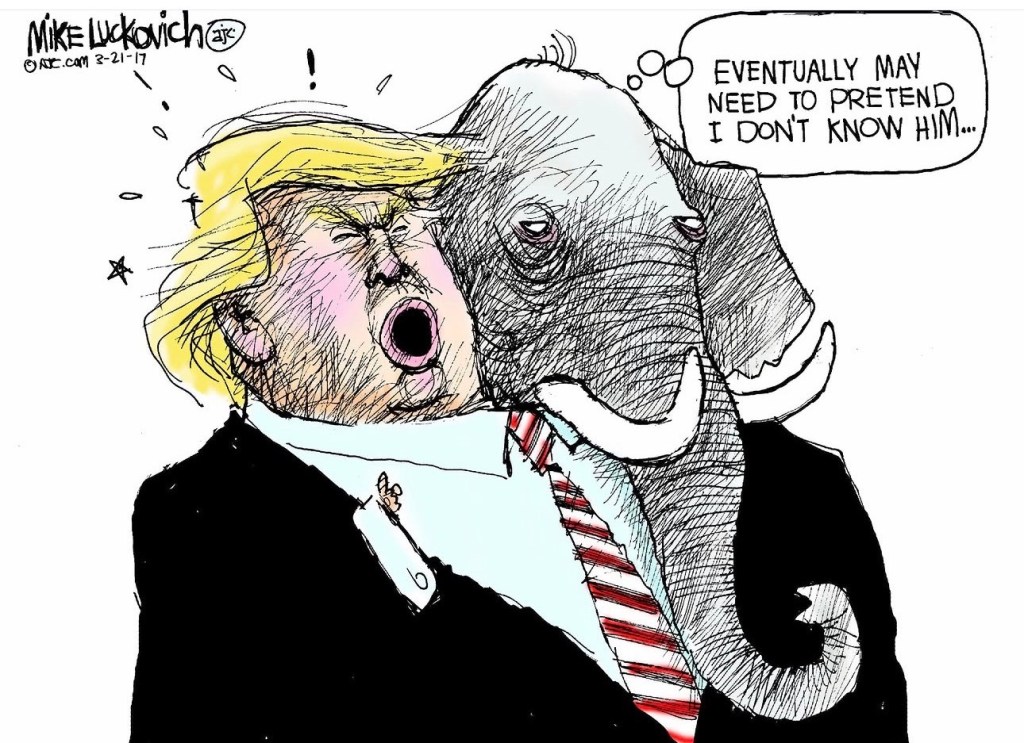
The Destroyer-in-Chief and the Republican Memory Hole
It is fascinating how quickly the Republican Party can develop a case of selective historical amnesia.
Remember George W. Bush?
Of course you do. Well, some of you do. Others apparently underwent the political equivalent of a factory reset.
There was a time when George W. Bush was the Republican president who could do no wrong. He was the strong leader, the cowboy, the guy who would stare down America’s enemies and protect the homeland. Then came Iraq. The weapons of mass destruction that somehow remained permanently invisible. The intelligence that turned out to be spectacularly wrong. The invasion. The occupation. The hundreds of thousands of dead. The trillions of dollars spent. The destabilization of an entire region.
And then, almost magically, Republicans discovered that George W. Bush was no longer their problem.
Funny how that works.
The party that once wrapped itself in the flag and defended every decision of the Bush administration eventually learned the ancient Washingtonian art of pretending that uncomfortable history happened to somebody else. Bush became the political equivalent of that embarrassing uncle everyone remembers fondly only after carefully removing the decade from the family photo album.
Which brings us to Donald Trump.
Because apparently the Republican Party has decided that if one president can eventually be memory-holed, why not another?
Trump has already accumulated a legacy large enough to require its own wing at the Smithsonian—or at least several dumpsters behind the National Archives. Yet his supporters continue to behave as though history is merely a suggestion and accountability is something that happens to Democrats.
He takes credit for successes that existed before he arrived, blames predecessors for failures that occur on his watch, declares victory whenever reality refuses to cooperate, and apparently believes that if he says something loudly enough, history will eventually update itself.
And Republicans applaud.
But here is the interesting question:
How long does the loyalty last?
Because eventually every political movement reaches the moment when the leader who was once considered indispensable becomes inconvenient.
It happened to Nixon.
It happened to Bush.
And eventually, whether Republicans like it or not, it will happen to Trump.
The question isn’t whether Trump’s legacy will eventually be reassessed. It will. History has a nasty habit of outliving political loyalty. The question is whether today’s Republicans will have the courage to acknowledge what they supported—or whether they’ll perform the traditional Washington ritual of suddenly discovering that they were never really that enthusiastic about the guy in the first place.
You can almost hear it now:
“Well, I always had concerns.”
“I wasn’t actually one of his biggest supporters.”
“I voted for him, but I didn’t agree with everything.”
“Let’s not rewrite history.”
Oh, absolutely.
Let’s not rewrite history.
That’s the problem.
History is already being written. The only question is whether we’re going to use permanent marker or the Republican Party’s preferred political medium: disappearing ink.
And perhaps that’s Trump’s ultimate contribution to the GOP. Not Make America Great Again, but Make Republicans Forget Again.
Because if George W. Bush can go from wartime president to awkward historical footnote, there is no reason Donald Trump can’t eventually make the same journey.
The only question is how many Republicans will still be standing around holding the Sharpie when the music stops.
And whether they’ll admit they helped draw the picture.

