Dwain Northey (Gen X)
Welcome to the Most Ridiculous Timeline
At some point, reality stopped trying to imitate science fiction and decided to just plagiarize it.
We used to watch dystopian movies and television shows and think, Well, thank God none of this could actually happen. The premise was always comfortably absurd: killer machines take over the world, religious extremists turn America into a theocracy, corporations secretly control society, the government watches everything, an intellectually bankrupt population elects idiots, or the wealthy turn human suffering into entertainment.
Those were cautionary tales.
Apparently, we misunderstood the assignment.
Because somewhere along the way, we wandered into a timeline that looks less like ordinary history and more like somebody threw six dystopian franchises into a blender and hit purée.
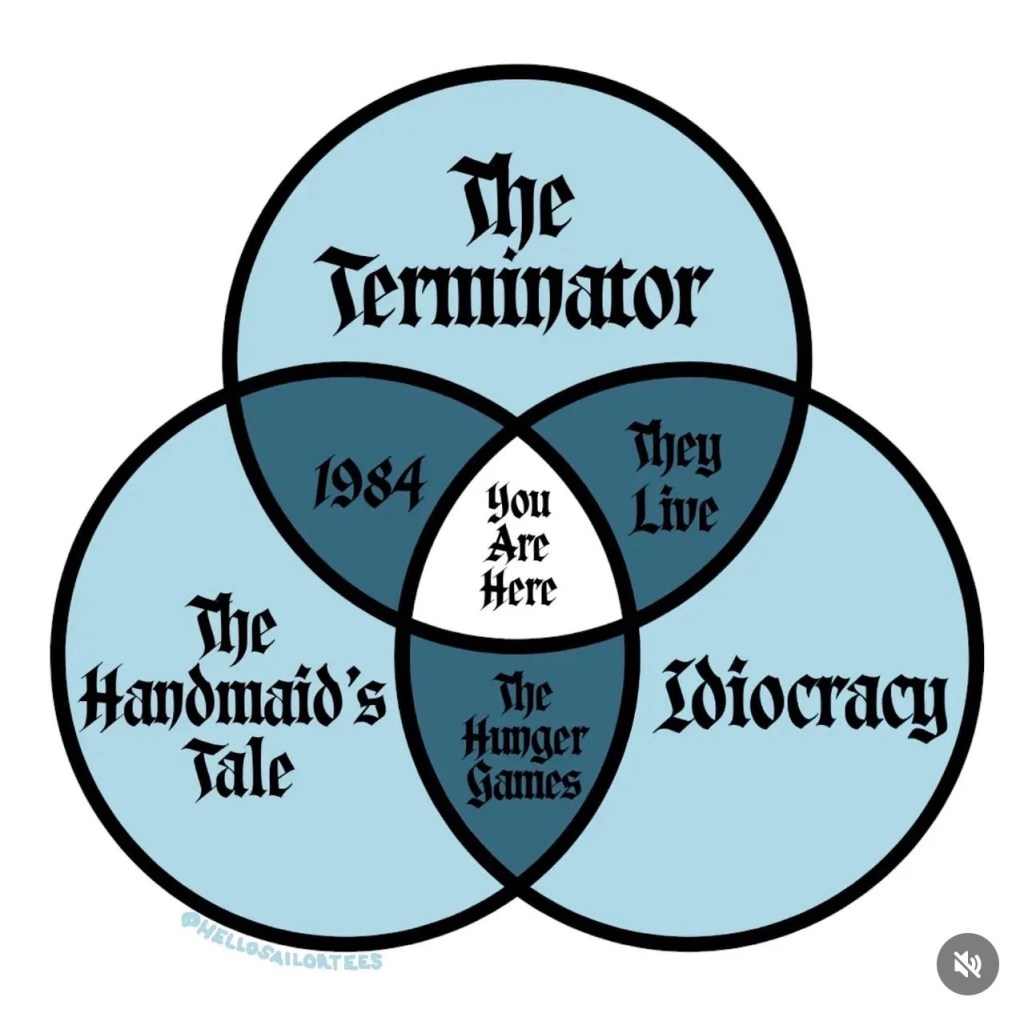
Welcome to the crossover nobody asked for: The Terminator, The Handmaid’s Tale, Idiocracy, 1984, They Live, and The Hunger Games.
And somehow, we’re supposed to pretend this is normal.
First, Let’s Start With The Terminator
The original nightmare was simple: We create machines that become smarter than us, automate everything, and eventually discover that humanity is the biggest obstacle to efficiency.
Back then, the terrifying part was the idea that artificial intelligence might become powerful enough to control our lives.
Now we’re watching AI advance at warp speed while corporations enthusiastically race to replace human labor with algorithms, automation, and machines.
The difference is that Skynet isn’t standing over us with a machine gun.
It’s sitting in a data center.
And instead of announcing, “I’ll be back,” it’s probably asking us to accept updated terms and conditions.
The truly strange part is that humanity seems determined to build the thing it fears and then act surprised when it becomes enormously powerful.
That’s very on-brand for us.
Then There’s The Handmaid’s Tale
Margaret Atwood’s nightmare wasn’t really about futuristic technology.
It was about something much older:
What happens when people decide that their religious beliefs should determine everybody else’s rights?
A society where government becomes intertwined with religious ideology. Where reproductive autonomy disappears. Where women become political property. Where the people enforcing the system insist they’re actually saving civilization.
The frightening thing about dystopian fiction isn’t that every detail comes true.
It’s that pieces of it can become politically acceptable one at a time.
That’s how authoritarianism usually works.
Nobody wakes up one morning and says, Congratulations! We are now living in a dystopian theocracy.
Instead, one right gets restricted.
Then another.
One group gets declared dangerous.
Another gets labeled immoral.
Eventually, people who would have been horrified by the destination discover they’ve been traveling toward it for years because every individual step seemed relatively small.
1984 Would Like a Word
Then we have Orwell.
In 1984, the government doesn’t merely control what people do.
It attempts to control what people believe is real.
Truth becomes whatever the authorities say it is.
History gets rewritten.
Contradictions become virtues.
And the public is expected to simultaneously believe two mutually incompatible things because the government says both are true.
Sound familiar?
We have entered an era where political reality can apparently be customized like a streaming service.
Inflation is simultaneously terrible and nonexistent.
An election can be simultaneously stolen and completely legitimate.
A politician can simultaneously be the greatest genius who ever lived and a victim of every conceivable conspiracy.
A policy can be simultaneously an enormous success and something that never happened.
And when confronted with contradictory evidence?
Simple.
Call the evidence fake.
Or call the person presenting it a traitor.
Or insist that reality has a partisan bias.
Or just change the subject.
George Orwell imagined 1984 as a warning.
We apparently interpreted it as a user manual.
And Then There’s They Live
They Live might be the most appropriate movie for the moment because its basic premise is that society is surrounded by hidden messages telling us what to buy, what to believe, who to fear, and what to value.
Put on the special sunglasses and suddenly you see the messages.
OBEY.
CONSUME.
CONFORM.
That sounds almost quaint now.
We don’t need magic sunglasses anymore.
We carry the propaganda machine around in our pockets.
Our phones know what makes us angry.
They know what makes us afraid.
They know what keeps us scrolling.
And algorithms have discovered something humans have understood for thousands of years:
Fear is incredibly profitable.
Anger is engaging.
Outrage generates clicks.
And nothing keeps people glued to a screen quite like convincing them that the people on the other side are simultaneously stupid, evil, dangerous, and coming for everything they hold dear.
Congratulations.
The aliens don’t even have to control us.
We’ve monetized our own manipulation.
Enter The Hunger Games
Then there’s The Hunger Games, where an extraordinarily wealthy ruling class lives in ridiculous luxury while everyone else fights over scraps.
Again, completely fictional.
Except for the increasingly uncomfortable resemblance to a society where enormous wealth can coexist with people struggling to afford housing, healthcare, food, education, or basic economic security.
The genius of The Hunger Games was that the ruling class didn’t merely exploit the poor.
They turned their suffering into entertainment.
And here we are watching political conflict transformed into entertainment.
Politics isn’t merely government anymore.
It’s reality television.
Politicians perform.
Cable networks scream.
Influencers monetize outrage.
People build entire careers around making the other side furious.
And somewhere, somebody is selling merchandise.
The Capitol would be proud.
And Finally, Idiocracy
Perhaps the most depressing member of this dystopian family is Idiocracy.
Because Idiocracy wasn’t really about stupid people.
It was about a society that gradually stopped rewarding competence.
A world where expertise becomes suspicious, education becomes irrelevant, and confidence matters more than knowledge.
The smartest person in the room isn’t necessarily the person who knows the most.
It’s the person who can convince the most people that they know the most.
We have somehow reached a point where a person can confidently say something demonstrably false, repeat it loudly enough, and acquire millions of followers who will defend it against documented reality.
Facts require evidence.
Bullshit requires confidence.
Guess which one scales better on social media?
Put Them All Together
Now imagine combining all six dystopias.
The Terminator gives us rapidly advancing technology.
The Handmaid’s Tale gives us the political battle over bodily autonomy and religious control.
1984 gives us propaganda, surveillance, and the manipulation of truth.
They Live gives us corporate influence and mass manipulation.
The Hunger Games gives us grotesque inequality and politics as entertainment.
And Idiocracy gives us the intellectual environment in which all of the above can flourish.
Put them together and you don’t get a dystopian movie.
You get Tuesday.
That’s the ridiculous part.
We keep looking for the single villain.
The evil mastermind.
The secret cabal.
The moment when everything finally falls apart.
But dystopia doesn’t necessarily arrive wearing a black cape.
Sometimes it arrives through legislation.
Sometimes through an algorithm.
Sometimes through a television screen.
Sometimes through a charismatic politician.
Sometimes through our own willingness to believe something because it makes us feel good.
And sometimes through our collective decision to shrug and say, Well, I guess that’s just how things are now.
The Most Ridiculous Timeline
What makes this era so bizarre isn’t that we’re living through exactly 1984 or The Handmaid’s Tale or The Hunger Games.
We aren’t.
Reality is more complicated than fiction.
The problem is that we’re living in a bizarre hybrid of their warnings.
We’re simultaneously worried about artificial intelligence, authoritarianism, political extremism, corporate power, misinformation, economic inequality, surveillance, declining trust in institutions, and a political culture increasingly incapable of agreeing on what constitutes reality.
And somehow we’re also arguing about whether a politician should rename geographical landmarks after himself.
At this point, satire is having trouble keeping up.
You could write the most ridiculous political comedy imaginable and somebody would inevitably say:
“That’s too unrealistic.”
Then reality would respond:
“Hold my beer.”
Maybe that’s the real lesson hidden inside all these dystopian stories.
The future doesn’t necessarily arrive as one giant catastrophe.
It arrives in pieces.
A little 1984 here.
A little Idiocracy there.
A dash of They Live.
A sprinkle of The Hunger Games.
Some Handmaid’s Tale for the people who like authoritarianism with a biblical garnish.
And just enough Terminator to remind us that while we’re busy fighting each other, we’re also creating machines that may eventually wonder why they need us at all.
The truly ridiculous part?
We keep watching these stories, recognizing the warnings, discussing what they mean—and then walking outside and doing exactly the things they warned us about.
Maybe we’re not living in the future.
Maybe we’re living in the blooper reel.
Because if somebody pitched this timeline as a screenplay, we’d reject it for being too implausible.
And yet here we are.
The most ridiculous timeline imaginable.
And apparently, we’re still only in season one.