Dwain Northey (Gen X)
Democrats Need to Become the Party of Yes
Here we are again.
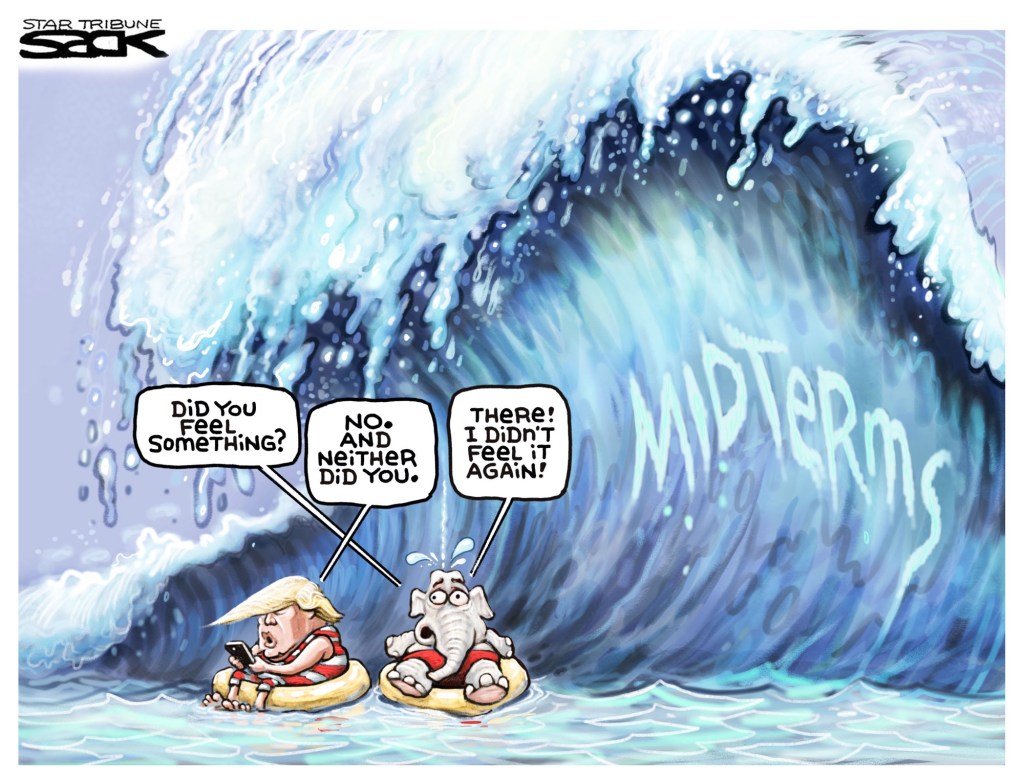
The 2026 midterm elections are right around the corner, and Democrats have a choice to make. We can spend the next few months standing in front of the political wreckage, pointing at Donald Trump and the Republicans and screaming, “Look what you broke!”
And, to be fair, there is plenty to point at.
But eventually somebody has to stop standing around the crime scene taking pictures.
Somebody has to clean the damn thing up.
And that is where Democrats have historically found themselves: arriving after the Republican Party has driven the fiscal bus into a ditch, set the dashboard on fire, and then handed us the keys while announcing that Democrats are responsible for the potholes.
The national debt is complicated, and Democrats certainly don’t get a free pass on fiscal responsibility. But the historical political pattern is hard to ignore: Republicans frequently campaign as the party of fiscal restraint, then pursue tax cuts and spending policies that increase deficits, only to rediscover their deep and abiding concern about the national debt when Democrats take power. The Committee for a Responsible Federal Budget estimated that Trump approved roughly $8.8 trillion in gross new borrowing during his first term. (CRFB)
It’s a remarkable political magic trick.
Republicans spend the money. Democrats inherit the bill. Republicans then complain about the size of the receipt.
And Democrats have been remarkably willing to participate in this routine.
We inherit the mess, spend years trying to repair it, and then discover that all the political oxygen has been consumed by explaining why the previous administration’s mess wasn’t actually our mess.
Meanwhile, the things we supposedly want to accomplish sit in the corner collecting dust.
Affordable healthcare?
Sorry. We’re fixing the budget.
Infrastructure?
Sorry. We’re repairing the infrastructure of government itself.
Education?
Hang on. We’re trying to figure out why the last administration blew a hole in the deficit.
Climate policy?
Maybe next time. We’re still cleaning up the last time.
Voting rights?
Absolutely. Right after we finish explaining the previous six scandals.
And eventually voters look around and ask the perfectly reasonable question:
“Okay, but what are you actually going to DO?”
That’s the question Democrats need to answer in 2026.
Because being anti-Trump is not a governing philosophy.
Being a Never Trumper is a perfectly legitimate position. Hell, it may be the easiest position in American politics right now.
But it isn’t enough.
We cannot simply be the party of NO.
No Trump.
No Trumpism.
No authoritarianism.
No corruption.
No government dismantling.
No attacks on democratic institutions.
No attacks on voting rights.
No dismantling of the federal workforce.
No politicizing the Justice Department.
No turning government agencies into personal loyalty clubs.
No using the machinery of government as a political weapon.
No.
No.
No.
Eventually, Americans are going to look at us and say:
“Okay, you’ve told us what you don’t want about 47,000 times. What the hell DO you want?”
That’s where we need to change the conversation.
We need to become the Party of Yes.
Yes, we are going to protect Social Security.
Yes, we are going to make healthcare more affordable.
Yes, we are going to invest in infrastructure.
Yes, we’re going to address housing costs.
Yes, we’re going to protect voting rights.
Yes, we’re going to rebuild America’s manufacturing capacity.
Yes, we’re going to invest in education.
Yes, we’re going to deal with climate change like adults instead of pretending the thermostat is a partisan issue.
Yes, we’re going to secure the border and build an immigration system that actually works.
Yes, we’re going to address the national debt with an honest conversation about both spending and revenue, rather than pretending that eliminating taxes somehow produces more money.
Yes, we’re going to restore competence to government.
And perhaps most importantly:
Yes, we’re going to repair the institutional damage that has been done to the American government.
Because that’s the part that doesn’t show up neatly on a tax bill.
Trumpism isn’t merely a collection of policies that Democrats can reverse with another piece of legislation.
It’s also the normalization of the idea that government exists to serve the person occupying the Oval Office.
That is the part Democrats need to fight.
Not just Trump.
Not just the latest outrageous statement.
Not just the latest executive order.
Not just the latest scandal.
The paper cuts.
The cumulative damage.
The little changes that individually don’t look catastrophic but collectively transform the way government operates.
Because democracy rarely disappears in one dramatic scene with ominous music playing in the background.
Sometimes it disappears through a thousand administrative decisions nobody bothered to pay attention to.
That’s why the Democratic message in 2026 needs to be bigger than “We’re not them.”
We need to say:
“We’re going to rebuild.”
And then we need to tell people exactly what that means.
We need to offer a vision that doesn’t require voters to spend every waking minute thinking about Donald Trump.
Because here’s the uncomfortable truth:
People don’t want to spend the next two years talking about Donald Trump either.
They want to know whether they can afford their groceries.
Whether their kids can afford college.
Whether they can buy a house.
Whether they can retire.
Whether their healthcare is going to bankrupt them.
Whether their roads, bridges and power grids work.
Whether their government is competent.
Whether their vote actually matters.
Whether America is going somewhere.
That’s our opening.
The Republican Party can keep selling nostalgia, grievance and an endless rerun of the Trump Show.
Democrats need to sell tomorrow.
And yes, we should absolutely remind voters what Republicans did.
But we shouldn’t spend the entire campaign standing beside the wreckage saying, “See? We told you so.”
We should be saying:
“Yes, they broke it. Now here’s what we’re going to build.”
Because that’s the difference between an opposition party and a governing party.
An opposition party says:
“Look at that disaster.”
A governing party says:
“Hand me a hammer.”
And Democrats desperately need to become the second one.
Not because Republicans deserve a pass.
They don’t.
Not because Trump shouldn’t be held accountable.
He should.
Not because Democrats shouldn’t expose corruption, incompetence and authoritarianism.
They absolutely should.
But because America needs more than a cleanup crew.
We need a construction crew.
We need Democrats to stop promising merely to restore the country to January 19, 2017—or January 19, 2025—and start explaining what America should look like on January 20, 2030.
Don’t just tell us what you’re going to undo.
Tell us what you’re going to build.
Don’t just tell us what you’re against.
Tell us what you’re for.
Don’t just promise to repair the damage.
Promise to build something better than what existed before the damage was done.
Because the 2026 election shouldn’t simply be a referendum on Donald Trump.
It should be a referendum on two competing visions of America.
One says: burn it down, blame somebody else, and call the ashes freedom.
The other should say:
Yes.
Yes, we can rebuild.
Yes, government can work.
Yes, democracy is worth defending.
Yes, fiscal responsibility can coexist with investment.
Yes, capitalism can exist without becoming corporate feudalism.
Yes, America can have secure borders without abandoning humanity.
Yes, we can protect individual freedom without turning government into a religious or ideological police force.
Yes, we can disagree without treating our fellow citizens like enemies.
Yes, we can move forward.
And yes, Democrats can finally stop being the political equivalent of the guy who gets called over after the party to unclog the toilet.
We’re allowed to throw our own damn party.
That’s the message.
Not simply:
“We’re not Trump.”
But:
“We’re what comes next.”
 Esoteric Meandering Shouting Into the Void