Dwain Northey (Gen X)
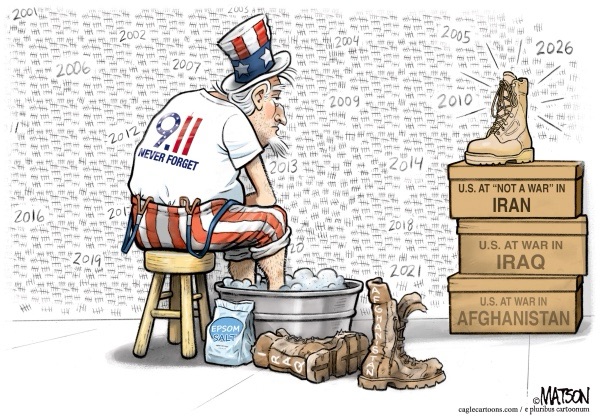
Twenty-Five Years Later, I’m Still Confused About Iraq
Twenty-five years after September 11, 2001, I find myself thinking about the things we were told, the things we believed, and the things that still don’t make much sense. And one of those things is how we went from being attacked by terrorists in New York, Washington, and Pennsylvania to invading Iraq.
I’m still confused.
Well, I guess I’m not entirely confused. I understand what happened. I’m just still trying to understand how we got from point A to point B and why so many people accepted the explanation along the way.
September 11 was an attack on the United States by al-Qaeda, a terrorist organization led by Osama bin Laden. Nineteen hijackers murdered nearly 3,000 people, destroyed the World Trade Center, damaged the Pentagon, and sent a plane into a Pennsylvania field because ordinary Americans were apparently not allowed to have a normal Tuesday.
The United States responded by invading Afghanistan, where the Taliban had provided sanctuary to al-Qaeda. That war had a direct connection to the attacks. We were looking for the people responsible.
Then, somehow, the conversation shifted to Iraq.
Saddam Hussein.
Weapons of mass destruction.
Mushroom clouds.
A dictator who had nothing to do with planning the September 11 attacks suddenly became the central character in America’s response to them.
And I’m sitting here wondering, did we lose the plot somewhere between the Pentagon and Baghdad?
Because if the reason we went to war was the terrorist attack on September 11, then why was George W. Bush more focused on finding Saddam Hussein than finding Osama bin Laden?
That question has never really gone away for me.
Osama bin Laden was the man who organized the attacks. He was the one responsible for sending those planes into buildings and killing thousands of Americans. He was the person we were supposed to be hunting.
Instead, the Bush administration spent enormous political energy making the case that Iraq was an imminent threat to the United States. We were told Saddam had weapons of mass destruction. We were told he had connections to terrorists. We were told that invading Iraq was part of the broader war on terror.
Except the weapons weren’t there, and the supposed connection between Saddam Hussein and the September 11 attacks wasn’t there either.
The 9/11 Commission found no evidence that Saddam Hussein’s regime cooperated with al-Qaeda in carrying out attacks against the United States. Saddam was a brutal dictator, but being a brutal dictator isn’t the same thing as being responsible for every terrorist attack that happens to occur while you’re in power.
If it were, we’d need a much larger map.
And let’s not forget that Iraq had already been invaded by the United States in 1991. Saddam Hussein had invaded Kuwait, and the international community responded. There were legitimate reasons for that war. But in 2003, we weren’t responding to a new Iraqi invasion of another country. We were making the case for a preventive war based on intelligence that turned out to be disastrously wrong.
Meanwhile, Osama bin Laden remained alive.
He was eventually killed in Pakistan in 2011, nearly a decade after September 11. By then, the United States had spent years fighting in Iraq, lost thousands of military personnel, spent enormous amounts of money, and helped create conditions that would contribute to further instability and violence across the region.
All while the man responsible for the attacks was still out there.
I understand that history is complicated. I understand that governments make decisions based on intelligence, politics, national security, and a thousand other things that ordinary people don’t get to see. I understand that hindsight is a wonderful tool because it doesn’t require us to sit in a room in 2002 trying to decide whether the information in front of us is accurate.
But some things don’t require hindsight.
You don’t need twenty-five years of historical distance to ask why the man responsible for the attack wasn’t the primary target of the war we were told was about that attack.
You don’t need a PhD in international relations to understand that Iraq and al-Qaeda were not the same thing.
And you certainly don’t need to be a military strategist to recognize that invading a country because its leader might have weapons of mass destruction is a very different argument from invading a country because its government is directly responsible for attacking you.
Those are two different wars with two different justifications.
Yet somehow, after September 11, we were expected to accept them as part of the same story.
Twenty-five years later, I still think about the people who died that day. The passengers on the planes. The people working in the towers. The firefighters, police officers, and emergency workers who ran toward the buildings while everyone else was trying to get away. The families who never got to say goodbye.
Their deaths deserved a response. Their families deserved justice. The country deserved leadership that could distinguish between the people who attacked us and the people we decided we wanted to fight.
Instead, we got a war in Iraq that was sold to the American public using the fear and anger of September 11.
And that is the part that still bothers me.
Not because Saddam Hussein was a good guy. He wasn’t. Not because Iraq was a peaceful democracy before we showed up. It wasn’t. And not because the United States had no legitimate national security concerns.
But because the reasons we were given for going to war mattered.
They mattered when we sent young men and women into combat. They mattered when families received folded flags. They mattered when we spent trillions of dollars that could have been used for almost anything else. They mattered when we asked Americans to trust their government.
And they matter now, twenty-five years later, when we look back at the decisions that followed the worst terrorist attack in American history.
The question isn’t whether Saddam Hussein was a terrible person. He was.
The question is whether he was responsible for September 11.
He wasn’t.
The question isn’t whether Iraq was a country with problems. It was.
The question is whether invading Iraq was the necessary response to the terrorist attacks.
It wasn’t.
And the question isn’t whether Osama bin Laden deserved to be brought to justice.
He did.
So when I think about September 11, I think about the people we lost, the families who still carry that loss, and the men and women who served in the wars that followed.
But I also think about the decisions made in the aftermath.
Because remembering history isn’t just about remembering what happened. It’s about remembering what we were told, what we believed, and what we should have learned.
Twenty-five years later, I still don’t understand how the country that was attacked by Osama bin Laden ended up invading Iraq.
Well, I understand the history.
I’m just still trying to understand the logic.
And maybe that’s the point. Maybe the most important thing we can do on this anniversary is keep asking the questions that make us uncomfortable.
Because the next time somebody tells us that a war is necessary, that the intelligence is solid, that the threat is imminent, and that we just need to trust the people in charge, maybe we should remember what happened the last time we stopped asking questions.

