Dwain Northey (Gen X)
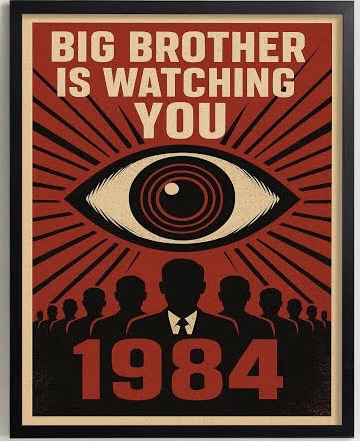
George Orwell was 42 years off.
In 1984, Big Brother had to install cameras, monitor conversations, and build an entire government apparatus to watch everybody. We have smartphones, doorbell cameras, and license plate readers. And unlike Winston Smith, we pay for our surveillance and carry it around voluntarily.
Apparently, dystopia is easier to sell when it comes with free shipping.
Alexa, Are You Listening?
Mention something you might want to buy, and suddenly your social media feed is full of advertisements for it. A vacuum cleaner. A vacation. A new pair of shoes.
Now, your phone may not literally be listening to every conversation. Advertising algorithms can infer an astonishing amount from your searches, location, browsing habits, purchases, and the people you interact with.
Which is somehow more comforting.
Your phone may not be listening. It may simply know you well enough to predict what you are going to say before you say it.
And then sell it to you.
Welcome to the Neighborhood
Ring doorbell cameras were supposed to protect our homes from porch pirates. Now, depending on the program and permissions involved, footage from privately owned cameras can become available to law enforcement.
You bought a doorbell.
You may have helped build a surveillance network.
And somewhere in the fine print, there is probably a sentence explaining that you agreed to this, provided you had the time, patience, and legal education to read it.
We have reached the point where you need to be a constitutional lawyer to install a doorbell.
Flock: Because License Plates Were Too Private
Then there are Flock cameras, automated license plate readers that capture vehicle information, including where and when a car was seen.
Useful when somebody steals your car.
Less comforting when you realize that a record of your movements can exist simply because you drove to work, the grocery store, or your mother’s house.
The camera was installed for public safety. The database can become a record of where ordinary people go.
And if that sounds like something out of 1984, congratulations. You have been paying attention.
The Box You Checked
Every app, camera, and online service comes with terms and conditions. We click “Accept” because the alternative is apparently not using the thing we just bought.
Somewhere in that legal equivalent of a hostage note, we may have agreed to data collection, retention, and sharing arrangements we never fully understood.
Then we discover what we agreed to and act surprised.
We shouldn’t have to be constitutional scholars to own a doorbell.
Safety, or Surveillance?
I am not opposed to cameras helping solve crimes. If somebody steals your car, I want the police to have useful evidence.
The question is how much surveillance we are willing to accept, who controls it, and what prevents a system designed for one purpose from becoming something else.
A camera installed to find stolen cars can become part of a system that tracks movements. A doorbell camera can become part of a system that shares footage. A smartphone can know more about you than some of your friends.
And the people controlling these systems are not necessarily the people living under them.
That is the part Orwell understood.
Big Brother Has Better Marketing
We imagine Big Brother as a government office filled with men in gray suits, reading our mail and monitoring our conversations.
The modern version is more efficient.
Big Brother might be a government agency, a technology company, a data broker, an advertising algorithm, or a neighborhood security system.
Sometimes it is all of them working together, and sometimes we have no idea who has access to what.
The technology does not have to be controlled by one person to create a surveillance state. It only has to become widespread enough that privacy is no longer the default.
And we are getting there.
In 1984, the telescreen was a symbol of oppression because it was always watching and impossible to escape.
We have something similar now, except ours comes with GPS, a microphone, a camera, and the ability to order toilet paper while sitting on the toilet.
We carry it everywhere.
We pay for it.
We tell it where we are, what we are doing, what we are buying, and occasionally what we had for breakfast.
Then we wonder why the advertisements are so damn accurate.
The difference between Orwell’s world and ours is that Big Brother no longer has to force us to participate.
We have made surveillance convenient.
We have made it profitable.
We have made it part of everyday life.
And when somebody points out that the cameras are everywhere, we call them paranoid.
George Orwell was 42 years off.
Big Brother is definitely watching.
He just has better marketing now.
And the really impressive part? We are paying for the privilege of being watched. We are installing the cameras, carrying the microphones, and clicking “Accept” on the terms and conditions.
Then we go online to complain about the government spying on us.
On the phone we bought.
Through the app we installed.
Using the Wi-Fi we pay for.
While the camera on our front porch records the delivery driver bringing us another device to make our lives more convenient.
At this point, the only thing missing from 1984 is the government sending us a monthly bill for the privilege of being surveilled.
Give it time.
I am sure somebody is working on an app for that.

