Dwain Northey (Gen X)
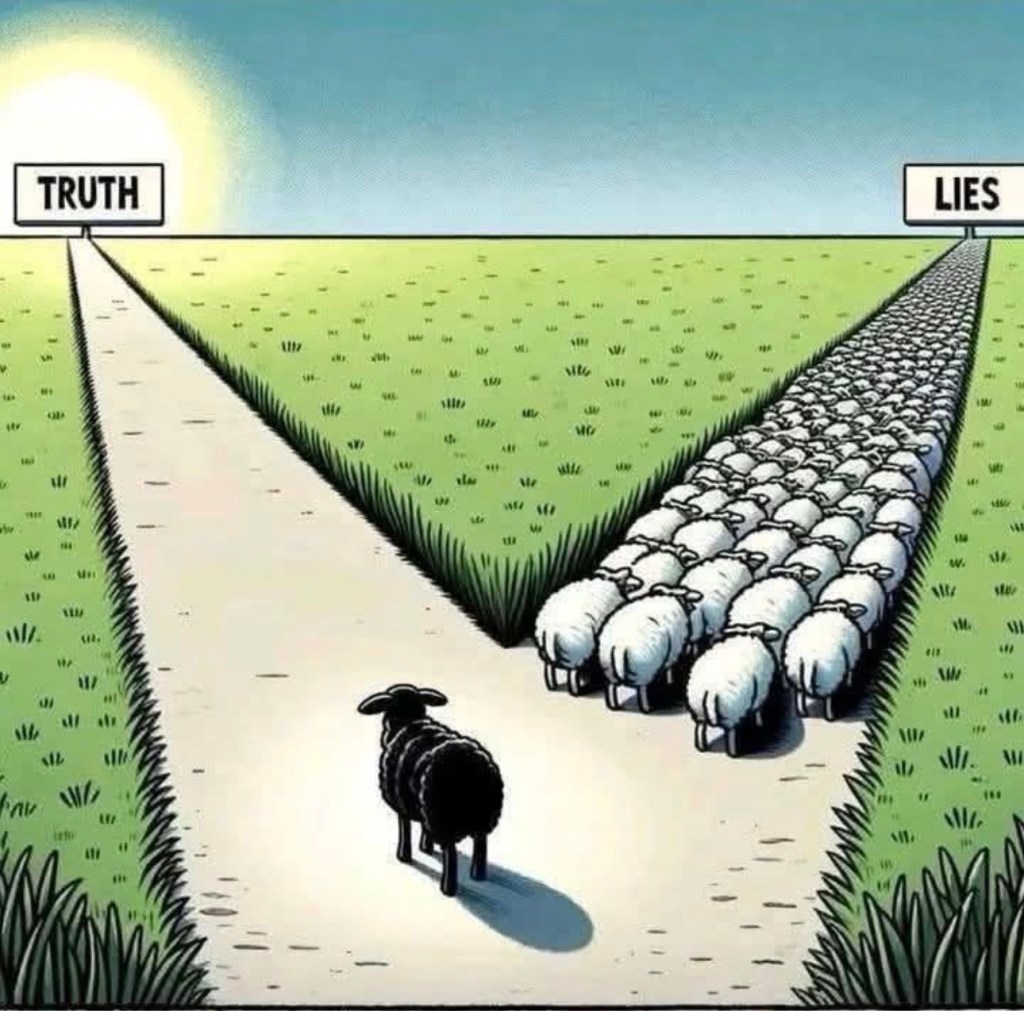
The Black Sheep Might Be Onto Something
We have a funny habit as human beings of assuming that the person who doesn’t fit in must be the problem.
We call them the black sheep.
The outlier.
The oddball.
The troublemaker.
The person who just can’t seem to get with the program.
And sometimes, sure, they really are just being difficult. Every family, office, classroom, and group of friends has at least one person who seems to have been issued a completely different instruction manual.
But here’s the thing:
Being different isn’t automatically being wrong.
Sometimes the black sheep is simply the person who looked at the herd and thought, “Um…where exactly are we going?”
And that person might actually have a point.
Progress has never been particularly kind to people who refuse to follow the crowd.
At one point, the crowd believed the Earth was the center of the universe. The crowd thought slavery was perfectly acceptable. The crowd thought women shouldn’t vote. The crowd thought segregation was normal. The crowd has repeatedly demonstrated throughout human history that being part of the majority is not necessarily evidence of being correct.
Sometimes it is just evidence that a whole bunch of people happen to believe the same thing.
There is a difference.
We teach children to conform almost from the moment they can walk. Sit here. Stand there. Do it this way. Don’t question the teacher. Don’t rock the boat. Follow the rules. Everybody else is doing it.
And eventually we grow into adults who are remarkably uncomfortable when somebody asks, “Why?”
Not “What are we doing?”
Not “Who decided this?”
Just “Why?”
That little word has probably caused more trouble throughout human history than almost any other word in the English language.
Because “why” requires us to examine assumptions.
And assumptions are comfortable.
If everybody has always done something a certain way, changing it means admitting that perhaps everybody has always done it the wrong way.
Nobody particularly enjoys that conversation.
So we ostracize the person who keeps asking questions.
We call them difficult.
We tell them they’re overthinking it.
We tell them they’re being unrealistic.
We tell them, “That’s just how things are.”
Which is possibly one of the dumbest sentences humanity has ever invented.
Because almost everything we now consider normal was once something that wasn’t normal.
Somebody had to be the first person to imagine it differently.
The black sheep might be that person.
Maybe they’re not trying to destroy the system. Maybe they’re trying to figure out why the system has a giant “DO NOT QUESTION” sign hanging over it.
Maybe they aren’t refusing to cooperate.
Maybe they simply see something the rest of us haven’t noticed yet.
Maybe their vision is different.
And different vision can be incredibly valuable.
The outlier sees the things the average person may overlook because the outlier isn’t standing in exactly the same place.
That’s why diversity of thought matters.
You don’t need everyone in the room thinking alike. In fact, if everyone in the room immediately agrees, somebody probably forgot to invite the person who asks uncomfortable questions.
The goal shouldn’t be to eliminate the black sheep.
It should be to listen to them.
That doesn’t mean they’re automatically right. Being different isn’t some magical certification of wisdom. Sometimes the black sheep is simply wrong.
But that’s the point.
We should evaluate the idea, not exile the person for having it.
Because occasionally the person standing outside the circle isn’t lost.
They’re standing there because they can see the circle.
And sometimes they’re the only person asking whether we should be drawing a circle at all.
So maybe we should stop treating the black sheep as something that needs to be fixed.
Maybe sometimes the black sheep is exactly what the flock needs.
Because conformity can keep a group moving in the same direction.
But somebody has to occasionally look up and ask whether we’re actually going anywhere worth going.
And if that person happens to be the oddball standing at the back saying, “Guys…this seems like a really bad idea,” maybe don’t ostracize them.
Maybe, just for a minute, listen.
They might be wrong.
But they might also be the one person in the room who sees the answer nobody else has considered yet.
And wouldn’t it be a little embarrassing to discover that the black sheep wasn’t the problem?
Maybe we were just following the wrong herd.

