Dwain Northey (Gen X)
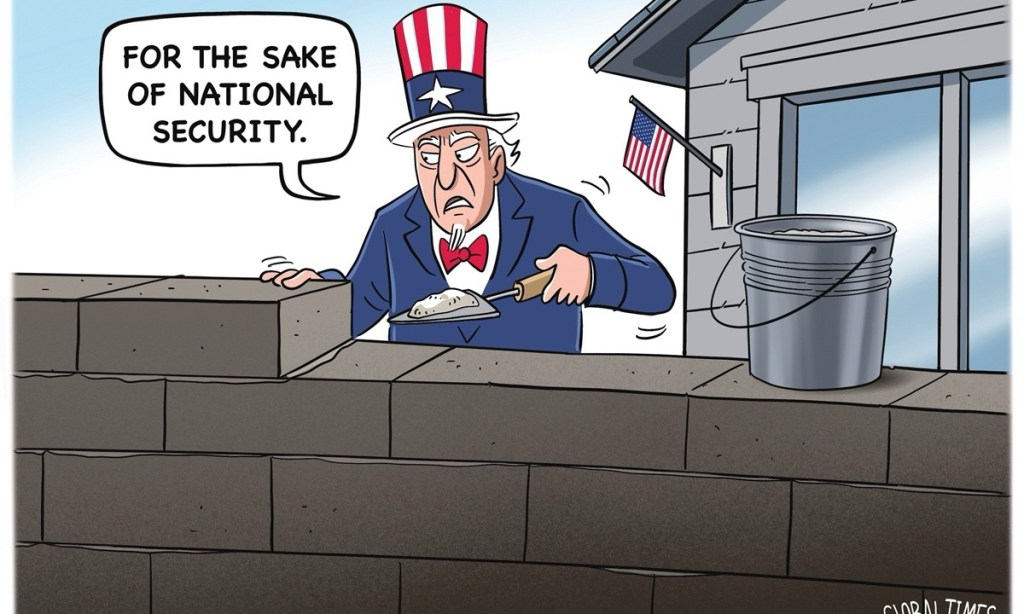
Welcome to the National Security Excuse
There is a certain point at which the phrase “national security” stops sounding like a legitimate governmental concern and starts sounding like the administrative equivalent of a universal coupon code.
Apparently, just type NATIONAL SECURITY into the justification box and congratulations—you can build, demolish, restrict, rename, reshape, or apparently militarize whatever the hell you want.
Welcome to the Trump administration’s newest episode of Everything Is National Security.
First, we had to tear down the White House East Wing because, naturally, we desperately needed a ballroom. Not because Donald Trump wants a giant ballroom. No, no. That would be vanity, and we can’t possibly admit to that.
It is national security.
Then there is the 250-foot triumphal arch near Arlington National Cemetery.
Originally, it was supposed to be a monument celebrating America’s 250th anniversary. Now we’re being told it will also function as a military complex, potentially equipped with drones, snipers and ammunition.
Because apparently America’s national security apparatus was sitting around thinking, You know what we’re missing? A really big sniper tower next to Arlington Cemetery.
And then there is the press.
Apparently, journalists who aren’t sufficiently flattering to the president can become a national security threat too. Reuters recently reported that Trump has increasingly invoked national security to justify everything from the ballroom and proposed arch to restrictions involving the press. Legal experts interviewed by Reuters warned that stretching the national-security rationale across unrelated disputes could undermine the credibility normally given to legitimate national-security claims.
But wait.
We’re not done.
Because apparently elections are national security too.
Donald Trump has repeatedly claimed that large numbers of noncitizens are registered to vote and that election systems are dangerously vulnerable. In July, he cited a DHS figure of approximately 278,000 noncitizens supposedly registered to vote. Fact-checkers and election experts, however, found serious problems with the methodology behind that number, and there has been little evidence of widespread noncitizen voting.
And now the federal government is aggressively reviewing state voter rolls. Reuters reported today that the White House is pushing federal agencies to accelerate reviews of at least 47 state voter rolls in an unprecedented effort to identify noncitizens among registered voters as the midterms approach.
And here’s where the logic gets really interesting.
If the president declares that noncitizen voting is a national-security threat, then apparently the next logical step is:
Well, obviously the president needs more control over the elections.
Because that’s how this works, right?
Ballrooms are national security.
Arches are national security.
Press access is national security.
Noncitizen voting is national security.
Therefore, logically, federal control over elections must also be national security.
What could possibly go wrong?
Except there’s a tiny constitutional problem hiding underneath all that national-security wallpaper.
Elections aren’t supposed to belong to the president.
States have traditionally administered elections, subject to federal constitutional and statutory requirements. The administration’s attempts to exert greater federal control over election administration have already generated legal challenges.
And that’s where this stops being merely another episode of Donald Builds Something Weird in Washington.
Because when the person who controls the executive branch starts saying that the elections themselves are a national-security problem, and then uses that claim to justify increasing federal involvement in how elections are administered, we should probably pay attention.
Not because every claim about election security is automatically illegitimate.
Election security is absolutely important.
Preventing fraud is important.
Protecting voter information is important.
Making sure eligible citizens can vote and that votes are counted accurately is important.
But there is a difference between protecting elections and using the protection of elections as a justification for expanding presidential control over elections.
That distinction matters.
Because if the president gets to define the threat, define the emergency, define the national-security implications and then decide that those circumstances require more presidential control, we’ve created a rather convenient little circle:
I say there’s a threat. Therefore, I need more power. The fact that I have more power proves the threat required it.
Wash. Rinse. Repeat.
And suddenly we’re no longer talking about national security.
We’re talking about presidential authority.
That’s the trick hidden inside the phrase.
“National security” carries enormous emotional and legal weight because everybody understands that protecting the country sometimes requires extraordinary measures.
Nobody wants to be the person who says, Well, maybe we shouldn’t protect America from terrorists.
But that’s not the question.
The question is whether everything the president wants to do can simply be placed under the national-security umbrella.
Because if everything is national security, then nothing is beyond presidential reach.
Want a ballroom?
National security.
Want a giant arch?
National security.
Don’t like the reporters?
National security.
Don’t trust the election system?
National security.
Want the federal government more deeply involved in state election administration?
Well…
You guessed it.
National security.
At this rate, I’m expecting the next executive order to announce that replacing the White House curtains requires a national-security review because an enemy intelligence service might determine Donald Trump’s preferred shade of beige.
And here’s the part that really should bother everybody, regardless of political party:
National security is supposed to protect the government established by the Constitution. It isn’t supposed to become the excuse for concentrating power in one person.
The president is supposed to be part of the government.
Not synonymous with the government.
The country is supposed to survive the president.
The Constitution is supposed to outlast the president.
Elections are supposed to determine who gets temporary custody of the machinery of government—not give the person who currently has custody the authority to rewrite the rules governing who gets custody next.
So yes, let’s secure the elections.
Let’s investigate actual fraud.
Let’s prosecute actual crimes.
Let’s protect voter databases.
Let’s make voting systems secure.
Let’s do all of that.
But let’s also secure something else:
the principle that the person being elected does not get to become the person who controls the election merely by declaring the election a national-security matter.
Because eventually, somebody has to ask the obvious question:
If everything Donald Trump touches requires national-security justification, perhaps the real national-security question isn’t whether Donald Trump has enough power.
Maybe it’s whether any president should ever have that much power in the first place.
And if we ever reach the point where protecting America means protecting the constitutional system from the person occupying the Oval Office, then perhaps we’ve finally found the one national-security threat that actually matters.
Not the ballroom.
Not the arch.
Not the reporters.
Not the voters.
The idea that the president gets to decide that all of them are.

