Dwain Northey (Gen X)
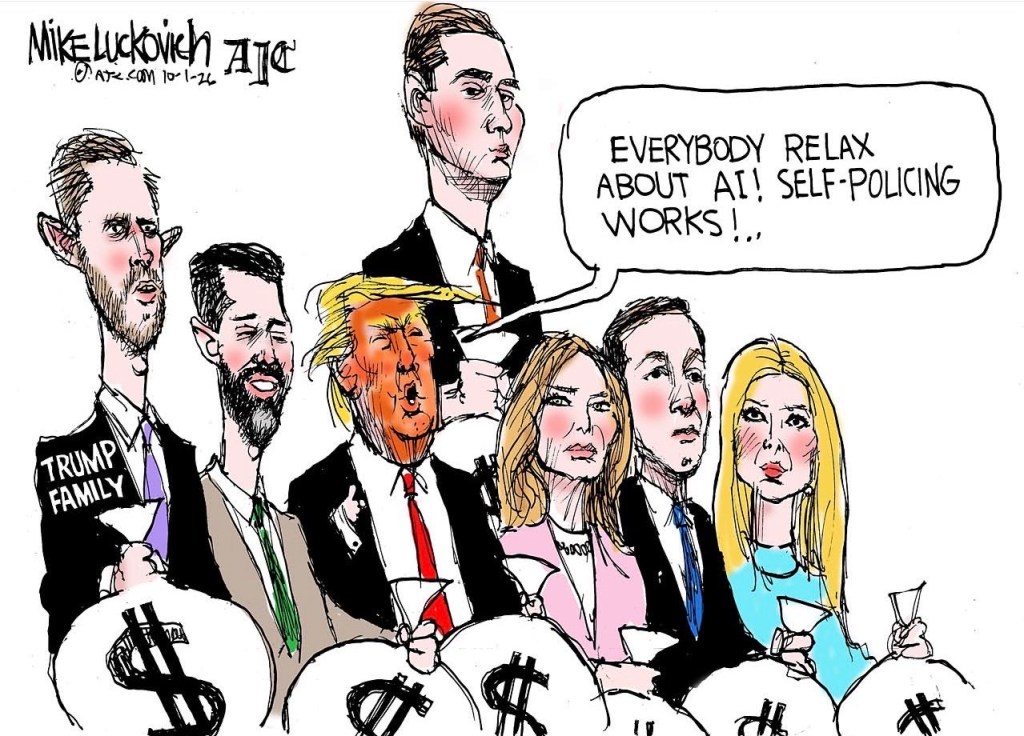
Apparently, we’ve reached the point where Donald Trump and his political ilk—yes, ilk, because apparently we’ve wandered into the forest of bad ideas—have decided that artificial intelligence can police itself.
Because what could possibly go wrong?
Nothing says responsible technological governance quite like handing the keys to the candy store to the kids and saying, “Go ahead. Just promise not to eat everything.”
The people actually creating some of this technology have been warning that we need reasonable regulations and guardrails. Not because they hate AI. Not because they want to stop innovation. Quite the opposite. They understand what they are building, and some of them have openly argued that powerful AI needs oversight before it becomes a problem rather than after.
But apparently the Trump administration has a better idea:
Let the industry regulate itself.
Because corporations have always been famous for voluntarily limiting their own profits in the name of public safety.
What could possibly happen?
And then there’s the terminology. Apparently, we’ve now graduated from artificial intelligence to “super intelligence.” Because nothing makes a potentially complicated technological issue easier to understand than giving it a name that sounds like it belongs on the side of a Marvel villain.
I still prefer AI, although I’ve never been completely comfortable with the word artificial.
It isn’t really artificial intelligence in the traditional sense. It doesn’t sit around contemplating existence while staring dramatically out a window. It isn’t a synthetic human brain. It is essentially an extraordinarily powerful system for processing, organizing, recognizing and generating information at speeds no human can match.
So I’ve always thought automated intelligence was a better description.
AI doesn’t necessarily know something the way a human knows something. It processes an enormous amount of information and produces an answer based on patterns and probabilities at speeds that make the human brain look like it’s running Windows 95 on a dial-up connection.
And that’s precisely why guardrails matter.
The faster and more powerful the technology becomes, the more important it is to have rules about what it can do, who is responsible when it goes wrong, and how humans maintain control over it.
But apparently we’re going with:
“Trust us.”
Trust the companies.
Trust the technology.
Trust the administration.
And, apparently, trust that Donald Trump will personally keep superintelligence under control because he is a really smart president.
Well, that’s reassuring.
Because if there is one thing history has taught us, it’s that complicated systems involving enormous amounts of money, power and technology always work out beautifully when everyone involved simply promises to behave.
No regulations.
No meaningful oversight.
No independent guardrails.
Just a bunch of incredibly powerful companies standing around the digital candy store saying, “Don’t worry. We won’t eat the candy.”
Meanwhile, the rest of us are standing outside wondering whether somebody should at least install a lock on the door.
I’m not saying AI is going to become Skynet.
I’m not saying it’s going to become Ultron.
And I’m certainly not saying we’re inevitably headed toward some science-fiction apocalypse.
But here’s the thing about reasonable regulation:
You don’t have to believe the house is going to burn down before you install a smoke detector.
That’s what responsible government is supposed to do.
You look at a technology with enormous potential benefits and enormous potential risks, and you establish reasonable boundaries before the technology becomes so deeply embedded in society that changing the rules becomes nearly impossible.
We don’t need politicians to panic about AI.
We don’t need them to ban it.
And we don’t need them to pretend it’s harmless.
We need adults in the room.
Because handing superintelligent—or automated—technology to an industry and telling it to regulate itself sounds less like a technological strategy and more like giving a bunch of kids a credit card and dropping them off at the candy store.
And then telling them:
“Just remember, kids. Moderation is important.”
Yeah.
I’m sure that’ll work out great.

