Dwain Northey (Gen X)
Every year, sometime around late August or early September, something strange happens in American retail.
An empty storefront suddenly becomes a Halloween store.
Not just any Halloween store, either. A Spirit Halloween store.
They appear almost overnight, usually in a vacant strip-mall space that has spent the previous several months looking like the retail equivalent of a condemned building. Then, suddenly, there are skeletons hanging from the ceiling, animatronic demons waiting to scare unsuspecting children, fake tombstones in the parking lot, costumes covering every available wall and enough inflatable Halloween decorations to make the neighborhood look like a portal to another dimension.
And then Halloween happens.
Twenty-four hours later, the whole thing starts disappearing.
By November 1, Spirit Halloween is essentially the retail equivalent of Cinderella at midnight. The costumes vanish. The skeletons go back into boxes. The animatronics are packed away. The fake cobwebs disappear. And the empty storefront goes right back to being empty.
Which has always made me wonder:
Why?
I’m sure I’m not the only person who has looked at this business model and thought, Wait a minute. You already have the building.
That’s the part that seems so strange to me.
Spirit Halloween goes through the trouble of finding retail space, negotiating leases, moving merchandise into the stores, hiring employees, installing displays, setting up registers, advertising and getting customers through the door.
And then, after approximately six weeks of business, they tear the whole thing down.
Why not keep going?
Not with Halloween merchandise, obviously. I’m not suggesting we celebrate Halloween until Easter.
I’m suggesting something far more logical.
Spirit Christmas.
On November 1, the skeletons come down and the Christmas trees go up.
The inflatable witches are replaced with inflatable Santas. The fake tombstones are replaced with inflatable snowmen. The animatronic zombies are replaced with reindeer, elves and whatever other electronic Christmas monstrosities the American consumer has decided belong on a front lawn.
Instead of costumes, you sell Christmas sweaters, Santa suits, stockings, ornaments, lights, wreaths, artificial Christmas trees, tree stands, outdoor decorations and approximately seventeen different varieties of enormous inflatable Christmas crap.
You know exactly what I’m talking about.
There are Christmas inflatables now that are so large that Santa looks like he’s preparing to land a Boeing 747 in someone’s front yard.
And Spirit already has the business infrastructure.
They have the stores.
They have the temporary retail model.
They have the employees.
They have the point-of-sale systems.
They have the supply chain.
They have customers who are already conditioned to visit these stores because the merchandise changes with the calendar.
So why pack everything up?
Turn Halloween Spirit into Christmas Spirit.
And honestly, Tim Burton already figured out the perfect transition for them.
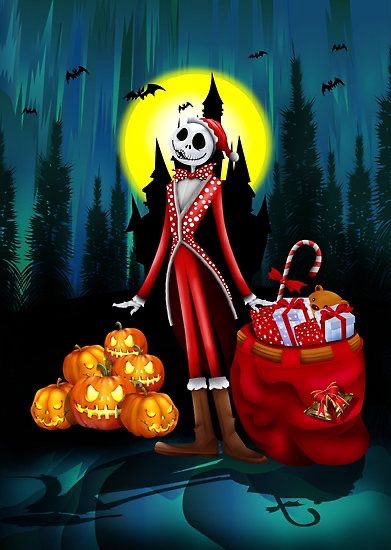
In The Nightmare Before Christmas, Jack Skellington literally walks from Halloween Town into Christmas Town and decides that Halloween can become Christmas.
Tim Burton basically created the business plan decades ago.
Jack is the seasonal retail executive Spirit Halloween didn’t know it needed.
Halloween Town discovers Christmas, becomes fascinated by it and decides, Hey, we could do this.
Spirit Halloween should be standing there saying, “Exactly, Jack. That’s what we’ve been trying to tell you.”
It’s almost too perfect.
You could even build the entire marketing concept around it.
Halloween merchandise gets boxed up. Christmas merchandise rolls in. Jack Skellington becomes the unofficial ambassador between the two seasons. The store doesn’t disappear—it transforms.
And there’s something almost poetically appropriate about that.
Halloween and Christmas are already two of America’s biggest decoration-driven holidays. Both have elaborate displays. Both have costumes. Both have lights. Both have inflatable lawn decorations. Both have people who transform their homes into something resembling a theme park.
Halloween has skeletons.
Christmas has reindeer.
Halloween has witches.
Christmas has elves.
Halloween has ghosts.
Christmas has… well, depending on the inflatable display, sometimes enormous snowmen.
The transition practically writes itself.
And then, when Christmas is over, perhaps you become Spirit Valentine’s Day.
Although I’m not entirely sure America needs a store dedicated entirely to enormous inflatable cupids and red-heart lawn decorations.
But knowing America, someone would buy them.
Then comes St. Patrick’s Day. Easter. Maybe Fourth of July.
Eventually you could have Spirit Holidays, a seasonal retail store that simply changes personalities throughout the year.
And that’s where The Nightmare Before Christmas becomes more than just a cute cultural reference. It almost provides the perfect fictional explanation for the entire business model.
Jack Skellington figured out that Halloween didn’t have to exist in isolation.
Spirit Halloween could figure out the same thing.
The genius of the temporary-store concept is that it doesn’t necessarily require the store itself to be temporary. The theme can be temporary.
That’s an important distinction.
You already have the real estate. You already have the retail infrastructure. You already have customers walking through the doors. Why not change the merchandise instead of changing the address?
Maybe there are logistical reasons Spirit doesn’t simply transform into a Christmas retailer. Maybe its supply chain, leases, inventory strategy or corporate structure are specifically optimized around Halloween. Maybe Christmas retail is already too competitive to make the economics work.
There are probably spreadsheets somewhere that explain all of this.
But from the perspective of the average consumer, it still feels like an opportunity sitting right there in the parking lot.
You have a building.
You have customers.
You have employees.
You have retail equipment.
You have seasonal merchandise.
And you have another gigantic retail holiday waiting approximately twelve hours after Halloween ends.
Use the building.
Tim Burton already gave you the transition.
Jack Skellington already crossed the seasonal border.
All Spirit has to do is follow him.
I’m not asking Spirit Halloween to reinvent capitalism.
I’m simply suggesting that when the last child has returned from trick-or-treating and the last plastic skeleton has been packed away, maybe don’t turn off the lights and walk away from the building.
Replace the skeletons with Santas.
Replace the cobwebs with tinsel.
Replace the haunted-house music with Christmas music.
And replace Spirit Halloween with Spirit Christmas.
Then, sometime around January 2, tear it all down again.
Because if we’re going to have temporary retail stores appear out of nowhere every year, disappear just as quickly and occupy perfectly good commercial space for only a few weeks, we might as well get more than one holiday out of the deal.
After all, if capitalism has taught us anything, it’s this:
There’s no reason a store that sells inflatable skeletons for six weeks can’t sell inflatable Santas for six weeks.
And somewhere, Jack Skellington is probably standing in a boardroom, pointing at the Christmas sales projections and saying:
“What’s this?”

