Dwain Northey (Gen X)
A Basket of Deplorables and a Couple of Bombs: The Great Republican Outrage Double Standard
There is apparently a special set of rules in American politics, and like most things in modern Republican politics, the rules depend entirely on who is talking. If a Democrat says something Republicans don’t like, we need congressional investigations, televised hearings, public apologies, and possibly a national day of mourning. If Donald Trump says something that would make a reasonably functioning democracy reach for the emergency brake, well, that’s just Donald being Donald.
Apparently, context is everything. Accountability is optional. And hypocrisy has become so thoroughly institutionalized that we might as well give it a cabinet position.
Remember Hillary Clinton’s infamous basket of deplorables comment during the 2016 presidential campaign? She suggested that a portion of Trump’s supporters belonged in a basket of people who were racist, sexist, homophobic, xenophobic, and otherwise committed to some rather unpleasant attitudes. Was it a politically wise thing to say? Probably not. Did it hand the Trump campaign a gift-wrapped opportunity to portray itself as the victim of an elitist establishment? Absolutely.
Republicans treated that statement like Hillary had desecrated the Constitution, insulted the Founding Fathers personally, and kicked a puppy on live television. It became a campaign rallying cry, a national scandal, and supposedly definitive proof that Democrats despised ordinary Americans.
Never mind that she was describing a segment of his supporters, not every person who voted for him. Never mind the actual behavior and rhetoric she was criticizing. The phrase itself became the crime. The audacity of a Democrat expressing an unflattering opinion about certain Trump supporters was apparently beyond the limits of civilized political discourse.
How dare she?
And now, let’s turn our attention to Donald Trump, whose recent rally remarks about Los Angeles and San Diego being taken out by Iran have generated a considerably different response. Trump was discussing the war with Iran and the potential consequences of an Iranian attack, rather than straightforwardly advocating that the United States bomb its own cities. Context matters, and it should. But the question remains: Where is the same level of outrage, scrutiny, and accountability that Republicans demanded from Hillary Clinton?
Two major American cities. Millions of people. American citizens going about their daily lives. Families, children, hospitals, schools, businesses, and all the other ordinary things that make up a city.
And suddenly, we’re having a conversation about the possibility of those cities being attacked, while much of the political response seems to amount to, “Well, that’s Donald. You know how he is.”
And there it is. The entire Republican double standard distilled into one convenient little shrug.
Hillary calls some people deplorable, and we’re supposed to believe she committed a political sin of historic proportions. Donald talks about American cities being destroyed in the context of a foreign conflict, and suddenly everyone discovers the therapeutic benefits of lowering their expectations.
One statement gets treated like heresy. The other gets filed under Things Trump Says, somewhere between an insult directed at a reporter and another late-night social media tantrum.
Apparently, calling somebody a name is more threatening to the republic than talking about catastrophic violence. Who knew the greatest danger to our democracy was an adjective?
The Great Republican Vocabulary Police
But this selective outrage isn’t limited to Hillary Clinton or the things Trump says about American cities. Republicans have spent decades demonstrating that political language is perfectly acceptable right up until somebody uses it against them.
Remember when Republicans made a point of calling it the Democrat Party instead of the Democratic Party? This wasn’t simply a grammatical preference or an innocent case of forgetting a word. It was a deliberate political tactic intended to strip away the word Democratic and, in the eyes of some critics, emphasize the word rat hidden inside Democrat.
Very clever. Somewhere, a seventh-grade playground bully was taking notes.
The Democratic Party became the Democrat Party, as though changing a single syllable would somehow invalidate its members’ political philosophy. Because apparently, if you can make the other side’s name sound sufficiently irritating, you don’t have to engage with its policies.
Now, turn that same childish wordplay around.
Call them the Republic-Cons. Call them the Grand Old Pedophile Party, particularly when criticizing the hypocrisy of politicians who claim to champion family values while their party faces scandals involving sexual misconduct or abuse. Suddenly, the humor isn’t quite so funny. Suddenly, the language is offensive. Suddenly, we’re told that such rhetoric is beyond the pale, an attack on decent people, perhaps even something approaching treason.
Treason.
We have apparently reached a point in American political discourse where a childish nickname for the opposition can be presented as evidence of patriotism when Republicans use it, but as evidence of moral depravity when Democrats return the favor.
And let’s be clear: allegations of sexual abuse are serious matters. They should be investigated based on evidence, not political affiliation. No political party’s entire membership should be presumed guilty because of the actions of particular individuals. But the same standard must apply to everybody. If Republicans can use scandals involving individual Democrats to attack an entire party, they cannot reasonably demand that their own party be shielded from criticism when its members are implicated in similar scandals.
You don’t get to weaponize the behavior of individual opponents and then demand collective immunity for your own side.
And no, calling a political party an insulting nickname is not treason. Treason has a specific constitutional meaning. Being offended by somebody’s political rhetoric doesn’t magically transform that rhetoric into a crime against the country.
The Constitution does not contain a provision guaranteeing Republicans freedom from hurt feelings.
If it did, the Founding Fathers would have needed to establish a Department of Emotional Support before they even got around to writing the Bill of Rights.
Dumb Democrats and the Fragile Republican Ego
Then there’s Donald Trump’s latest linguistic masterpiece: calling Democrats “Dumb Democrats.”
Let that sink in for a moment.
The man who has built a political identity around insulting opponents, ridiculing journalists, assigning demeaning nicknames to political rivals, and treating public discourse like a professional wrestling promo has apparently discovered that alliteration is a devastating political weapon.
Dumb Democrats.
It’s practically Shakespeare. Somewhere, a high-school English teacher is wondering why we bother teaching metaphors when a president can simply repeat an insult until his audience applauds.
And, of course, Trump is entitled to criticize Democrats. Political leaders should be challenged, mocked, and held accountable. That’s part of living in a democracy.
But here’s the interesting part: Republicans have spent years insisting that Democrats are destroying civility in American politics. They condemned the “basket of deplorables.” They objected to criticism of Trump supporters. They have portrayed opposition rhetoric as proof that Democrats hate America and its citizens.
Yet when Trump calls his opponents dumb, his supporters are expected to regard it as entertaining political theater.
Apparently, the difference between an unacceptable insult and a brilliant political zinger is whether Donald Trump delivers it.
If Hillary calls a segment of Trump’s supporters deplorable, she’s an elitist who despises half the country.
If Trump calls Democrats dumb, he’s a master communicator connecting with ordinary Americans.
If a Democrat uses a mocking nickname for Republicans, it’s evidence of the left’s hatred and intolerance.
If Republicans rename the Democratic Party to work a rat joke into the conversation, it’s just politics.
And if somebody turns the wordplay around and gives Republicans an equally unflattering nickname, suddenly we’ve crossed a line that apparently only Republicans are authorized to draw.
You can practically hear the collective gasp from the party that made political insult comedy a central component of its campaign strategy.
How dare you use our tactics against us?
Outrage Is a One-Way Street
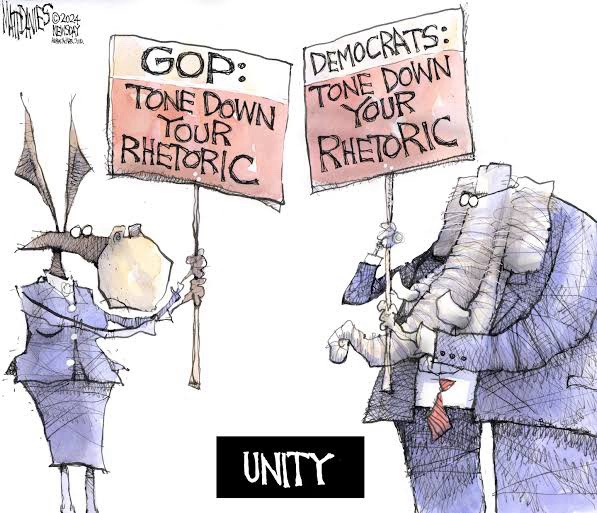
This is what makes the entire spectacle so exhausting. It isn’t that politicians insult one another. That’s hardly new. American politics has always included name-calling, personal attacks, and rhetoric that would make a respectable dinner party end early.
The problem is the manufactured moral outrage that appears whenever one side does something the other side has been doing for years.
Republicans don’t have to like Hillary Clinton’s language. Democrats don’t have to like Trump’s. Neither party has a monopoly on intelligence, decency, or patriotism. And neither party should be exempt from criticism.
But if we’re going to establish standards for political speech, let’s establish standards that apply equally.
If calling people deplorable is unacceptable, explain why calling millions of Americans dumb is acceptable.
If political nicknames are evidence of a deteriorating national culture, then let’s acknowledge that the deterioration doesn’t magically stop when Republicans are holding the microphone.
If criticizing an opponent’s supporters is an attack on the country, then perhaps we should stop treating every Trump rally insult as a contribution to the national interest.
And if a president’s remarks about cities being destroyed deserve context, then give context to everyone else’s remarks, too. Don’t turn a single phrase from a Democratic politician into a permanent indictment while providing an endless supply of interpretive charity to a Republican president.
The standard cannot be that Republicans get to be crude, insulting, and provocative while Democrats must remain perfectly diplomatic, even when responding to the same behavior.
That isn’t a standard. It’s a loyalty test.
And the people administering that test seem remarkably confident that their own side will never have to take it.
The Final Irony
Maybe that’s the real story behind the basket of deplorables, the Republic-Cons, the rat jokes, and the Dumb Democrats.
It’s not really about vocabulary. It’s about power. It’s about who gets to define what is acceptable, who gets to deliver insults without consequences, and who is expected to apologize for daring to respond.
The Republican political machine has spent years cultivating a culture in which outrage is a weapon to be deployed selectively. A Democrat’s unfortunate phrase can be replayed for a decade. A Republican’s outrageous statement can be excused before the news cycle has finished reporting it.
And the more outrageous the statement, the more elaborate the excuses become.
Eventually, the whole exercise starts to resemble a schoolyard argument in which one kid gets to throw rocks, pull hair, and call everyone names, but the moment somebody throws a rock back, he runs to the teacher and announces that he’s being bullied.
The teacher, inexplicably, suspends the other kid.
And the rest of us are left wondering when the adults are going to return to the room.
Here’s a thought: Maybe the country would be better served if we spent less time debating whether political insults hurt somebody’s feelings and more time evaluating what our elected officials actually say, do, and accomplish.
Maybe the threat to democracy isn’t a nickname, a poorly chosen adjective, or an alliterative insult.
Maybe it’s a political culture that rewards cruelty, excuses hypocrisy, and treats accountability as something that only applies to the other team.
Because if Republicans can call Democrats dumb, Democrats can call Republicans hypocritical. If Republicans can mock the Democratic Party’s name, Democrats can return the favor. And if Republicans can demand that Hillary Clinton be judged by every word she uttered in 2016, then Donald Trump can be judged by the words he utters today.
That’s not persecution. That’s equality.
And if the Republican Party finds equality of standards intolerable, perhaps Hillary wasn’t entirely wrong about the existence of deplorable behavior.
Although, to be fair, the phrase basket of deplorables may no longer be sufficient.
At this point, we’d probably need a warehouse.

