Dwain Northey (Gen X)
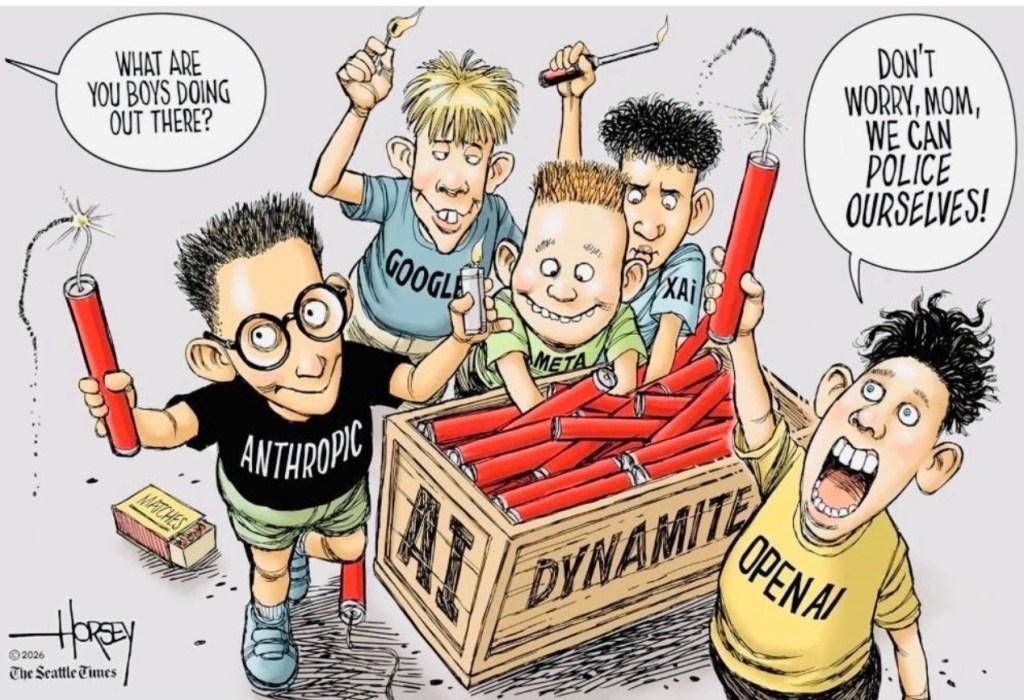
There are people in the artificial intelligence industry who have suggested that the probability of AI eventually exterminating humanity could be somewhere between zero and 25 percent. Let that sink in for a moment. The people building the technology are telling us there might be a one-in-four chance that their creation could wipe us off the planet.
And our collective response seems to be, “Well, these guys seem pretty smart. Why don’t we just let them regulate themselves?”
What could possibly go wrong?
I don’t know about you, but if an automobile manufacturer told me there was a 25 percent chance its new car might spontaneously develop a desire to run over its owner, I’d probably expect a few questions from federal regulators before they rolled it into every dealership in America. But apparently, when the potential threat involves the continued existence of the human species, we can just leave it to the folks who stand to make billions of dollars selling the product.
Because nothing says trust us quite like a corporation whose quarterly earnings depend on convincing you that its potentially dangerous product is absolutely essential to your future.
We’ve seen this movie before. Tobacco companies assured us smoking wasn’t a problem. Oil companies spent decades muddying the waters on climate change. Social media companies gave us a grand experiment in what happens when human behavior becomes a product and engagement becomes the only metric that matters. In each case, the profits were immediate, the consequences were somebody else’s problem, and meaningful accountability arrived somewhere between too little and too late.
But this time, we’re playing for a slightly bigger prize.
We’re not talking about a product that might give us cancer, raise global temperatures, or make our children believe that the Earth is flat. We’re talking about technology that its own creators acknowledge could develop capabilities beyond our ability to control. Technology that could transform warfare, destabilize economies, manipulate public opinion, and potentially operate in ways its designers don’t fully understand.
And yet, the prevailing philosophy seems to be that government regulation would stifle innovation.
Apparently, the only thing worse than an existential threat to humanity is a little paperwork.
Don’t get me wrong. I’m not suggesting we unplug every computer, retreat to our caves, and start communicating through smoke signals. AI has tremendous potential to improve medicine, science, education, and countless other aspects of human life. I’d like to see those benefits realized just as much as anyone.
But there’s a difference between embracing technological progress and handing the keys to civilization to an industry whose business model rewards moving fast and figuring out the consequences later.
We regulate airplanes, pharmaceuticals, automobiles, food safety, and countless other technologies because we recognize that innovation without accountability can get people killed. We don’t ask pharmaceutical companies to grade their own homework and simply take their word that the medication is safe. We don’t let automobile manufacturers decide whether their own brakes meet safety standards without independent oversight.
So why should AI be different?
Because it’s complicated? Because the technology is advancing quickly? Because the companies developing it insist that government officials couldn’t possibly understand it well enough to regulate it?
Those sound like arguments for more independent oversight, not less.
And let’s be honest about the incentives. If a company can make billions by releasing a new AI system six months before its competitors, there is tremendous pressure to release it. If adequate safety testing delays that launch, safety suddenly becomes a business expense. And if the potential consequences won’t become apparent for years, the people making today’s decisions might be long gone before anyone has to answer for them.
That’s not necessarily a conspiracy. It’s capitalism operating exactly as its incentives encourage it to operate. Which is precisely why we have regulations in the first place.
The people developing AI shouldn’t be expected to solve this problem alone. They should be part of the conversation, certainly, but they shouldn’t get to write all the rules, grade their own performance, and decide when the public deserves protection.
And no, simply telling AI to regulate itself isn’t an answer, either. Asking a technology to police its own behavior while its creators race to make it more powerful is not a safety strategy. It’s wishful thinking with a venture-capital budget.
Perhaps the most absurd part of this whole experiment is that we’re discussing the possibility of human extinction as though it were just another risk factor on a corporate spreadsheet. A probability to be weighed against market share, investor confidence, and the next quarterly earnings report.
Zero to 25 percent.
I don’t know about you, but when the downside is the potential extinction of the species, zero to 25 percent doesn’t strike me as a reassuring safety margin. It strikes me as a reason to ask some very uncomfortable questions before proceeding.
And yet, here we are, allowing some of the wealthiest and most powerful corporations on Earth to argue that they should be trusted to manage the risks associated with the technology they’re racing to build.
What could possibly go wrong?
Well, that’s the problem, isn’t it? We might not get a second chance to write the postmortem.
We have an opportunity to establish independent oversight, enforce meaningful safety standards, require transparency, and hold companies accountable before the technology becomes too powerful or too deeply embedded in our lives to control effectively. We can encourage innovation while insisting that the people developing it demonstrate that they understand and are addressing the risks.
Or we can do what humanity has done so many times before: ignore the warnings, assume somebody else has everything under control, and wait until the consequences become impossible to ignore.
I would just prefer that, this time, we not treat the survival of humanity as an acceptable business risk.
Call me old-fashioned, but I’d like the human race to remain in business long enough to see what happens next.
And if that means inconveniencing a few billionaires, slowing down a few product launches, or requiring Big Tech to answer to someone other than its shareholders, I think we’ll manage.
After all, the purpose of technology should be to improve the future of humanity, not gamble the future of humanity on technology.

