Dwain Northey (Gen X)
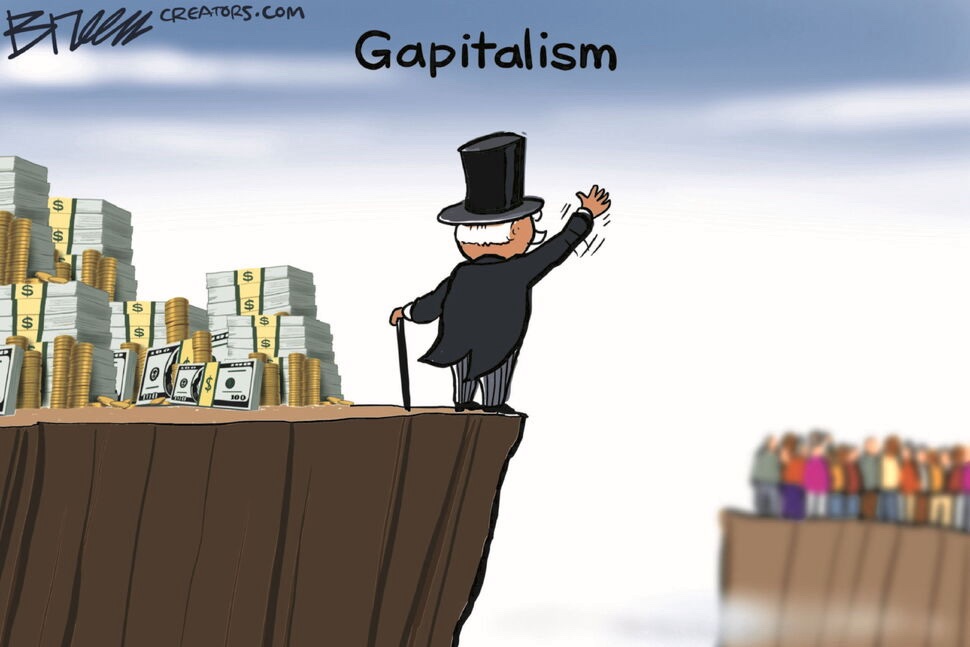
Every election, every political debate, every time someone tries to explain why Americans are angry, frustrated, or struggling to get by, we hear the same familiar phrase: “It’s the economy, stupid.”
It has become the political equivalent of a universal answer. If people are unhappy, look at the economy. If politicians are losing elections, look at the economy. If working Americans can’t afford groceries, rent, or health insurance, well, apparently, we need to look at the economy.
But I think we’ve been getting the phrase wrong all along.
It isn’t “It’s the economy, stupid.”
It’s the economy is stupid.
Somehow, we have been bamboozled into believing that if we give more money to people who already have more money than they could reasonably spend in several lifetimes, that wealth will somehow trickle down to everyone else. We have been sold this economic fairy tale for decades, and we keep coming back for another helping, despite the fact that the promised results never seem to arrive for the people who need them most.
The theory is simple enough: lower taxes on corporations and the wealthy, remove regulations, let businesses keep more of their profits, and eventually everyone benefits. The rich get richer, businesses grow, jobs appear, wages rise, and we all live happily ever after.
Except that isn’t what happens. At least, not for everyone.
The money accumulates at the top, corporate profits soar, executive compensation reaches astronomical levels, and the average American is left wondering how working forty hours a week somehow became insufficient to pay for the basic necessities of life.
Apparently, the problem isn’t that the system isn’t working. It’s that we’re still waiting for the part where it works for us.
We have confused the accumulation of wealth with the health of an economy. They are not the same thing.
We live in a capitalist, consumer-based economy. Businesses manufacture products, provide services, and sell goods because people buy them. That sounds remarkably simple, doesn’t it? You need customers with money to sustain a business. Without customers, you don’t have a market. Without a market, you don’t have a business. You have a warehouse full of inventory and a very expensive accounting problem.
Yet somehow, the people running some of the largest corporations in the world seem determined to eliminate the very people their businesses depend on.
Take Jeff Bezos and the continued push toward automation in Amazon’s distribution network. The goal is to make operations more efficient, reduce labor costs, and increase profits. From the perspective of an individual corporation, that makes perfect sense. Why pay thousands of employees if machines can perform the same work for less?
But let’s take that logic one step further.
Amazon sells products to consumers. Consumers need money to purchase those products. Most consumers get that money by working for a living. If enough companies automate their operations, eliminate jobs, and suppress wages, where exactly do they expect the next generation of consumers to get the money to buy their products?
Does Bezos imagine that the robots will eventually order everything, too?
Perhaps somebody should explain to the corporate boardroom that a robot might pack a box, move a pallet, or sort a shipment, but it doesn’t need a new television, a pair of shoes, a refrigerator, or a birthday present for its kid. It doesn’t need to pay rent. It doesn’t buy groceries. It doesn’t contribute to the consumer economy beyond whatever investment its owner makes in keeping it operational.
The company saves money on labor, but if enough companies follow the same strategy, they collectively weaken the purchasing power of their customers.
Individually rational decisions can produce a collectively stupid outcome.
And that, in a nutshell, is the problem with an economic system that rewards businesses for cutting costs without requiring anyone to consider what happens when the people whose costs are being cut can no longer afford to participate in the economy.
Historically, commerce began with a much simpler proposition. Someone had something another person needed, and the two found a way to exchange value. Perhaps a farmer traded food for a service. Perhaps someone repaired a roof in exchange for livestock. Eventually, currency made those transactions easier, and increasingly complex markets developed around them.
But the fundamental principle never changed: an economy depends on people exchanging goods and services.
Money is the mechanism. People are the participants.
You can make that mechanism more sophisticated, automate transactions, develop global supply chains, and create financial instruments so complicated that even the people trading them struggle to explain what they’re worth. But none of that changes the basic fact that a functioning consumer economy needs consumers who can afford to consume.
And consumers need money.
Which brings us to the other great economic myth: the idea that lowering taxes on corporations and the wealthy automatically produces better outcomes for everyone.
Look back at periods in American history when the top marginal income tax rates were substantially higher than they are today. Consider the postwar decades, when the country experienced strong economic growth, expanding middle-class prosperity, rising wages, and the development of a broad consumer market. The economy grew while taxes on the highest incomes were much higher than the rates many wealthy Americans pay today.
Now, history is complicated. Tax rates alone do not explain economic growth, and the headline marginal tax rate was not necessarily what wealthy individuals actually paid after deductions and loopholes. Other factors, including demographics, productivity, labor organization, public investment, and global economic conditions, mattered enormously.
But the historical record does undermine the claim that low taxes on the wealthy are an absolute prerequisite for prosperity.
We managed to build an enormous economy, expand the middle class, and create widespread consumer prosperity without giving the richest Americans every tax break they could possibly want.
Imagine that.
When workers earned enough to buy homes, raise families, purchase cars, and spend money on things beyond their immediate survival, that spending supported businesses. Those businesses hired more workers, expanded their operations, and sold more products. The money circulated through the economy, creating additional demand and opportunity.
Higher wages were not simply a cost imposed on businesses. They were also a source of customers.
Today, too many Americans are working two or three jobs just to keep their heads above water. They work longer hours, take on more debt, postpone medical care, and watch the price of basic necessities consume an ever-larger portion of their paychecks.
Then we wonder why people are anxious about the economy.
Perhaps it’s because the people doing the work are increasingly unable to afford the products and services their labor helps create.
We celebrate record corporate profits while families struggle to cover the electric bill. We congratulate executives for reducing payroll expenses while wondering why consumer confidence is weak. We praise companies for increasing productivity while ignoring the question of who benefits from that productivity.
If all the additional wealth goes to people who already have more than enough, the benefits to the broader economy can be surprisingly limited.
And this is where the difference between the spending habits of ordinary workers and the wealthy becomes important.
Give someone earning $50,000 a year an additional $10,000, and there’s a good chance a substantial portion of that money will go straight back into the economy. They’ll pay down debt, replace an aging appliance, repair their car, buy better groceries, catch up on bills, or finally take the family somewhere other than the living room.
Some will save a portion, and that’s sensible. But a significant share will likely be spent because they have needs that their existing income cannot fully meet.
Now give someone earning $10 million a year another $10 million.
Are they going to buy twice as many groceries? Drive twice as many cars? Purchase twice as many houses to live in? Replace their wardrobe every afternoon?
Of course not.
They might spend some of it, invest it, purchase additional property, or finance a new business. Wealthy people do invest, and investment can support economic growth. It would be inaccurate to suggest that every dollar retained by a wealthy person simply disappears into a bank vault.
But money invested in financial assets does not automatically translate into immediate consumer spending, higher wages, or new jobs. The outcome depends on where that money goes and whether it creates productive economic activity.
There is a difference between money circulating through the economy and money accumulating in financial portfolios.
A dollar in the hands of someone who needs to spend it often does more immediate work for the consumer economy than another dollar given to someone who has already satisfied nearly every material need.
This isn’t about punishing success or declaring that nobody should be wealthy. It’s about understanding how an economy functions and recognizing that the people who do the work and purchase the products are not incidental to the system. They are essential to it.
A business cannot thrive indefinitely by making products that fewer and fewer people can afford.
A corporation cannot endlessly reduce labor costs without consequences if those reductions weaken the purchasing power of its customer base.
And a country cannot build a durable middle class by treating wages as an expense to eliminate rather than income that sustains demand.
Yet we continue to make policy decisions as though the wealthiest Americans are the only people capable of keeping the economy moving. We cut taxes at the top, weaken worker protections, tolerate the concentration of market power, and tell struggling families to work harder, learn new skills, or stop buying coffee.
Because apparently, the person earning $35,000 a year is the problem, not the economic structure that leaves them unable to afford the necessities their parents could purchase on a single income.
At some point, we have to stop confusing what is good for an individual corporation with what is good for the entire economy.
A company may increase its profits by eliminating jobs. But if every company eliminates enough jobs, who buys the products?
An executive may increase shareholder returns by suppressing wages. But if wages remain stagnant while the cost of living rises, who sustains consumer demand?
A wealthy investor may accumulate another billion dollars. But if the money isn’t being put to productive use, how much does that additional accumulation contribute to the prosperity of the country as a whole?
These are not radical questions. They are basic questions about how a consumer economy is supposed to function.
And the answers suggest that we should be measuring economic success differently.
Instead of obsessing over stock market records, corporate earnings, and the growing fortunes of billionaires, perhaps we should pay more attention to whether ordinary people can afford housing, healthcare, food, transportation, and a little enjoyment of the lives they’re working so hard to maintain.
Perhaps we should ask whether productivity gains are translating into better wages, shorter working hours, and greater financial security, rather than simply larger executive bonuses.
Perhaps we should recognize that public investment, fair taxation, and a strong middle class are not necessarily obstacles to economic growth. They can be among its foundations.
Because when workers have money, they spend it. When they spend it, businesses have customers. When businesses have customers, they have reasons to expand, invest, and hire.
That isn’t some mysterious socialist conspiracy. It’s how a consumer economy works.
So the next time an election rolls around and politicians start repeating that familiar phrase, “It’s the economy, stupid,” perhaps we should correct them.
It’s not simply a question of whether the economy is growing. It’s a question of who is benefiting from that growth, who is paying for it, and whether the system is sustainable when the people at the bottom can no longer afford to participate.
We have spent decades being told that if we make the wealthy wealthier, prosperity will eventually find its way to everyone else. Meanwhile, the gap between those who have more money than they can reasonably spend and those who cannot afford their monthly bills continues to define American life.
The solution isn’t to destroy capitalism. It’s to stop pretending that capitalism works best when we undermine the purchasing power of the very people who make it possible.
An economy should be a system that creates and exchanges value, not an elaborate mechanism for transferring an ever-greater share of that value to the people who already own the most.
We don’t need to hate the wealthy. We need to understand that their fortunes ultimately depend on a functioning society, a productive workforce, and customers with money in their pockets.
You can automate the warehouse, reduce the payroll, eliminate the middleman, and squeeze every last cent out of production. You can celebrate the resulting profits and congratulate yourself on having built a more efficient company.
But sooner or later, somebody has to buy what you’re selling.
And if you’ve eliminated their job, stagnated their wages, and made everything they need more expensive, you might discover that you’ve optimized your business right into a shrinking market.
Congratulations. You’ve won the quarterly earnings report and lost the economy.
So, yes, every election is about the economy. Every administration claims to know how to fix it. Every political party promises that its policies will make life better.
But maybe the question isn’t whether we can make the economy grow.
Maybe the question is why we’ve built an economy that can produce more wealth than ever before while leaving so many of the people responsible for producing and purchasing that wealth struggling to get by.
Because the economy isn’t just stupid when we misunderstand it.
It’s stupid when we keep rewarding a system for accumulating money at the top while making it harder for everyone else to afford the things that keep the system alive.
And if we can’t figure out that an economy needs customers who can afford to be customers, then perhaps the problem isn’t the economy.
Perhaps the problem is us.

