Dwain Northey (Gen X)
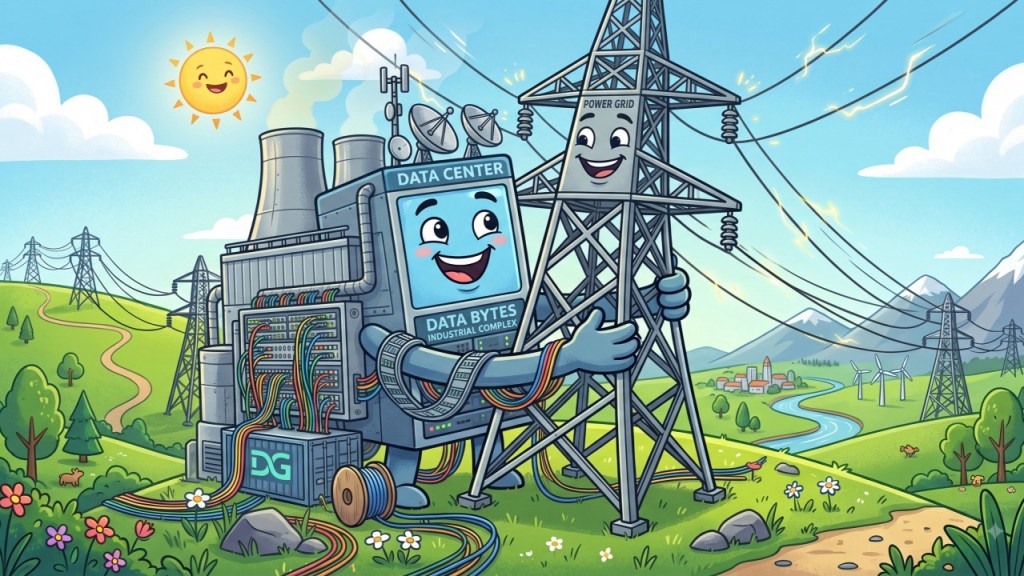
Let me preface this by saying I’m not an engineer, an architect, or someone who designs data centers for a living. I’m just a guy looking at the growing controversy surrounding data centers, particularly their enormous consumption of electricity and water, and wondering why we seem to be approaching the problem as though these facilities have to operate at the expense of the communities surrounding them.
We keep hearing about data centers being built across the country, the enormous amounts of electricity they consume, the strain they put on local power grids, and the water required to keep all those servers from overheating. Communities are increasingly being asked to shoulder the burden of these facilities while the companies building them reap the benefits.
And I keep coming back to a relatively simple question: Why aren’t we designing these facilities to be more self-sufficient?
I have a couple of ideas. They may not be technically practical in exactly the form I’m imagining, and I’m sure an engineer could explain a dozen things I haven’t considered. But sometimes looking at a problem without being invested in the existing way of doing things allows you to ask a different question.
First, let’s deal with the water.
One of the biggest complaints about data centers, particularly in places like Arizona and other water-stressed regions, is how much water they require for cooling. We’re talking about facilities that can place an additional burden on communities already struggling to manage a limited water supply.
My thought would be to design the facility around a calculated water-storage and recirculation system. Essentially, build the necessary storage tanks on the property, fill them with the initial volume of water required for cooling, and continuously circulate that water through a closed-loop cooling system.
Rather than constantly drawing fresh water from municipal supplies, the facility would recycle and reuse its cooling water on the premises. Think of it as a large-scale gray-water system designed specifically for industrial cooling.
There would inevitably be some water loss through evaporation, maintenance, and system requirements. Perhaps the tanks would need periodic replenishment every 30 or 60 days, depending on the system’s actual consumption. But the objective would be to make those replenishments relatively small compared with the facility’s overall cooling requirements.
The important distinction is that the water would be a stored resource being reused rather than a continuously consumed resource being taken away from the surrounding community.
Obviously, water quality, filtration, mineral buildup, and treatment would have to be engineered into the system. But those are engineering problems to solve, not necessarily reasons to abandon the concept.
Second, let’s talk about electricity.
If we’re going to build enormous facilities that consume enormous amounts of electricity, why shouldn’t we require them to generate a substantial portion of their own power?
My idea would be to require enough property around the facility to accommodate two or three football-field-sized solar installations. Not a token collection of panels on the roof intended to make the company look environmentally responsible in its annual sustainability report, but an actual solar-generation field designed to contribute meaningfully to the facility’s electrical requirements.
The facility could incorporate battery storage to capture excess daytime generation and provide electricity when sunlight isn’t available. It could remain connected to the electrical grid for supplemental power and reliability, but the goal would be to reduce its dependence on the local electrical infrastructure.
If a company is profitable enough to build a multibillion-dollar data center, it should be capable of investing in the infrastructure necessary to support its own operation.
Third, let’s address the noise.
Anyone who has lived near industrial facilities knows that noise isn’t an insignificant consideration. Data centers require substantial cooling infrastructure, and those enormous ventilation and cooling systems can create a constant mechanical hum.
My thought would be to place the cooling fans and associated mechanical equipment inside partially or fully earth-covered sound-dampening structures. Imagine bunkered enclosures with two or three feet of engineered sound insulation, covered with earth and planted with native vegetation.
Essentially, rather than having enormous mechanical equipment sitting exposed around the perimeter of a building, you incorporate it into the landscape.
The vegetation and earth-covered structures would provide additional sound mitigation, improve the appearance of the property, and create a more natural buffer between the facility and neighboring communities.
Obviously, engineers would have to account for airflow, heat rejection, maintenance access, fire safety, and equipment ventilation. You can’t simply bury a giant cooling fan and expect it to work. But the concept of enclosing noisy mechanical equipment in engineered, sound-dampened structures seems worth exploring.
And in Arizona, using native desert vegetation rather than some decorative grass lawn would make considerably more sense.
Put all three ideas together, and you have a different approach to building a data center.
A facility with its own substantial water-storage and recycling system. Its own solar-generation infrastructure and battery storage. And cooling equipment designed to minimize noise and environmental disruption.
Would it eliminate every demand on municipal infrastructure? Probably not. Would solar panels covering two or three football fields provide all the electricity a massive modern data center requires? Almost certainly not. The actual energy requirements would have to determine the size of the installation, and additional renewable generation or other sources might be necessary.
But that’s precisely the point. These facilities should be designed around reducing their impact on the communities where they’re built, not simply connecting to whatever public resources happen to be available.
We seem to have developed an interesting business model in this country. Private corporations build enormous facilities, consume public resources, negotiate favorable utility arrangements, and then expect local communities to accommodate the consequences. When residents complain about water shortages, rising electricity costs, or industrial noise, we’re told that these facilities represent progress and economic development.
Apparently, progress means everybody else gets to pay for the infrastructure.
I’m not suggesting that data centers shouldn’t exist. Quite the opposite. We are becoming increasingly dependent on them, and artificial intelligence, cloud computing, and digital infrastructure aren’t going away. But if these companies are going to become essential components of our economy, perhaps we should start treating their infrastructure requirements as part of the cost of doing business.
Build the water system. Generate the electricity. Contain the noise. Use the land intelligently. Incorporate native vegetation. Reduce the burden on the people who already live there.
And perhaps most importantly, make self-sufficiency a requirement rather than an optional environmental talking point.
Again, I’m not an engineer. Maybe there are technical limitations that make some of these ideas impractical, or perhaps there are better ways to accomplish the same objectives. I’m perfectly willing to let the people who understand the engineering work out the details.
But I don’t think it’s unreasonable to suggest that a company capable of building a facility that processes billions of pieces of information every second should also be capable of figuring out how to recycle its water, generate more of its own electricity, and keep its neighbors from listening to its cooling equipment around the clock.
We managed to put a man on the moon. Surely we can figure out how to build a data center that doesn’t need to borrow the neighborhood’s water, electricity, and peace and quiet just to keep its computers running.

