Dwain Northey (Gen X)
The National Popular Vote: A Wonky Name for a Pretty Simple Idea
There is a term that doesn’t exactly roll off the tongue, and unless you’ve spent some time reading about election laws and constitutional mechanics, you might not recognize it: the National Popular Vote Interstate Compact. It’s a mouthful, I know. Sounds like something a committee of lawyers came up with after three days of arguing over lunch. But the idea behind it is actually pretty simple: the person who gets the most votes in a presidential election should become president. Imagine that.
For those of us who have spent years wondering how we ended up with presidents who didn’t actually win the popular vote, this is something worth paying attention to.
Let’s start with the obvious. We’ve had two presidential elections in relatively recent history where the Republican candidate won the presidency despite losing the national popular vote. George W. Bush in 2000 and Donald Trump in 2016. In 2024, Trump did win the popular vote, although by a relatively narrow margin. So this isn’t an argument that every Republican president has lost the popular vote. It’s an argument that our current system allows someone to lose the nationwide election and still occupy the Oval Office.
How exactly does that make sense in a country that likes to describe itself as a democracy?
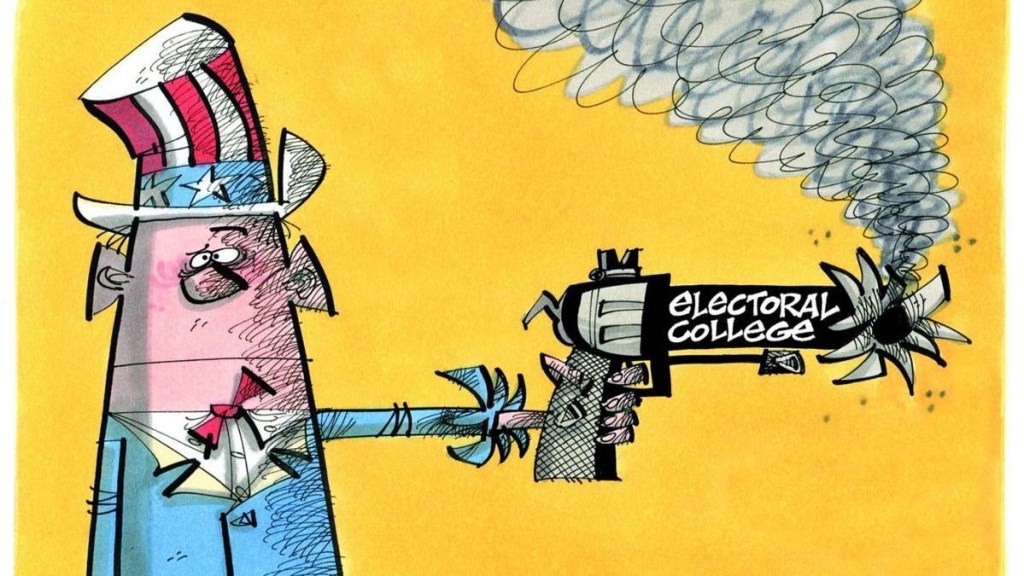
The Electoral College was established when the Constitution was written, in a very different country with very different ideas about representation, communication, transportation, and, frankly, who should be allowed to participate in elections. It was a compromise between competing political interests. Two hundred-plus years later, we’re still operating under a system that can make a handful of states disproportionately important while millions of votes elsewhere become practically irrelevant to the outcome.
We have effectively turned presidential elections into a competition over a handful of battleground states. Campaigns spend extraordinary amounts of money and time courting voters in Pennsylvania, Wisconsin, Michigan, Arizona, Georgia, and a few others, while voters in states considered safely Democratic or Republican are largely treated as background scenery.
If you live in California, your presidential vote is almost an afterthought to campaign strategists. If you live in Wyoming, the same thing applies. But if you live in one of those handful of battleground states, suddenly you’re everyone’s best friend. Politicians are practically knocking on your door with a casserole.
And that’s not what representative democracy should look like.
Enter the National Popular Vote Interstate Compact.
The concept is that states voluntarily agree to award all their electoral votes to the presidential candidate who wins the nationwide popular vote, rather than automatically awarding them to whoever wins that particular state.
There is one important catch: The compact doesn’t take effect until participating states collectively represent at least 270 electoral votes, the number needed to win the presidency.
Currently, 19 jurisdictions, including Washington, D.C., have enacted the compact, representing 222 electoral votes. That means another 48 electoral votes are needed before it becomes operational. Virginia joined in 2026, adding 13 electoral votes to the effort.
And here’s where the recent election results become particularly interesting.
Democrats have made substantial gains in the 2026 midterms. We now have a much stronger position among governors and state legislatures. Democrats have gained governorships in states including Georgia, Iowa, Nevada, Ohio, and Texas, while also gaining legislative control in several states.
That matters because this isn’t something governors can accomplish simply by signing an executive order. State legislatures must pass the necessary legislation, and governors must sign it where required. In other words, we need Democratic governors and Democratic legislators working together rather than simply celebrating election-night victories.
We have an opportunity to make some progress here.
And let’s be clear: This isn’t about Democrats trying to rig the system in their favor. If the national popular vote produces a Republican president, then that Republican should become president. If it produces a Democratic president, then that Democrat should become president. That’s the entire point.
The presidency should reflect the collective decision of the American electorate, not the mathematical outcome of a handful of state elections.
I don’t particularly care whether the candidate lives in a big city, a small town, a rural community, or somewhere in the middle of a cornfield. Their votes should count equally. Someone in Phoenix shouldn’t have a fundamentally different level of influence over the presidential election than someone in rural Ohio or Wyoming.
And before someone starts shouting that this is an attempt to eliminate the Electoral College, technically it isn’t. The compact uses the existing constitutional authority of states to determine how their electoral votes are allocated. It doesn’t require a constitutional amendment. It simply changes the rules those participating states use to award their electoral votes.
Now, will it happen overnight? Of course not. Nothing involving American politics happens overnight unless somebody is trying to give a billionaire a tax break.
But we have an opportunity, and I would like to see our newly elected Democratic governors and state legislators recognize it.
We’ve spent considerable time talking about protecting democracy, restoring institutions, and making sure every American has a meaningful voice in their government. Well, here’s an actual opportunity to do something about one of the structural problems that has been sitting in the middle of our presidential elections for generations.
We shouldn’t have to explain to someone that their candidate received millions more votes nationwide but somehow didn’t win the presidency. We shouldn’t have to tell voters in safe states that their participation is less consequential than someone else’s because of where they happen to live.
And we certainly shouldn’t have to spend every presidential election cycle watching candidates campaign in the same six or seven states while essentially ignoring everybody else.
I know we’re all feeling a little nauseously optimistic after the midterm results. But this is precisely the kind of long-term institutional change we should be pursuing. Not revenge, not political scorekeeping, and not simply replacing one group of politicians with another.
Actual reform.
The National Popular Vote Interstate Compact might have a ridiculous name, but the principle behind it is something most Americans should be able to understand.
One person. One vote. Whoever gets the most votes wins.
What a revolutionary concept for a country that has been telling the rest of the world how democracy is supposed to work for nearly 250 years.
Maybe it’s time we started practicing what we’ve been preaching.

