Dwain Northey (Gen X)
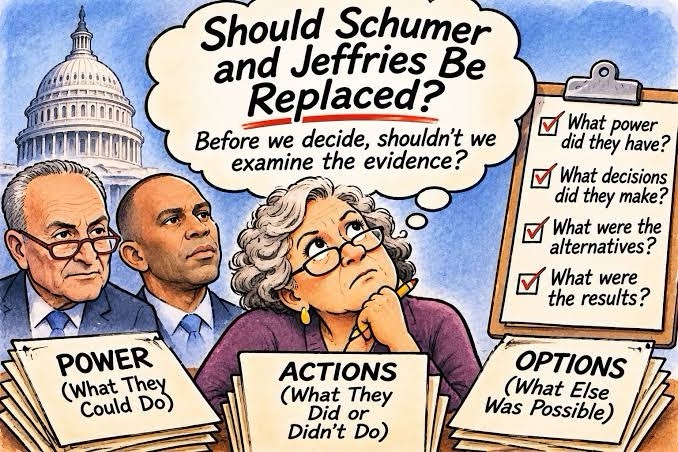
The Leadership Dilemma: Be Careful What You Wish For
Well, here we are. After celebrating a Democratic sweep and the possibility of finally changing the direction of this country, we’ve managed to find ourselves with a new dilemma. Apparently, winning elections wasn’t enough. Now we’re preparing for the inevitable internal wrestling match over who gets to sit in the big chairs in Congress. The potential fights over House Speaker and Senate Majority Leader are already becoming another test of Democratic unity.
Before everybody starts sharpening their knives, perhaps we should take a moment to remember exactly what these positions entail.
First, let’s understand that both of these jobs are largely administrative positions. The Speaker of the House isn’t suddenly handed a magic wand and given the ability to personally write legislation, fix the economy, or solve every problem facing the country. The Speaker’s primary responsibility is managing the business of the House, determining what legislation comes to the floor, overseeing the legislative agenda, and keeping the various personalities and factions of the party moving in roughly the same direction.
And let’s be honest, it’s not exactly a dream job.
You’re constantly under a microscope. Every disagreement, every legislative failure, every unexpected political development somehow becomes your responsibility. When something goes wrong, whose face do you see on television? The Speaker’s. When legislation stalls, the Speaker gets blamed. When members of your own party decide they have a better idea, congratulations, you’ve just inherited another headache.
The Senate Majority Leader faces much the same predicament. You’re responsible for managing the Senate’s schedule, organizing the legislative priorities, negotiating with members, and deciding what gets brought forward for consideration. You’re not suddenly appointed chairman of every important committee, nor do you personally control every senator’s vote.
Both positions carry considerable political influence, certainly, and they are excellent fundraising platforms. But they’re also enormous administrative responsibilities that require managing people who sometimes seem incapable of agreeing on what day of the week it is.
So why are we already entertaining the possibility of turning this into an internal Democratic pissing contest?
I understand the argument for new leadership. I understand that people want fresh faces, new ideas, and a departure from the same familiar names we’ve seen for years. There’s nothing inherently wrong with wanting change. In fact, change is often necessary. But there’s a difference between demanding accountability and creating unnecessary division just because we want to demonstrate that we’re doing something different.
We should also remember that leadership doesn’t operate in a vacuum. We elected these people, we gave them a mandate, and we still have the ability to influence the direction they take. We don’t have to agree with every decision a Speaker or Majority Leader makes. We can push them, challenge them, and demand that they follow through on the priorities that got Democrats elected in the first place.
And let’s not forget the power of the pen. Committee chairs, legislative priorities, investigations, oversight, and the ability to actually move legislation through Congress are all tools available to a Democratic majority. We have an opportunity to accomplish something meaningful, provided we don’t spend the first several months arguing amongst ourselves about who gets the better office and the nicer desk.
We just spent considerable time watching the Republican Party turn the selection of a Speaker into a political circus. Multiple rounds of voting, public disagreements, backroom negotiations, and enough internal dysfunction to make a dysfunctional family reunion look organized. We don’t need to recreate that particular performance. We’ve already seen the show, and frankly, the reviews weren’t very good.
There’s something else worth considering: The person occupying the leadership position isn’t necessarily the person who determines the direction of the party. The people behind that person, the members who provide the votes, have considerable influence over that direction.
If we want progressive legislation, stronger oversight, accountability, economic reforms, and a government that actually responds to the people who elected it, then we need to make those expectations clear. We need representatives who understand that winning an election isn’t the finish line. It’s the beginning of the responsibility.
So by all means, let’s have a discussion about leadership. Let’s consider experience, competence, effectiveness, and whether someone can actually bring the different factions of our party together. But let’s not confuse replacing leadership with changing direction. Those are two entirely different things.
We’ve spent years watching Republicans put party loyalty ahead of governing. We shouldn’t celebrate winning back Congress only to start demonstrating that Democrats are perfectly capable of doing the same thing to themselves.
We’ve got a lot of work to do, and the country is expecting results. Let’s spend less time fighting over who gets to hold the gavel and more time figuring out what we’re going to do with it.
We didn’t vote for a new set of personalities. We voted for a change in direction. Let’s not lose sight of that distinction.

