Dwain Northey (Gen X)
Apparently, We Missed the Point of Being Human
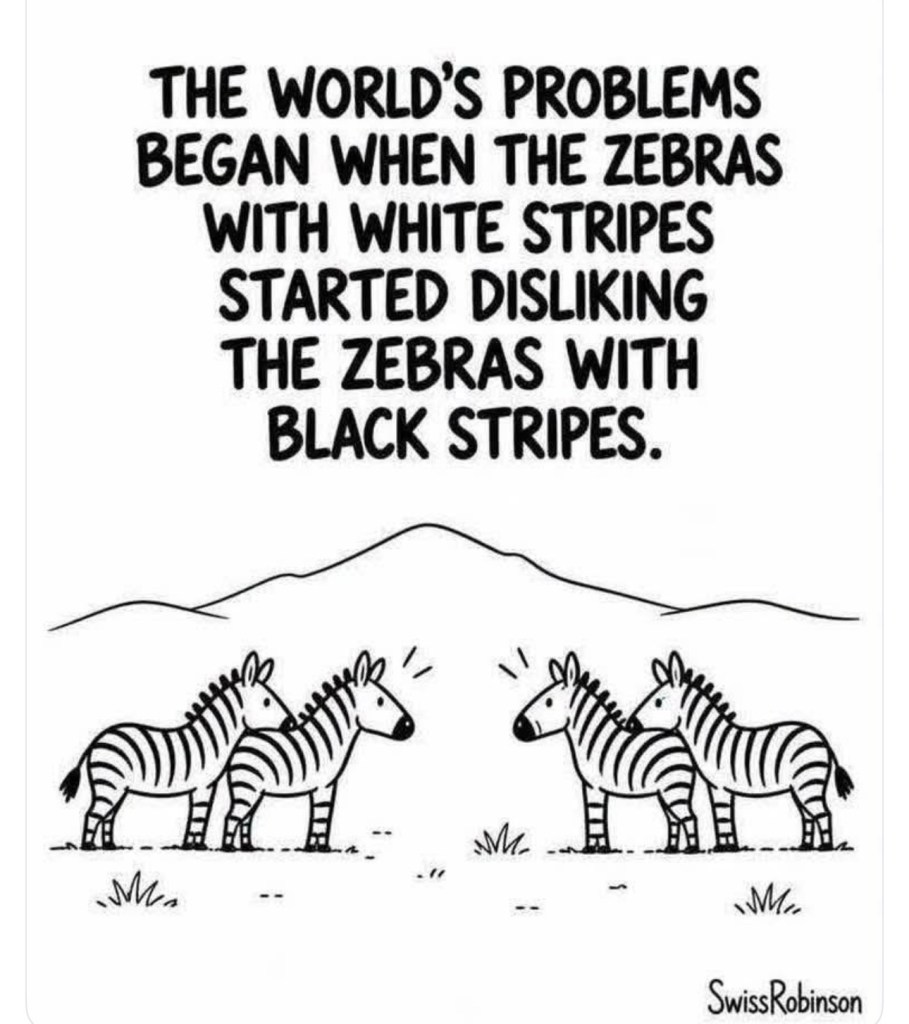
I recently came across a comment attributed to Neil deGrasse Tyson that made me laugh, not necessarily because it was particularly profound, but because it was so ridiculously accurate in illustrating the stupidity of racism. The analogy went something like this: Racism probably started when a white zebra with black stripes complained about a black zebra with white stripes.
Think about that for a minute. Two zebras, essentially the same animal, standing there arguing over the arrangement of the same two colors. Welcome to humanity. We’ve apparently been doing variations of this nonsense for thousands of years.
Somewhere along the way, human beings decided that the amount of pigment in another person’s skin was a perfectly reasonable excuse to assign value, intelligence, worth, and even basic human rights. Apparently, we looked at the extraordinary complexity of the human species and decided the most important characteristic worth judging was how much melanin somebody happened to inherit from their parents. Congratulations, civilization. We’ve reached the pinnacle of intellectual achievement.
But here’s the interesting part: Racism didn’t simply appear because people noticed that other people looked different. Humans have always recognized differences between populations. Different languages, customs, clothing, appearances, and traditions have existed throughout history. The problem developed when those differences became a convenient excuse for establishing hierarchies, claiming superiority, controlling resources, and justifying the exploitation of other human beings.
And if we’re being historically honest, racism as we understand it today was heavily shaped by colonialism, slavery, and the economic interests of people who needed an excuse for treating other human beings as property. It is considerably easier to sleep at night when you’ve convinced yourself that the people you’re exploiting are somehow inferior to you. Eventually, people even invented elaborate pseudoscientific theories to give their prejudices the appearance of intellectual credibility. Nothing says enlightened civilization quite like inventing science to justify your own bigotry.
And here we are, centuries later, still dealing with the leftovers of that intellectual dumpster fire.
The irony is that underneath all that pigmentation, we’re remarkably similar. We share essentially the same biological machinery, the same organs, the same vulnerabilities, the same capacity to love, grieve, laugh, learn, and occasionally do something spectacularly stupid. Our skin color is largely an adaptation to different levels of ultraviolet radiation over generations. That’s biology, not a ranking system. Mother Nature wasn’t handing out gold, silver, and bronze medals based on complexion.
In fact, if you want to get particularly scientific about it, human genetic variation within populations is substantial, and racial categories don’t neatly divide humanity into distinct biological groups. We’re one species with a remarkably complicated family history. Somewhere along the evolutionary journey, our ancestors spread across the planet, adapted to different environments, and developed different physical characteristics. That’s not a reason to hate one another. It’s actually a pretty extraordinary story.
And yet, somehow, we’ve managed to turn that story into a competition over whose ancestors got the better geographical real estate.
What makes racism particularly absurd is that it requires an enormous amount of effort to maintain an imaginary distinction. You have to teach it, reinforce it, defend it, pass it down, and occasionally rewrite history to keep it alive. Nobody is born looking at another infant and deciding that the amount of melanin in that baby’s skin makes it less deserving of love or compassion. Those ideas have to be learned. And unfortunately, they can be unlearned.
I’m a Gen Xer. We grew up hearing about Martin Luther King Jr., the civil rights movement, and the promise that people should be judged by the content of their character rather than the color of their skin. Somewhere between those lessons and the present day, apparently some people decided that was all a little too ambitious.
And that’s perhaps the most disappointing part. We have the technology to explore other planets, communicate instantaneously across continents, map the human genome, and develop artificial intelligence. Yet we still have people who cannot walk into a room with someone whose skin is a different shade without making assumptions about their worth.
Seriously? We can put a rover on Mars, but we haven’t figured out how to get along with the people living next door?
Maybe Tyson’s zebra analogy is more insightful than it initially appears. Imagine two zebras standing in the African savanna, arguing over their stripes while a lion watches from the bushes. The lion doesn’t care which zebra has white stripes or black stripes. It sees dinner. And perhaps there’s a lesson in that. The things that divide us often matter considerably less than the things we share.
We all bleed the same color. We all experience pain. We all have families, hopes, disappointments, fears, and an expiration date. Nobody gets an exemption from being human because their skin happens to be a different shade.
I suppose the real question isn’t why racism exists. History gives us plenty of explanations for that. The question is why, with everything we’ve learned about ourselves and the world around us, we’re still willing to entertain something so fundamentally ridiculous.
Maybe it’s time we stopped worrying about the color of one another’s stripes and started recognizing that we’re all zebras.
And if we’re going to spend our limited time on this planet arguing about something, perhaps we could find something a little more productive than the paint job.

