Dwain Northey (Gen X)
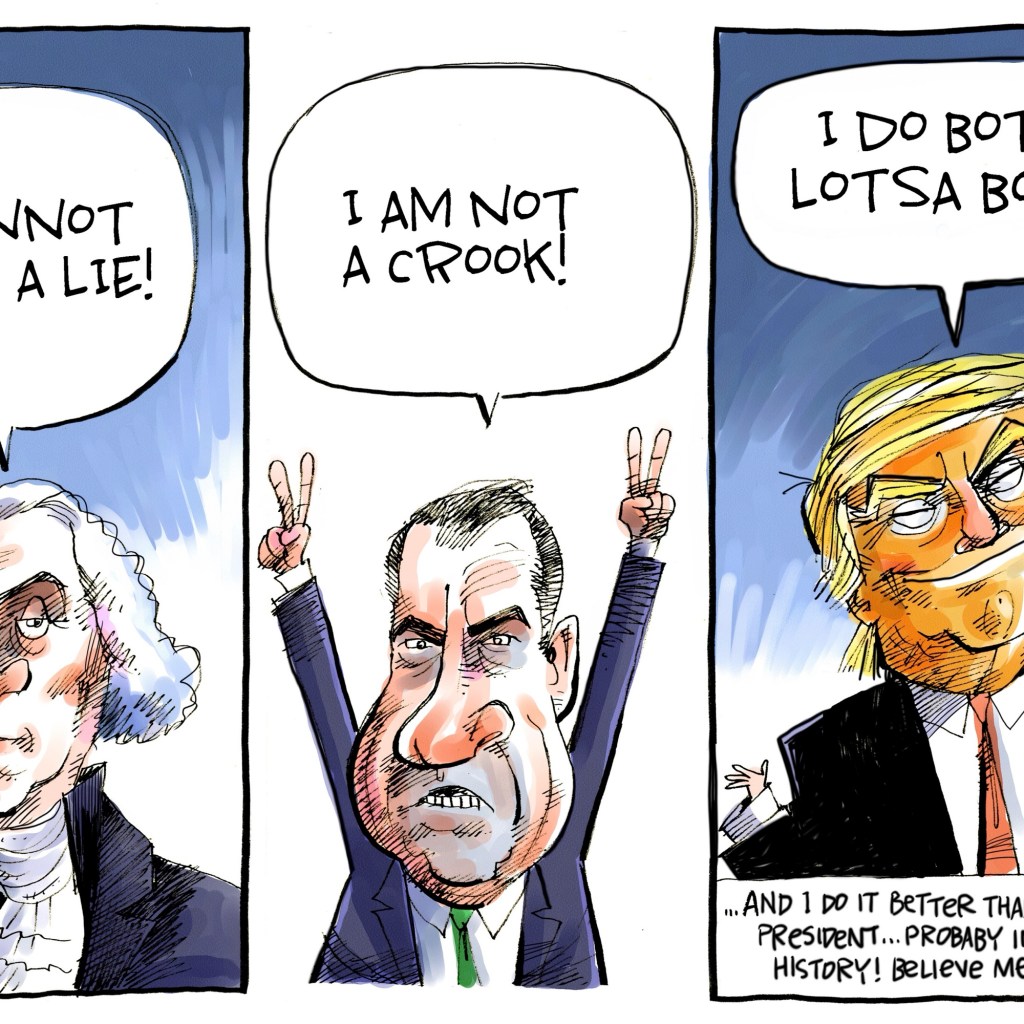
There is something particularly ironic about a man who has repeatedly demonstrated that he has little interest in history occupying an office that is, arguably, the most historically consequential position in the world. Donald John Trump has never struck me as a student of history, unless we’re talking about the history of Donald Trump. That particular subject seems to hold his undivided attention.
But perhaps if he had spent a little time studying the history of the American presidency, he might have learned something about the consequences of treating the Oval Office as personal property rather than a public trust.
We’ve had some questionable occupants of that office over the years. Warren G. Harding gave us the Teapot Dome scandal, cronyism, corruption, and an administration so thoroughly compromised that it became synonymous with presidential incompetence. Richard Nixon gave us Watergate, the abuse of executive power, political enemies lists, and a president who ultimately discovered that the Constitution wasn’t simply a decorative document sitting on somebody’s desk.
Both men left considerable stains on the institution of the presidency. Yet here we are, watching Donald Trump seemingly attempt to combine the worst characteristics of both administrations and add a generous helping of reality television, personal grievance, and authoritarian ambition.
Harding had his cronies. Nixon had his enemies list. Trump appears to have an entire government operating around the principle that loyalty to Donald Trump is more important than loyalty to the United States Constitution.
And that’s where the comparison becomes particularly uncomfortable.
The presidency was never intended to be a throne. It wasn’t designed to be a family business, a personal investment opportunity, or a platform for settling decades-old grudges. The founders deliberately established checks and balances because they understood what happens when too much power is concentrated in the hands of one individual. They had just finished separating themselves from a monarchy, after all. Apparently, somebody should have included that little historical footnote in Trump’s briefing materials.
During his second term, the attacks on established institutions, the treatment of independent government agencies, the pressure placed on political opponents, the willingness to blur the boundaries between public office and private financial interests, and the repeated questioning of constitutional constraints have raised questions that extend well beyond ordinary partisan disagreements.
This isn’t simply about whether you like his policies. It isn’t even about whether you voted for him. It’s about whether the American presidency can survive being treated as an extension of one man’s personality and personal ambitions.
And let’s be honest, the personality isn’t exactly reassuring.
Nixon eventually discovered that there were limits to presidential power. His own administration produced the evidence that ultimately brought him down. Harding didn’t live long enough to see the full consequences of his administration’s scandals, but history certainly didn’t give him a pass.
Trump seems determined to challenge whether those historical lessons still apply.
Perhaps the most disturbing aspect of all this is the normalization of behavior that would have once produced bipartisan outrage. Things that would have ended political careers in previous administrations are now treated as another Tuesday afternoon in Washington. We have become so accustomed to the daily circus that the extraordinary has become ordinary. The goalposts move, the headlines change, and yesterday’s constitutional controversy is replaced by today’s outrage.
It’s exhausting. And perhaps that’s part of the problem. Exhaustion creates indifference, and indifference is exactly what allows institutions to deteriorate.
There is a distinction between damaging a presidency and damaging the institution of the presidency itself. Presidents come and go. Some are celebrated, some are criticized, and some become cautionary chapters in American history textbooks. But the office is supposed to remain larger than the individual occupying it.
George Washington understood that distinction when he voluntarily surrendered power. Lincoln understood the weight of preserving the Union. Eisenhower understood the importance of a peaceful transfer of power. Even Nixon, eventually, had to acknowledge that he could not remain above the law indefinitely.
The question now is whether Trump understands that the presidency belongs to the American people, not to Donald John Trump.
I suspect history will have a rather unflattering answer.
And here’s the real irony: Trump seems obsessed with his legacy. Buildings bearing his name, his likeness, his signature, and his version of events. He wants to be remembered as one of the greatest presidents in American history. But history is a rather stubborn record keeper. It doesn’t necessarily cooperate with the people who want to write their own biographies while they’re still occupying the office.
Harding left behind a legacy of corruption. Nixon left behind a legacy of constitutional crisis and resignation. Trump may yet leave behind something more consequential: a presidency that tested just how much institutional damage one individual can inflict before the system finally pushes back.
Perhaps the history books will eventually need a new chapter. Not simply about another corrupt or controversial president, but about what happens when a president actively challenges the institutions designed to limit his power.
And if Trump had bothered to study those history books, he might have recognized the warning signs.
Unfortunately, he seems far more interested in being the headline than learning from the history that came before him.
The Oval Office is not a throne. The Constitution is not a suggestion. And the United States government is not a subsidiary of the Trump Organization.
Those are lessons that should never have needed repeating.
But apparently, here we are.

