Dwain Northey (Gen X)
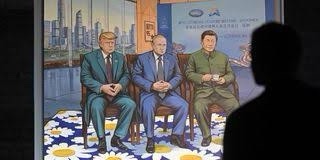
Donald’s Nuclear Conversations
Well, apparently dear Donald is having nuclear discussions with Xi Jinping and Vladimir Putin. Let that sink in for a moment. Three world leaders, two nuclear-armed adversaries, and one very large language barrier. And no, I’m not talking about Russian or Mandarin.
My first thought was that Donald has somehow managed to walk into a diplomatic situation where the deck is stacked against him before anybody even sits down at the table. Putin speaks English. Xi Jinping understands English and may speak it to varying degrees. Donald, on the other hand, doesn’t speak Russian, doesn’t speak Chinese, and, judging by some of his public statements, occasionally appears to be negotiating with the English language itself.
Which means we’re essentially trusting that the interpreters are doing their jobs, that the translations are accurate, and that Donald is actually understanding what is being said to him. That’s an awful lot of trust to put into a conversation involving nuclear weapons.
And let’s be clear about what we’re talking about here. This isn’t a disagreement over tariffs, real estate, or who gets to sit at the head of the table. We’re talking about weapons capable of destroying entire cities in minutes, killing hundreds of thousands of people in a single attack, and setting off consequences that could spread far beyond the country that launched them.
Russia and the United States possess enormous nuclear arsenals. China is rapidly expanding its own. These weapons aren’t theoretical bargaining chips. They are real missiles, real warheads, real submarines patrolling oceans, and real military systems designed to respond to perceived threats.
A misunderstanding about nuclear policy isn’t like misunderstanding the terms of a business contract. An inaccurate interpretation of an agreement about missile deployments, warning systems, weapons inspections, or launch procedures could have consequences that are almost impossible to reverse.
Imagine a discussion about limiting the number of deployed nuclear warheads. Does everyone agree on what counts as deployed? Are weapons in storage included? What about missiles aboard submarines? What happens if one side believes the other has violated the agreement?
Or consider early-warning systems. These countries depend on intelligence and technology to determine whether an incoming missile attack is real. In a nuclear crisis, leaders may have very little time to assess information and make decisions. The last thing the world needs is an ambiguous agreement, a misunderstood military commitment, or a president who doesn’t fully grasp what the other side has promised.
Because once nuclear weapons start flying, there is no opportunity to call everybody back to the negotiating table and ask for clarification.
Imagine the conversation.
Putin says something in Russian, the interpreter translates it into English, Donald hears it, processes whatever portion of it survives the journey, and responds. Then Donald says something, which gets translated into Russian, where Putin presumably gets a reasonably accurate account of what was said. Somewhere in that exchange, Xi is listening, calculating, and probably wondering how he ended up in a diplomatic version of a Three Stooges routine.
And here’s the really interesting part: Putin and Xi don’t necessarily need interpreters to understand Donald. They can listen to his public speeches, watch his interviews, read his social media posts, and have a pretty good idea of how he thinks. They have years of material to study. They know his tendencies, his ego, his need for praise, and his apparent inability to resist telling people how wonderful he is.
Donald doesn’t have that same advantage.
He has to depend on somebody else to tell him what these men are saying, what they actually mean, and whether the words being translated accurately reflect their intentions.
And nuclear negotiations aren’t just about agreeing not to push a button. They’re about verification, inspections, weapons reductions, delivery systems, submarine patrols, military exercises, communication channels, and what happens when one country believes another has violated an agreement.
There are enormous differences between saying you’ll reduce your arsenal, agreeing to reduce it, and allowing independent verification that you’ve actually done so.
Those distinctions matter.
A country cannot simply take another country’s word for it when thousands of nuclear warheads are involved. Agreements need precise language, enforceable commitments, and people who understand the technical details well enough to recognize when someone is trying to slip something past them.
Which brings us back to our dear Donald.
Diplomacy is complicated enough when everybody understands the language. It’s even more complicated when the participants have entirely different political objectives, cultural perspectives, and definitions of what constitutes an acceptable agreement.
Putin and Xi have professional diplomatic and intelligence establishments behind them. They have people whose careers are built around understanding American policy, anticipating American responses, and exploiting American political weaknesses.
What do we have?
A president who seems to believe that personal relationships are a substitute for foreign policy, that flattery is a negotiating strategy, and that declaring yourself the winner is somehow equivalent to actually winning.
I’m sure the Russians and Chinese appreciate the entertainment value.
But the stakes are not entertaining.
A nuclear exchange between major powers wouldn’t be a television spectacle with a commercial break and a chance to change the channel. It could mean entire metropolitan areas destroyed, hospitals overwhelmed or obliterated, transportation and communications systems collapsing, and millions of people dead. The economic, environmental, and humanitarian consequences would extend across borders and generations.
And even a limited nuclear exchange could trigger escalation that nobody intended and nobody could control.
That’s why these conversations require extraordinary preparation, experienced negotiators, technical expertise, and a president who understands precisely what is being discussed.
Not somebody who simply leaves the room believing he got a great deal because everyone smiled, shook hands, and told him how impressive he was.
I keep coming back to the interpreter issue because there’s an uncomfortable imbalance here. Putin and Xi have the luxury of understanding more about the American president than the American president may understand about them. They know our language, our media, our political divisions, and our institutional weaknesses. They have had plenty of opportunity to study the man sitting across the table.
Donald, meanwhile, is relying on a translation service and presumably the confidence that nobody is telling him something different from what was actually said.
Think about that for a minute.
We’re trusting that every word, every qualification, every condition, and every diplomatic distinction is being translated accurately. We’re trusting that the people advising him understand the military implications. We’re trusting that he can distinguish a genuine commitment from a cleverly worded promise designed to make him feel victorious.
And we’re doing all this while discussing weapons that can end cities.
Perhaps we should establish a new diplomatic protocol: Before Donald signs anything, somebody should read it to him in English, explain it in simple English, have an independent expert explain the military consequences, and then have another person verify that Donald understood what he just agreed to.
Because this isn’t a real estate deal in which he can declare bankruptcy if things go badly.
There is no bankruptcy protection for a nuclear war.
And there is certainly no do-over.
The rest of us are essentially trusting that the adults in the room are doing their jobs, while hoping that the man representing us understands that this particular negotiation isn’t about winning a popularity contest. It’s about making sure there is still a world left in which anybody can declare themselves the winner.

