November 2026 — Watching the Train Wreck in Slow Motion
Dwain Northey (Gen X)
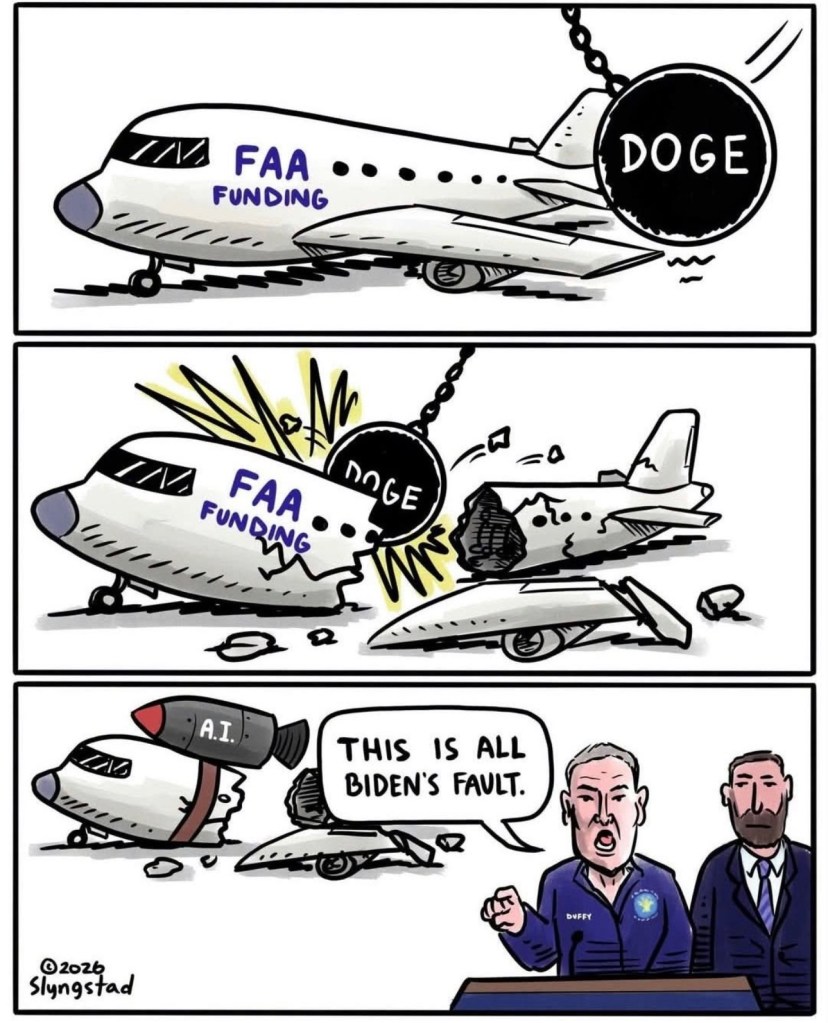
There comes a point when you stop asking yourself how much worse things can get and start wondering whether anybody in Washington is even looking at the brakes.
Here we are, approaching the end of 2026, and I find myself looking at the state of our government, our institutions, and our country with a mixture of disbelief, frustration, and an almost exhausted sense of déjà vu. What was once considered the occasional political controversy has become something resembling a permanent condition. Every morning brings another announcement, another questionable decision, another institution under attack, and another explanation from the people responsible for the mess about why none of it is actually their fault.
Apparently, accountability has become the one government program that DOGE couldn’t find funding for.
Let’s start with DOGE. Sold to the American public as some sort of government efficiency crusade, complete with promises of eliminating waste, fraud, and abuse, it became an exercise in taking a chainsaw to government operations and calling the resulting destruction a renovation. Government employees were dismissed, agencies disrupted, programs dismantled, and institutional knowledge discarded. All under the banner of saving taxpayers money.
Except there’s a rather important distinction between eliminating waste and eliminating the people and resources necessary to provide services taxpayers have already paid for. Government isn’t a private company where you can simply close an office, fire everyone, and declare success because the quarterly payroll is smaller. Those offices administer benefits, oversee safety, maintain infrastructure, protect consumers, and provide services that millions of Americans depend upon.
You don’t make government more efficient by breaking the machinery and congratulating yourself because fewer people are operating it.
And then there’s Donald.
At this point, trying to keep up with the decisions coming out of the White House has become something of an endurance sport. Foreign policy that seems to change depending on the last person who spoke to him. Economic decisions that create uncertainty for businesses and families. International relationships treated like personal popularity contests. Institutions that are supposed to operate independently increasingly treated as extensions of presidential authority.
And whenever something goes wrong, there’s always somebody else to blame. Biden. Obama. The Democrats. The media. The courts. Somebody, anybody, except the people currently occupying the offices where the decisions are being made.
It’s an extraordinary governing philosophy. Take credit for anything that goes right, regardless of who actually accomplished it, and assign responsibility for everything that goes wrong to somebody who hasn’t been in office for years.
Meanwhile, the country is left trying to make sense of it all.
We have watched political loyalty become more important than competence, personal allegiance become more important than constitutional responsibility, and the business of governing become secondary to the business of maintaining power. The people who should be asking difficult questions are too often busy protecting the people who need to answer them.
And that brings us to where we are today.
We are approaching the end of 2026 with a government that has spent an extraordinary amount of time dismantling, disrupting, and undermining institutions that took generations to build. Some of that damage can be repaired relatively quickly. Some will take years. Some of the institutional knowledge, expertise, and public trust that have been lost may never be completely recovered.
And let’s not pretend that changing the political balance in Congress magically makes all of this disappear.
But there is reason for some cautious optimism.
The congressional elections have given us an opportunity to change the direction of this runaway train. When the new Congress is sworn in on January 3, 2027, Democrats will have the opportunity to reclaim meaningful oversight, investigate what has happened, demand answers, and begin putting some boundaries back around an administration that has too frequently treated boundaries as optional.
That means hearings. Subpoenas. Investigations. Financial accountability. Examining what DOGE actually did, where the money went, what contracts were affected, what information was accessed, and what happened to the programs and services that were dismantled in the name of efficiency.
It means asking questions that deserve answers rather than accepting another round of political talking points.
It also means remembering that winning an election isn’t the same thing as fixing a government. Democrats cannot simply take control, spend two years complaining about what Republicans did, and expect the public to consider that a successful recovery. The country needs action. It needs legislation. It needs oversight. It needs institutions rebuilt and protections restored.
And perhaps most importantly, it needs a Congress willing to remember that its responsibility is to the American people, not to whichever individual happens to occupy the Oval Office.
I don’t expect everything to be fixed overnight. I’m not particularly interested in another political savior promising that everything will be wonderful if we just give him or her enough power. We’ve had quite enough of that nonsense.
What I would like to see is something considerably less glamorous: competence, accountability, transparency, and a government that understands its purpose is to serve the country rather than use the country to serve itself.
We’ve spent much of the past year watching a train gather speed while the people in the engine room argue about who gets to blow the whistle. Some are cheering. Others are pretending there isn’t a problem. And the passengers are beginning to wonder whether anybody remembers where the emergency brake is.
January 3 cannot come soon enough.
But here’s the thing: taking the train off the tracks isn’t going to be enough. We need to stop it, assess the damage, get the passengers safely out, and figure out whether the machinery can be repaired before we attempt to put it back into service.
And we need to make absolutely certain that the people responsible for driving it into this mess don’t simply get handed the keys again.
I’m a Gen Xer. I’ve lived long enough to know that things don’t always turn out the way we hope, that institutions aren’t indestructible, and that sometimes the damage is considerably worse than anyone initially admits.
But I’ve also lived long enough to know that just because something is broken doesn’t mean we should accept it as permanently broken.
This country is bigger than one president, one administration, one political party, or one billionaire’s idea of how government ought to work.
The Constitution is still there. The institutions are still worth defending. And the American people still have a say in what happens next.
So, as we approach the end of 2026, I’ll settle for a little hope. Not blind optimism, not political cheerleading, and certainly not another round of promises from people who have already demonstrated that they can’t be trusted with them.
Just the hope that on January 3, somebody finally gets into the engine room, finds the brakes, and starts figuring out how to get this country back on the tracks.
Because frankly, I’m getting a little tired of watching the scenery go by while wondering what we’re going to hit next.
And for the love of everything sacred, can we please stop letting the people who caused the wreck insist they’re the only ones qualified to investigate it?

